
By continuing, you agree to LoansJagat's Credit Report Terms of Use, Terms and Conditions, Privacy Policy, and authorize contact via Call, SMS, Email, or WhatsApp
Disclaimer: The information published on LoansJagat is intended for general informational and educational purposes only and should not be considered financial, legal, or investment advice. Interest rates, loan terms, statistics, and other data may change over time and may vary by lender or source. Please verify the latest information and consult a qualified financial advisor or the respective Bank/NBFC before making any financial decisions.
Subscribe Now
About the author

Arshathul Afia
Arshathul Afia is a journalism graduate and fintech content writer with 4+ years of experience in digital publishing and research-led writing. She has written 200+ articles covering personal finance, lending, banking, digital payments, credit, insurance, and major financial developments in India. At LoansJagat, she focuses on simplifying complex fintech news, RBI updates, loan-related changes, policy developments, and industry trends for everyday readers. Her journalism background helps her approach stories with research, context, and clarity, while her SEO experience ensures content remains discoverable and relevant. She aims to make financial news easier to understand, practical, and useful for readers across India.
Related Blog Post
Simplify All Your Loans Into One Affordable EMI

Customers Served

Debt Consolidated

1200+ Reviews

Locations in India
Club all Loans & Credit Card Bills into Single EMI

Quick Apply Loan
Consolidate your debts into one easy EMI.

Takes less than 2 minutes. No paperwork.

10 Lakhs+
Trusted Customers

2000 Cr+
Loans Disbursed

4.7/5
Google Reviews

50+
Banks & NBFCs Offers
RBI’s latest cash withdrawal shows banks hold surplus money, while weak 30-day participation reveals caution about locking funds away for longer at current offered rates.
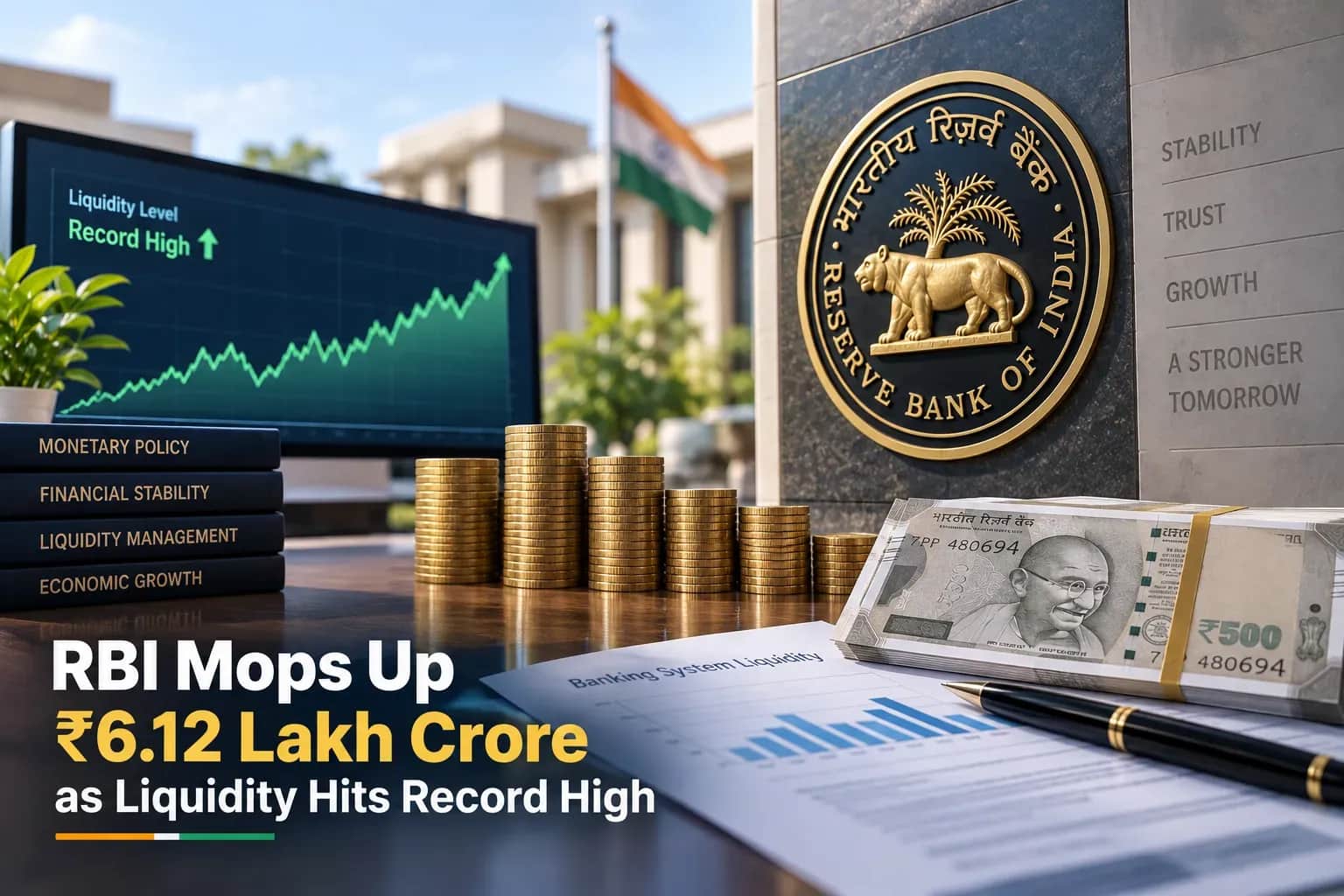
The Reserve Bank of India withdrew ₹6,12,666 crore from India’s banking system through 2 variable rate reverse repo auctions on September 7, 2026. Conducted through the central bank’s electronic auction platform in Mumbai, the operations involved banks and eligible market participants. RBI accepted ₹2,59,276 crore for 30 days and ₹3,53,390 crore overnight. It acted after the banking liquidity surplus reached a record level, estimated at around ₹11.16 lakh crore on September 6.
In the short term, the withdrawal can prevent excess money from pulling overnight interest rates too far below the policy repo rate. Borrowers may continue to find credit available because banks still hold ample funds. The longer-term concern looks different. If large cash balances remain inside banks for months, lenders may chase borrowers or financial assets too aggressively. That can weaken monetary-policy transmission, encourage poor lending decisions and add to inflation pressure.
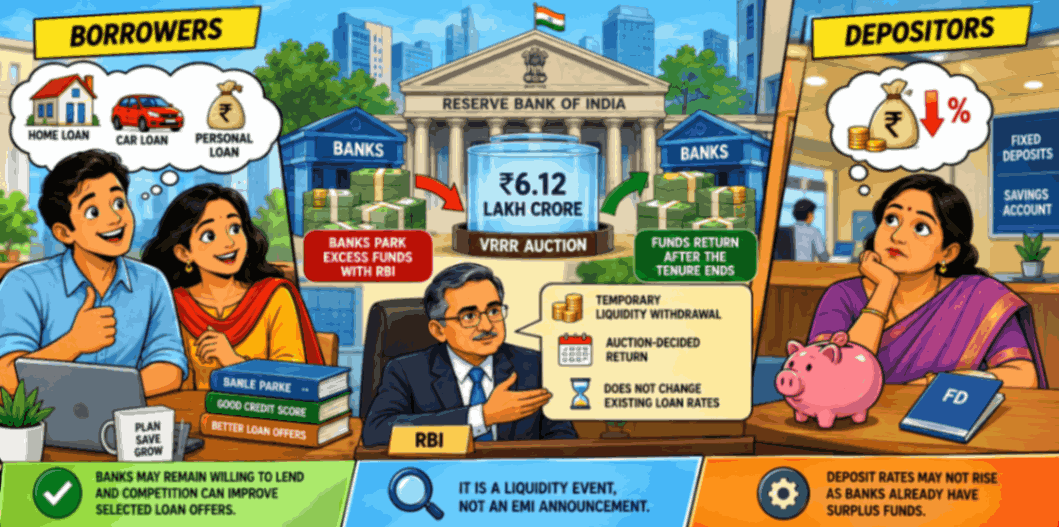
A VRRR auction does not revise home loan EMIs or personal loan rates on the auction date. RBI temporarily receives money from banks and pays an auction-decided return. The funds come back when the transaction ends. Loans linked to the repo rate, Treasury Bill yield or another external benchmark will continue to follow their contracted reset terms.
For households seeking credit, surplus liquidity can keep banks willing to lend. Competition may improve selected loan offers, mainly for applicants with stable income and strong credit profiles. Yet the auction does not guarantee lower interest rates. LoansJagat’s Liquidity Adjustment Facility guide, published on April 16, 2026, explains that reverse repo operations remove excess banking funds without changing an existing borrower’s contract.
Depositors could face a less favourable outcome. Banks do not need to fight hard for fresh deposits when their accounts already contain more money than they can use. Some lenders may therefore avoid raising fixed deposit rates. A later policy-rate increase or a sustained liquidity drain could reverse that position, though the September 7 auction alone does not point to an immediate deposit-rate change.
LoansJagat’s borrower-side reading is straightforward. The ₹6.12 lakh crore operation should be described as a liquidity event, not an EMI announcement. Its value for borrowers comes through better control over market rates. That distinction prevents readers from expecting an instant loan-rate reduction that banks have not announced.
The answer lies in access. Banks gave RBI ₹3.53 lakh crore for 1 night but offered only ₹2.59 lakh crore for 30 days. A treasury desk may have cash available on Monday and still expect loan disbursements, tax outflows, customer withdrawals or securities purchases later in September. The overnight option earns a return without restricting the bank for an entire month.
Alok Singh, head of treasury at CSB Bank, told The Economic Times on September 8 that banks did not want to park funds for 30 days at 5.24%. He also referred to a section of the market expecting a possible rate increase at a later policy review. If rates rise, money locked at 5.24% could earn less than a new short-term opportunity.
Reuters reported another explanation on September 7. Five traders linked the weak 30-day bids to technical problems during the auction. A person familiar with the system rejected that claim and said the bids had passed through RBI’s e-Kuber platform. RBI did not publicly confirm any technical failure, so the available evidence cannot show how much of the shortfall came from technology and how much came from banks’ own treasury decisions.
Gaura Sen Gupta, chief economist at IDFC First Bank, told Reuters that Market Stabilisation Scheme securities and dollar-rupee sell-buy swaps could help drain the surplus. Such tools can keep money away for longer than an overnight auction. The practical option may involve several instruments, with shorter VRRRs handling daily cash and longer operations dealing with the portion that refuses to leave.
The 30-day window came first. Banks responded with offers far below the notified amount, prompting RBI to open an overnight auction later that morning. The Reserve Bank of India’s money-market data, released on September 8 for operations conducted on September 7, recorded the following figures.
The table shows that both auctions remained undersubscribed. Still, banks offered more than 70% of the overnight amount, against only about 37% for the 30-day operation. RBI accepted every bid it received. No partial allocation was required.
The difference between the notified and accepted amounts does not mean the operation failed. RBI removed a sizeable pool of money. The response did, however, show the limit of using longer auctions when banks expect their funding requirements or available interest rates to change.
RBI had already conducted 2 three-day VRRR auctions on September 4, 2026. Together, those windows carried a notified amount of ₹8.50 lakh crore. Banks placed ₹5,41,975 crore in the first auction and ₹60,419 crore in the second, taking the accepted total to approximately ₹6.02 lakh crore.
Those funds returned on September 7 when the three-day transactions matured. RBI then removed part of the same banking surplus through the fresh 30-day and overnight operations. This explains why adding every auction figure can produce the wrong picture. VRRR money returns after maturity unless RBI conducts another auction.
A special USD-INR swap facility had contributed heavily to the liquidity increase. RBI introduced the arrangement on June 8, 2026, for foreign-currency non-resident deposits and selected overseas borrowings. Its September 2 release recorded provisional inflows of $136.377 billion up to August 31, with FCNR(B) deposits providing $127.226 billion.
Banks brought foreign currency to RBI and received rupees in return. That strengthened the country’s foreign-currency position, but the rupee leg placed a large amount of domestic money in bank accounts. The benefit on the external side therefore created a liquidity-management job at home.
Earlier policy action also provides useful context. The Press Information Bureau’s Economic Survey 2025-26 note, published on January 30, 2026, recorded how rate reductions, cash reserve changes and bond purchases had supported credit flow during FY26. By September, foreign inflows had pushed the system into a far stronger surplus, requiring absorption rather than additional support.
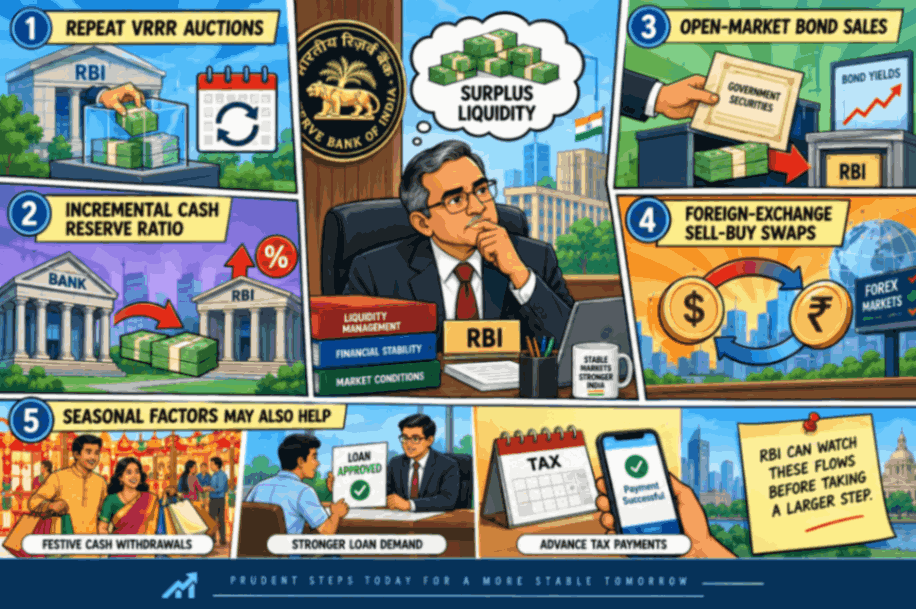
Short VRRR auctions offer flexibility, but RBI must repeat them when the funds return. Longer auctions hold money for weeks. The September 7 result showed that banks may hesitate when the offered rate does not compensate them for giving up access to their cash.
An incremental cash reserve ratio could withdraw money faster. RBI used a similar temporary measure in 2023. Banks would have to hold an additional part of selected deposits with the central bank, usually without earning the return available through a VRRR. That can increase their funding cost.
Open-market bond sales provide another option. When banks or investors buy securities from RBI, their rupee payments leave the system. Large sales may push government bond yields higher, which can influence corporate funding and some market-linked loan benchmarks.
Foreign-exchange sell-buy swaps could address liquidity created by dollar transactions more directly. RBI would sell dollars for rupees in the first leg and reverse the trade later. Such transactions may affect forward premiums, so the central bank would need to control their size and timing.
Seasonal activity may remove part of the surplus without another major step. Festive cash withdrawals take money out of banks, while stronger loan demand puts idle deposits to work. Advance tax payments can also reduce available banking funds for a period. RBI can watch these flows before choosing a longer withdrawal.
RBI’s September 7 auctions absorbed ₹6.12 lakh crore, but the split between the 2 windows revealed more than the total. Banks had spare money, yet they wanted it back quickly. The 30-day commitment attracted a weak response, while the overnight option performed better.
Borrowers should not expect an automatic EMI cut or increase from this operation. RBI used VRRR auctions to keep short-term market rates aligned with monetary policy and limit the risks created by excess cash. If foreign inflows continue and longer auctions remain unpopular, RBI may turn to bond sales, additional swaps or a temporary reserve requirement.
A VRRR auction allows eligible banks to place surplus money with RBI for a stated period. Banks submit rates and amounts, after which RBI decides the accepted bids.
No immediate EMI change follows from the September 7 auctions. Existing borrowers will see a revision only when their contracted benchmark or lending rate changes on its scheduled reset date.
The 30-day auction received only ₹2.59 lakh crore against a ₹7 lakh crore notified amount. RBI opened an overnight window and received another ₹3.53 lakh crore.
No. RBI temporarily removes surplus cash to prevent short-term rates from falling excessively and to reduce inflation risk. The action does not stop banks from continuing normal lending.
No. The overnight money returns the next day, while the 30-day funds return at maturity. RBI must renew the auctions if excess liquidity remains in the system.








.png&w=3840&q=75)


