
By continuing, you agree to LoansJagat's Credit Report Terms of Use, Terms and Conditions, Privacy Policy, and authorize contact via Call, SMS, Email, or WhatsApp
Disclaimer: The information published on LoansJagat is intended for general informational and educational purposes only and should not be considered financial, legal, or investment advice. Interest rates, loan terms, statistics, and other data may change over time and may vary by lender or source. Please verify the latest information and consult a qualified financial advisor or the respective Bank/NBFC before making any financial decisions.
Subscribe Now
About the author

Arshathul Afia
Arshathul Afia is a journalism graduate and fintech content writer with 4+ years of experience in digital publishing and research-led writing. She has written 200+ articles covering personal finance, lending, banking, digital payments, credit, insurance, and major financial developments in India. At LoansJagat, she focuses on simplifying complex fintech news, RBI updates, loan-related changes, policy developments, and industry trends for everyday readers. Her journalism background helps her approach stories with research, context, and clarity, while her SEO experience ensures content remains discoverable and relevant. She aims to make financial news easier to understand, practical, and useful for readers across India.
Related News
Simplify All Your Loans Into One Affordable EMI

Customers Served

Debt Consolidated

1200+ Reviews

Locations in India
Club all Loans & Credit Card Bills into Single EMI

Quick Apply Loan
Consolidate your debts into one easy EMI.

Takes less than 2 minutes. No paperwork.

10 Lakhs+
Trusted Customers

2000 Cr+
Loans Disbursed

4.7/5
Google Reviews

50+
Banks & NBFCs Offers
Other services mentioned in this article
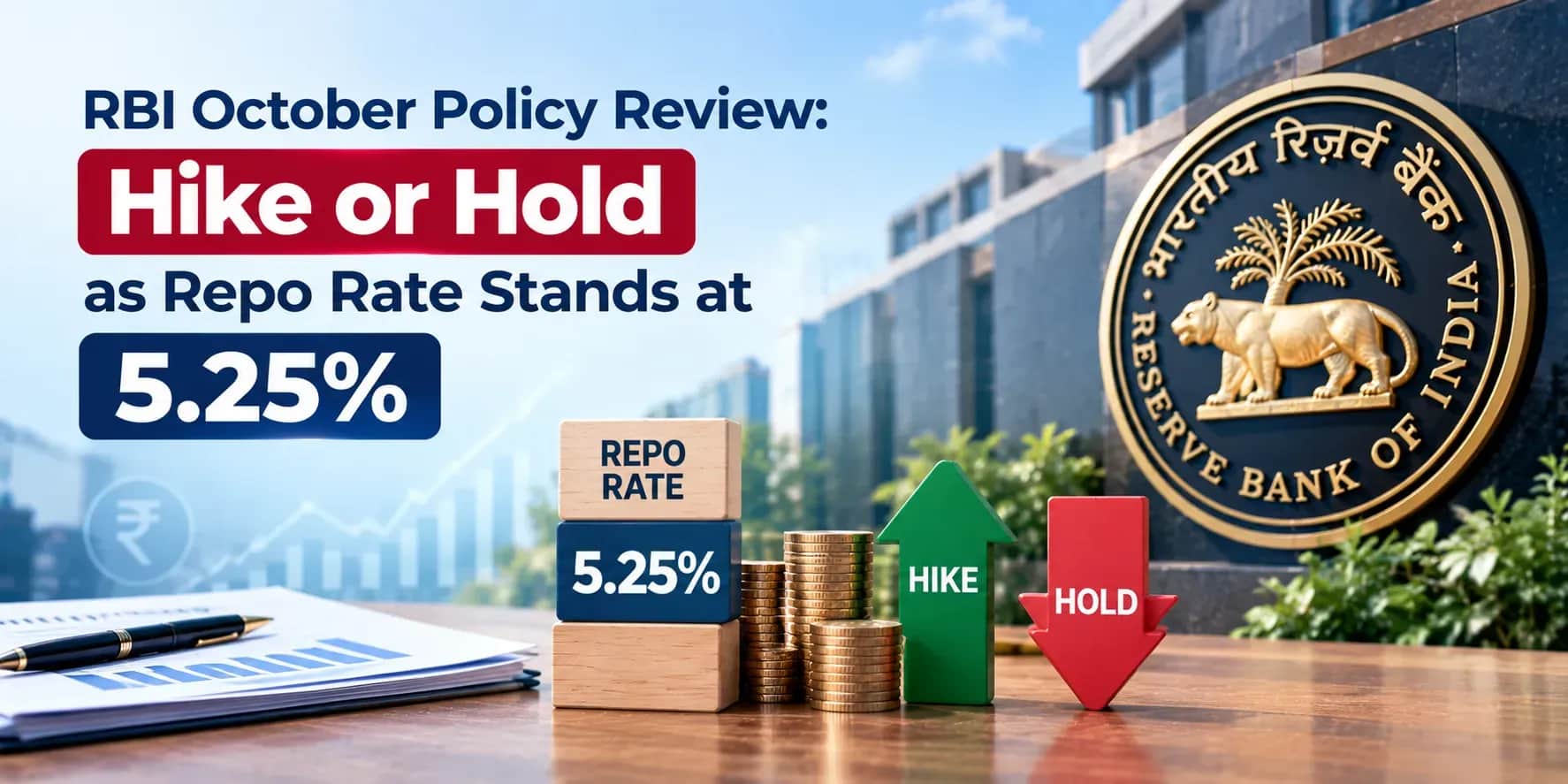
The October monetary policy review begins with economists divided over a rate increase, while borrowers await the decision and its implications for their future repayments.
Key Highlights
India’s Monetary Policy Committee begins its October review on 5 October 2026, weighing an interest-rate increase against another hold. The 5 August 2026 policy announcement retained the repo rate at 5.25% and maintained the neutral stance. Some economists see enough inflation risk to support an increase at this meeting; others favour waiting.
Borrowers whose lending rate rises at the next reset could face a higher EMI, leaving less money for household expenses. Repaying over a longer period could keep the monthly payment lower, but add to the interest paid overall. Rising consumer prices are already reducing households’ purchasing power, adding pressure on the committee to respond.
For floating-rate loans, the agreement names the benchmark used to set interest and specifies the reset terms. Those terms govern how a repo-rate change affects repayment, including whether the EMI changes or the loan takes longer to repay. The effect therefore varies across loans. For a genuinely fixed-rate loan, the agreed terms continue to apply without an automatic adjustment to the repo rate.
The reading for borrowers is that the EMI alone can hide part of the cost. Keeping the instalment unchanged offers little relief if repayments continue for longer and total interest rises. An EMI calculator helps compare those outcomes, but the lender’s revised repayment schedule establishes the actual obligation. This distinction deserves attention whichever way the October decision goes.
Canara Bank chief economist Madhavankutty G expects an increase while retaining the neutral stance, citing elevated oil prices and inflation risks. YES Bank chief economist Indranil Pan also expects an increase, although he questions how effectively it would pass through the economy while surplus liquidity persists. Their comments, reported on 5 October 2026, put liquidity management alongside the rate decision.
Bank of Baroda chief economist Madan Sabnavis favours keeping both the rate and stance unchanged, arguing that an immediate increase would be premature ahead of the festival season. HDFC Bank also expects a hold, with a possible shift towards tightening in the stance. Inflation remains a concern across these views. They disagree on when to raise rates and how much an increase would help contain inflation.
The committee retained the existing rate in August. Since that decision, the Ministry of Statistics and Programme Implementation’s 14 September 2026 release has recorded faster annual retail inflation. These published figures provide the starting point for the October debate.
The 4.82% figure compares August 2026 prices with August 2025 prices. July is not the base for that calculation. The committee’s decision on raising rates now requires a judgement about the months ahead: whether price rises will become more widespread and continue.
With the decision due on 7 October 2026, economists remain divided over acting now to address the risk of inflation spreading further. Waiting carries that risk, but raising rates could leave borrowers paying more. Households would feel the effect through the repayments their lender applies under the loan agreement. The policy announcement alone does not determine that amount.
The MPC meets from 5 to 7 October 2026. Its decision is scheduled for 7 October 2026.
The August review left the repo rate unchanged at 5.25%, its level going into the October meeting.
High oil prices could feed into costs elsewhere in the economy. Economists supporting an increase point to that risk of wider inflation as a reason to act.
The adjustment may be to the number of instalments remaining rather than the amount paid each month. A revised repayment schedule shows the effect more fully than the monthly debit alone.
The lender’s amortisation schedule records principal and interest repayments and the remaining tenure. It helps explain changes that may not be apparent from the EMI displayed in an app.









.png&w=3840&q=75)


