

By continuing, you agree to LoansJagat's Credit Report Terms of Use, Terms and Conditions, Privacy Policy, and authorize contact via Call, SMS, Email, or WhatsApp
Disclaimer: The information published on LoansJagat is intended for general informational and educational purposes only and should not be considered financial, legal, or investment advice. Interest rates, loan terms, statistics, and other data may change over time and may vary by lender or source. Please verify the latest information and consult a qualified financial advisor or the respective Bank/NBFC before making any financial decisions.
Subscribe Now
About the author

Arshathul Afia
Arshathul Afia is a journalism graduate and fintech content writer with 4+ years of experience in digital publishing and research-led writing. She has written 200+ articles covering personal finance, lending, banking, digital payments, credit, insurance, and major financial developments in India. At LoansJagat, she focuses on simplifying complex fintech news, RBI updates, loan-related changes, policy developments, and industry trends for everyday readers. Her journalism background helps her approach stories with research, context, and clarity, while her SEO experience ensures content remains discoverable and relevant. She aims to make financial news easier to understand, practical, and useful for readers across India.
Related News
Simplify All Your Loans Into One Affordable EMI

Customers Served

Debt Consolidated

1200+ Reviews

Locations in India
Club all Loans & Credit Card Bills into Single EMI

Quick Apply Loan
Consolidate your debts into one easy EMI.

Takes less than 2 minutes. No paperwork.

10 Lakhs+
Trusted Customers

2000 Cr+
Loans Disbursed

4.7/5
Google Reviews

50+
Banks & NBFCs Offers
From January 1, 2027, lenders can restrict financed phones and laptops after prolonged default, while new safeguards limit recovery agents and protect essential digital access.
India's loan recovery process will change from January 1, 2027, under final directions issued on August 6, 2026. According to the Reserve Bank of India, the rules cover recovery conduct as well as technology-based restrictions on phones, tablets and laptops bought through finance. A lender can begin gradual restrictions on that financed device after 30 days past due and apply the wider set permitted under the loan agreement after 60 days past due. An unrelated phone cannot be locked because a borrower missed payments on a personal, home, or vehicle loan.
For borrowers, the short-term impact is fairly direct. Falling behind on a device EMI may now affect how the financed product can be used. Yet lenders cannot switch off every function at once. Incoming calls, SMS, and emergency SOS access remain protected, while restrictions cannot stop employment-related use. Over time, the framework could reduce aggressive physical recovery for small device loans. The downside is equally important. A phone used for work, payments, education, or customer communication may still become part of the recovery process once arrears continue.
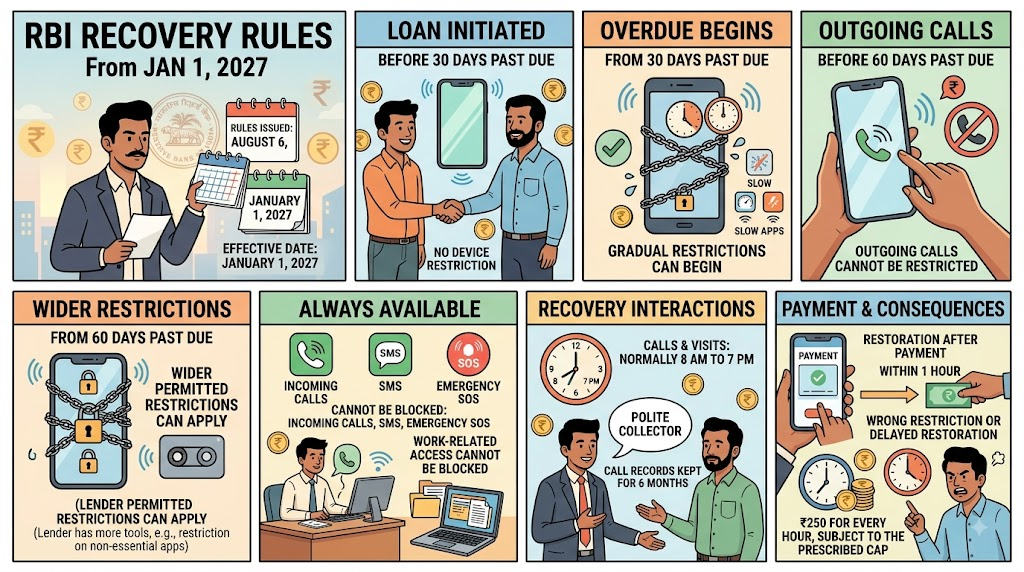
The first protection is about ownership and the purpose of the loan. A lender cannot use software to restrict any device it chooses. The action is available only when that particular phone, tablet, or laptop was financed through the defaulted loan and the agreement permits such technology. That distinction is important for households carrying several loans. Missing a credit-card payment, car EMI, or personal-loan instalment does not give the lender control over a separately purchased smartphone.
The second protection comes through timing. The account must first reach the prescribed overdue stage. This creates space between an initial missed payment and digital restrictions, but borrowers should not treat the 30-day point as a repayment holiday. Late-payment consequences under the loan contract can arise earlier. The table below shows what changes as a financed-device loan moves deeper into arrears.
The privacy limits are just as relevant as the timing rules. A lender or technology provider cannot enter the device and use contacts, photographs, messages, call logs or location history as recovery material. That closes off one of the most controversial risks attached to phone-locking technology, where access to personal information could otherwise become another source of pressure.
Before the final rules were issued, lawyers Arun Prabhu, Lakshmi Rajagopalan and Dhriti Hundia of Cyril Amarchand Mangaldas examined the May 2026 proposal. Their July 23 analysis argued that a device-locking framework has to protect a borrower's ability to work and repay without making the recovery tool ineffective for lenders. They also questioned whether waiting until 90 days past due, as proposed at that stage, placed the restriction too far into the delinquency cycle.
The final 30-day and 60-day structure moves closer to that middle path. That is an analysis of the final change, not an official explanation for why the threshold was altered. It gives lenders an earlier intervention point but prevents immediate blanket lockouts. For borrowers, the practical solution is to contact the lender before the account crosses 30 days past due, keep copies of notices and payment receipts, and check exactly what the device-finance agreement permits. A borrower should also document any restriction that blocks a protected function.
A LoansJagat analysis published on August 7, 2026, also points to call recording as an important borrower safeguard. The useful part is the audit trail. If a borrower later complains about threats, repeated demands, or false statements made during recovery, a stored conversation gives the lender's grievance team something specific to examine.
The device provisions are only part of the new recovery framework. Employees and recovery agents must ordinarily call or visit between 8 AM and 7 PM. Repeated contact can still become harassment even when every call falls inside that window. Anonymous calls, threatening language, public humiliation, misuse of social media, and pressure through relatives, neighbours or co-workers are prohibited. Recovery discussions are meant to remain with the borrower or guarantor.
Lenders must also keep records of recovery calls for 6 months. Before an outside recovery agency makes its first physical visit, the borrower must receive the agency's details at least 1 day earlier. Visiting personnel need identification and authorisation documents. In a March 2026 parliamentary response carried by the Press Information Bureau, the government reiterated that regulated lenders and their agents cannot use intimidation, harassment or public humiliation in debt recovery.
There is a practical reason for these checks. Outsourcing a recovery case does not remove the lender from responsibility. The lender still has to supervise the agency, deal with complaints, and prevent targets or incentives from encouraging harsh collection behaviour.
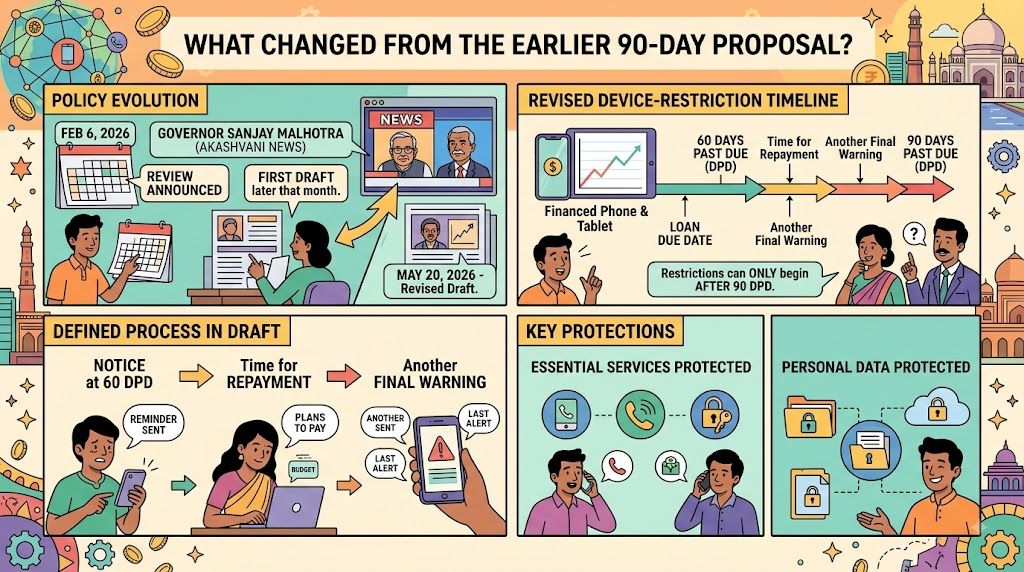
The policy did not appear suddenly in August. Akashvani News reported on February 6, 2026, that Governor Sanjay Malhotra had announced plans to review and harmonise existing instructions covering loan recovery and recovery agents. The first draft followed later that month.
A revised draft arrived on May 20, 2026. That version proposed a much later device-restriction timeline. A financed phone or tablet would first need to become 90 days past due. The proposed process included notice at 60 days past due, time for repayment, and another warning before restrictions could begin. Essential services and personal data were also protected under that version.
The final August framework shortened the waiting period. Gradual controls may begin after 30 days past due, while the complete contractual set can operate after 60 days. The shift gives lenders an earlier recovery lever without allowing a financed phone to become unusable immediately after a missed EMI.
Consumer groups have warned for some time that phone restrictions can go beyond ordinary debt collection. Srikanth L, founder of CashlessConsumer, told Reuters in September 2025 that locking devices can cut people off from livelihoods, education and financial services. That concern is especially relevant where a mobile phone doubles as a work terminal, payment device and communication tool.
The lender-side argument is different. Device finance often involves small loans and products that lose resale value quickly. Physical repossession can be expensive compared with the outstanding amount. Technology gives the lender another way to encourage repayment without sending an agent to seize a device. The final framework accepts that tool, but surrounds it with limits on timing, data access and essential services.
The borrower-facing analysis is therefore not that phone locking has been banned. It has been regulated. The crucial test from January 2027 will be whether restrictions remain proportionate in practice, particularly for people whose income depends on the financed device.
The 2027 recovery framework changes both digital and traditional collections. A financed phone, tablet or laptop can face graduated restrictions once the linked loan reaches 30 days past due, with wider controls after 60 days. But another loan cannot be used as an excuse to restrict an unrelated device, and protected communication and work functions must remain available.
For borrowers, acting before arrears deepen will become more important. For lenders, every recovery step will need stronger documentation, from call records to agency visits and device restoration. The rules do not cancel an unpaid EMI. They change how far a lender or recovery agent can go while trying to collect it.
Not immediately. Technology-based restrictions cannot begin before the financed-device loan reaches 30 days past due.
No. Device restrictions apply only when that particular phone, tablet or laptop was financed through the defaulted loan.
The lender may introduce the wider set of restrictions permitted by the agreement, while protected functions must continue.
Normally, no. Recovery calls and visits are generally restricted to 8 AM to 7 PM unless specifically authorised otherwise.
No. Contacts, photographs, messages, call logs, and location history cannot be accessed for the device-recovery process.
No. Recovery agents cannot threaten, shame, or pressure relatives, and borrowers can complain to the lender.









.png&w=3840&q=75)


