Disclaimer: The information published on LoansJagat is intended for general informational and educational purposes only and should not be considered financial, legal, or investment advice. Interest rates, loan terms, statistics, and other data may change over time and may vary by lender or source. Please verify the latest information and consult a qualified financial advisor or the respective Bank/NBFC before making any financial decisions.
Subscribe Now
About the author

Arshathul Afia is a journalism graduate and fintech content writer with 4+ years of experience in digital publishing and research-led writing. She has written 200+ articles covering personal finance, lending, banking, digital payments, credit, insurance, and major financial developments in India. At LoansJagat, she focuses on simplifying complex fintech news, RBI updates, loan-related changes, policy developments, and industry trends for everyday readers. Her journalism background helps her approach stories with research, context, and clarity, while her SEO experience ensures content remains discoverable and relevant. She aims to make financial news easier to understand, practical, and useful for readers across India.
Related News
Simplify All Your Loans Into One Affordable EMI

Customers Served

Debt Consolidated

1200+ Reviews

Locations in India
Club all Loans & Credit Card Bills into Single EMI

Quick Apply Loan
Consolidate your debts into one easy EMI.

Takes less than 2 minutes. No paperwork.

10 Lakhs+
Trusted Customers

2000 Cr+
Loans Disbursed

4.7/5
Google Reviews

50+
Banks & NBFCs Offers
October inflation of 6.09% strengthened the case for a December rate hike. Cheaper crude has lowered economists’ forecasts for how high the repo rate could go.
Key Highlights
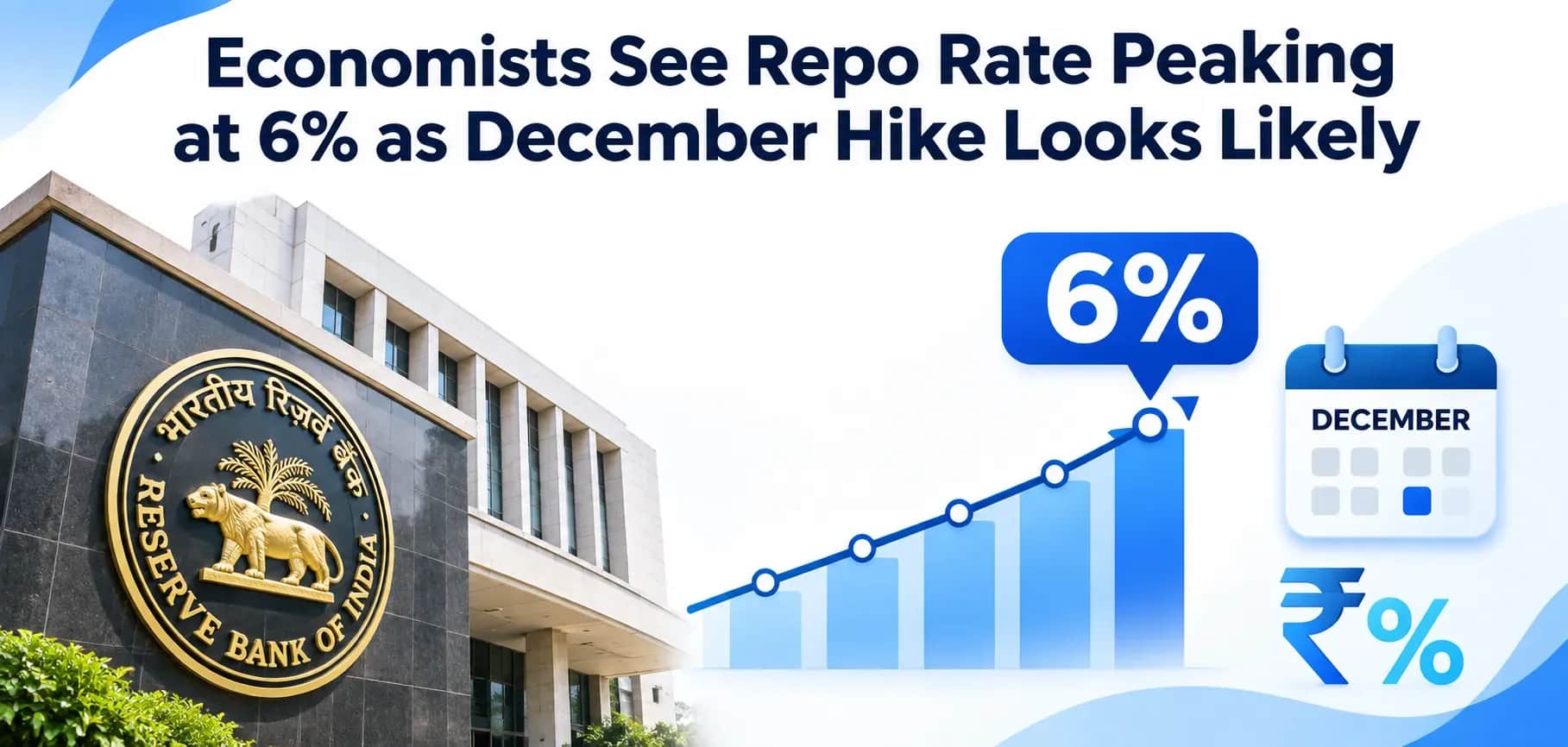
The Reserve Bank of India’s (RBI) Monetary Policy Committee will meet from 2 to 4 December 2026, with its rate decision due on 4 December. As of 16 November, economists widely expected a second consecutive increase after the committee raised the repo rate by 25 basis points in October.
October’s inflation reading strengthened the case for another increase. Expectations for the months after December have shifted in the other direction. If crude stays cheaper and tensions in West Asia continue to ease into 2027, economists see less need for a long run of rate increases. Some still see a path to 6.25%, though they put a low probability on that outcome and say it depends on incoming data.
Food inflation rose to 8.94% in October from 7.74% in September. The increase in overall retail inflation was slightly sharper in rural India, where it reached 6.63%. Urban inflation climbed to 5.41%. The October figures, released on 12 November, are provisional.
The RBI has a 4% inflation target, with a tolerance band of 2% to 6%. In October, the Monetary Policy Committee voted unanimously to raise the repo rate from 5.25% to 5.50% and shifted its policy stance to calibrated tightening. It pointed to uncertainty about energy prices and the risks a deficient monsoon and El Niño posed to food supplies. At the time, the RBI projected that inflation would average 6% in the October to December quarter.
Read also: ICICI Bank to Raise Credit Card Fees and Drop Select Insurance and INOX Benefits
Brent crude fell sharply in early November. Oil traders lowered their expectations of further US military escalation in West Asia after Democrats won both chambers of Congress in the midterm elections. Brent spot prices fell below $100 a barrel on 4 November, after averaging $124 a barrel in October. As crude prices fell, financial markets priced in fewer RBI rate increases.
Cheaper crude can ease India’s oil import bill, and a firmer rupee reduces the local cost of dollar-priced oil. Food prices present a separate risk, particularly if El Niño puts pressure on supplies. Barclays chief economist Aastha Gudwani expected upcoming inflation readings to soften and stay elevated enough for the RBI to raise rates in small steps. She expected a short hiking cycle.
State Bank of India (SBI) Research cut its forecast for the December hike from 50 basis points to 25, citing an improvement in external conditions and less pressure on the rupee. Its chief economic adviser, Soumya Kanti Ghosh, argued against another increase in February given the proximity to the Union Budget. He expected subsequent decisions to depend more heavily on new data.
SBI Research saw a possible peak of 6% and put a 50% probability on the cycle ending at 5.75%. Yes Bank’s forecast included quarter-point increases in December and February, which would take the repo rate to 6%. Indranil Pan, the bank’s chief economist, said cheaper oil and a steadier rupee had reduced the likelihood of a further hike in April.
The November Consumer Price Index (CPI) release is scheduled for 14 December, ten days after the policy decision. It will give economists their first official reading of November retail inflation as they reassess the case for a further hike.
A quarter-point increase on 4 December would put the repo rate at 5.75%. How much further it rises will depend in part on whether crude stays cheaper into 2027 and whether food inflation starts to ease.
The repo rate is 5.50% as of 16 November 2026. The Monetary Policy Committee raised it by 25 basis points at its October meeting.
It would raise the repo rate from 5.50% to 5.75%. A basis point is one-hundredth of a percentage point.
Economists expect 6% to be the highest policy rate in the current cycle. The RBI will assess inflation and growth data at each meeting.
The repo rate is the rate at which banks borrow short-term funds from the RBI against eligible securities. In a reverse repo, the RBI absorbs funds from banks.
Yes. When a floating-rate home loan resets, the lender can offer a longer repayment period with the same equated monthly instalment (EMI). A higher EMI or a combination of both may also be available.
Start your journey today
Apply Now*T&C apply