
By continuing, you agree to LoansJagat's Credit Report Terms of Use, Terms and Conditions, Privacy Policy, and authorize contact via Call, SMS, Email, or WhatsApp
Disclaimer: The information published on LoansJagat is intended for general informational and educational purposes only and should not be considered financial, legal, or investment advice. Interest rates, loan terms, statistics, and other data may change over time and may vary by lender or source. Please verify the latest information and consult a qualified financial advisor or the respective Bank/NBFC before making any financial decisions.
Subscribe Now
About the author

Arshathul Afia
Arshathul Afia is a journalism graduate and fintech content writer with 4+ years of experience in digital publishing and research-led writing. She has written 200+ articles covering personal finance, lending, banking, digital payments, credit, insurance, and major financial developments in India. At LoansJagat, she focuses on simplifying complex fintech news, RBI updates, loan-related changes, policy developments, and industry trends for everyday readers. Her journalism background helps her approach stories with research, context, and clarity, while her SEO experience ensures content remains discoverable and relevant. She aims to make financial news easier to understand, practical, and useful for readers across India.
Related News
Simplify All Your Loans Into One Affordable EMI

Customers Served

Debt Consolidated

1200+ Reviews

Locations in India
Club all Loans & Credit Card Bills into Single EMI

Quick Apply Loan
Consolidate your debts into one easy EMI.

Takes less than 2 minutes. No paperwork.

10 Lakhs+
Trusted Customers

2000 Cr+
Loans Disbursed

4.7/5
Google Reviews

50+
Banks & NBFCs Offers
Other services mentioned in this article
Homeowners face possible repayment increases ahead of October’s policy decision, but loan terms will determine whether higher rates increase monthly installments or extend repayment periods.
Key Takeaways
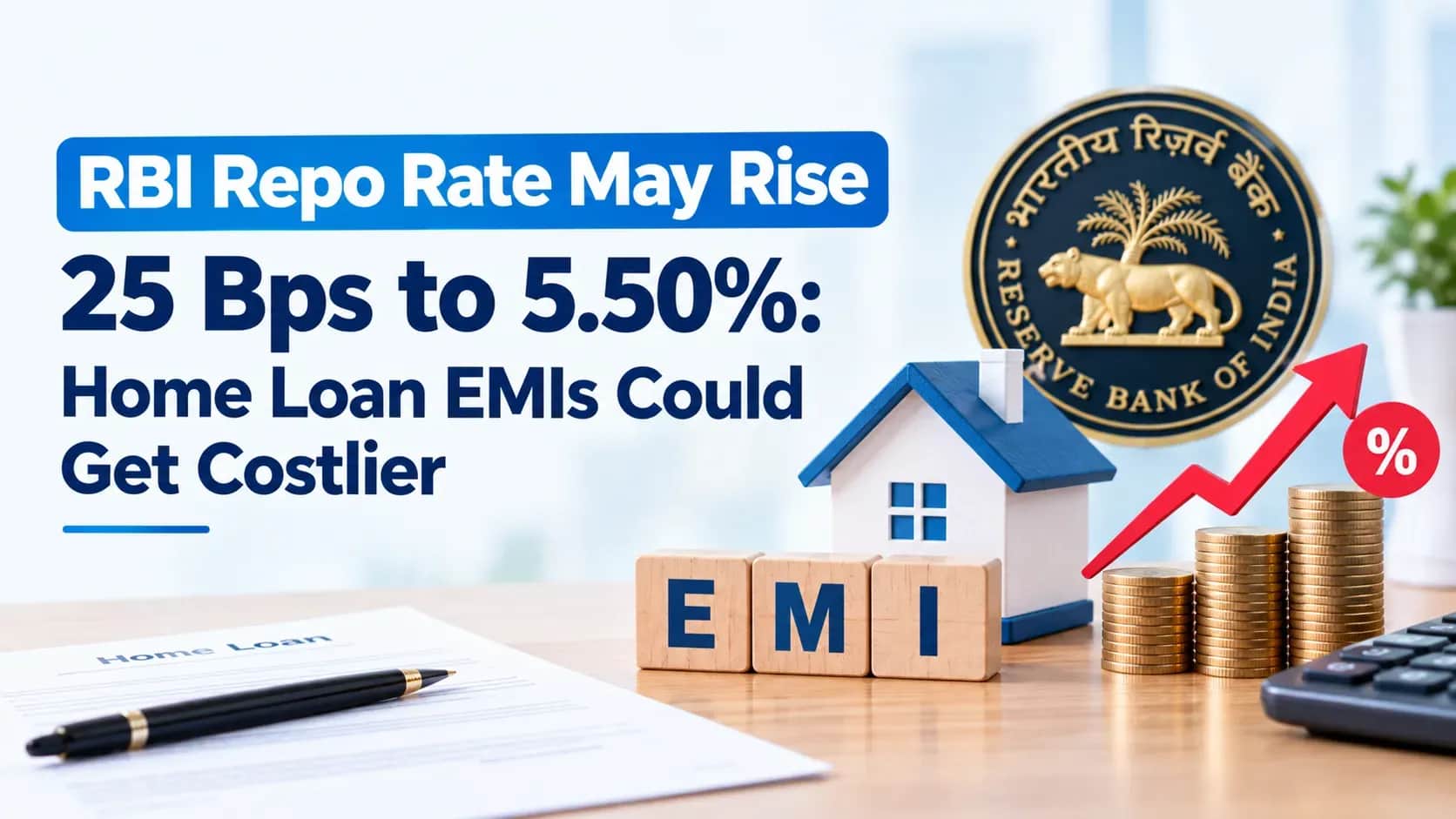
With the RBI’s October monetary policy decision due on 7 October 2026, housing loan repayments are back in focus amid expectations of a possible repo rate increase. According to Reuters, 60% of the economists in its survey predicted a 25-bps increase on 28 September. It might raise the benchmark from 5.25% to 5.50%. The forecast is subject to the policy decision, but borrowers in India may be at risk of higher financing costs.
A floating-rate housing loan moves in tandem with the agreed benchmark, and any change in the benchmark is passed through to the account via the reset process. An announcement of a higher debit does not necessarily mean a higher rate; it just means that it is announced. The calculation would differ for someone who has recently taken on substantial borrowing compared with a borrower nearing the end of their repayment term. Fixed-rate loans are governed by their contract with the bank and, if there is such a clause, then the loan is also subject to a change to floating rates.
If banks boost their fixed deposit rates, savers may be better able to get a better rate on new deposits or renewals. Fixed deposit schemes with an outstanding balance will retain their promised interest rates until they mature. This is thus a differential benefit. A retired depositor renewing a deposit may gain, while a working household with a large floating mortgage may face higher outgoings.
The forecast has not attracted unanimous agreement. Quantum AMC fixed-income fund manager Sneha Pandey told The Indian Express, in its 4 October 2026 report, that RBI could leave rates unchanged while adopting more cautious guidance. That leaves room for a pause. Households preparing for a higher EMI need not treat the expected increase as an event that has already happened.
BankBazaar CEO Adhil Shetty suggested modest EMI increases or partial prepayments to contain interest costs, Moneycontrol reported on 6 October 2026.
Take a hypothetical ₹50 lakh outstanding loan with 20 years remaining. At 8.00%, the monthly EMI works out to about ₹41,822. At 8.25%, with the same tenure, it becomes about ₹42,603. The difference is approximately ₹781. These figures use a standard monthly reducing-balance calculation, exclude fees and assume full transmission of the proposed increase.
It shows why the remaining balance and repayment period belong beside the interest rate in any comparison. RBI’s loan-reset framework gives borrowers repayment choices, summarised below.
Prepayment (partial or full) is also permitted under the framework, subject to the rules in place. No negative amortisation, or an increase in balance, should result from an extension of tenure.
An unchanged EMI can conceal a later final repayment date. The cost moves into future years rather than disappearing. That is the main budgeting risk in a tenure extension: today's bank balance looks unaffected while the household commits income for longer.
Comparisons through our home-loan page need identical outstanding balances and repayment periods. A lower advertised instalment may reflect a longer loan, not a lower borrowing cost. Transfer fees also reduce potential savings. For an existing borrower, a revised schedule offers more useful evidence than an assurance that the EMI remains affordable.
The proposed move to 5.50% remains a forecast ahead of RBI’s announcement. Borrowers have reason to prepare, but no basis to assume identical increases across all mortgages. The decision, lender reset, and revised repayment schedule will establish the actual cost.
No announcement confirms that increase as of 6 October 2026. The October policy decision remains pending, and the expected increase could differ from RBI's decision.
Existing fixed-rate deposits retain their contracted returns until maturity. Higher bank offers would apply to eligible new deposits or renewals, depending on the product's terms.
A higher floating rate can extend repayment when the EMI stays unchanged; the lender must communicate applicable changes.
Reset timing and repayment arrangements differ, so the updated loan schedule is needed to establish how the account changed.
No. RBI's updated framework allows lenders to offer that option under their policies.
Availability and conversion charges require confirmation before a borrower plans the switch.









.png&w=3840&q=75)


