
By continuing, you agree to LoansJagat's Credit Report Terms of Use, Terms and Conditions, Privacy Policy, and authorize contact via Call, SMS, Email, or WhatsApp
Disclaimer: The information published on LoansJagat is intended for general informational and educational purposes only and should not be considered financial, legal, or investment advice. Interest rates, loan terms, statistics, and other data may change over time and may vary by lender or source. Please verify the latest information and consult a qualified financial advisor or the respective Bank/NBFC before making any financial decisions.
Subscribe Now
About the author

Arshathul Afia
Arshathul Afia is a journalism graduate and fintech content writer with 4+ years of experience in digital publishing and research-led writing. She has written 200+ articles covering personal finance, lending, banking, digital payments, credit, insurance, and major financial developments in India. At LoansJagat, she focuses on simplifying complex fintech news, RBI updates, loan-related changes, policy developments, and industry trends for everyday readers. Her journalism background helps her approach stories with research, context, and clarity, while her SEO experience ensures content remains discoverable and relevant. She aims to make financial news easier to understand, practical, and useful for readers across India.
Related News
Simplify All Your Loans Into One Affordable EMI

Customers Served

Debt Consolidated

1200+ Reviews

Locations in India
Club all Loans & Credit Card Bills into Single EMI

Quick Apply Loan
Consolidate your debts into one easy EMI.

Takes less than 2 minutes. No paperwork.

10 Lakhs+
Trusted Customers

2000 Cr+
Loans Disbursed

4.7/5
Google Reviews

50+
Banks & NBFCs Offers
Other services mentioned in this article
India’s repo rate has risen to 5.50%, putting floating-rate borrowers under pressure as policymakers act against rising inflation and signal that near-term cuts are unlikely.
Key Highlights
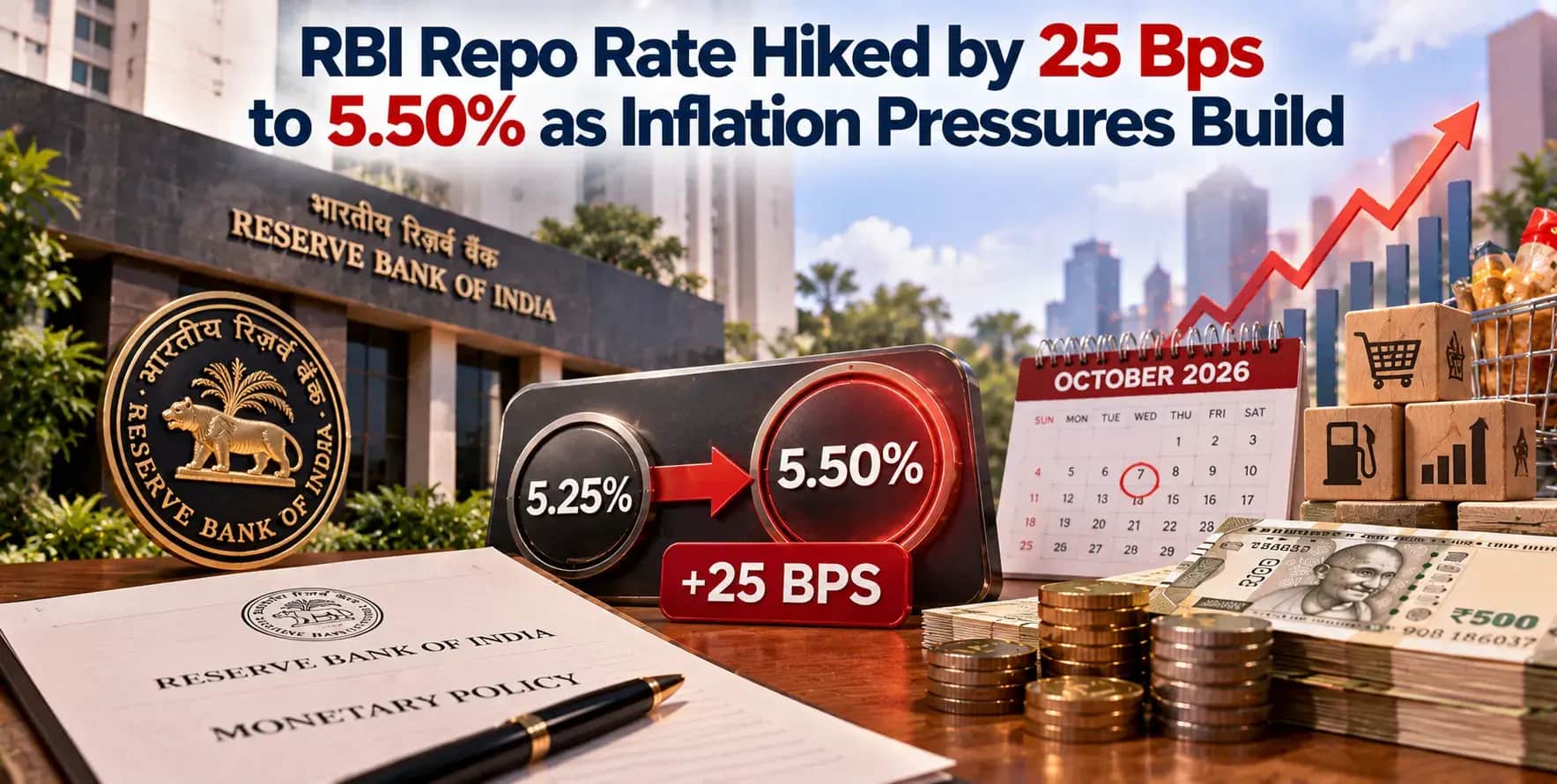
The Reserve Bank of India (RBI) increased the Repo rate by 25 basis points to 5.50% at its meeting in October. The economy was experiencing a rise in international energy costs and inflation. Domestic economic activity was positive at the time of the announcement.
For households with floating-rate loans, the impact may appear when the interest rate next resets. Repayments could rise, reducing the amount left for regular household expenses. The policy response is aimed at preventing the current inflation pressure from continuing over a longer period. Food and fuel prices, however, will not fall immediately because borrowing has become costlier.
Food and fuel accounted for much of the price pressure. Policymakers were also seeing increases elsewhere, with the October assessment pointing to poor monsoon conditions and expensive energy as continuing risks. Businesses passing higher input costs into selling prices would make inflation harder to contain.
Governor Sanjay Malhotra’s 7 October remarks also addressed supply shocks. Interest rate hikes can be a response to feedback on prices. For example, rate hikes may be a response to a build-up in inflation expectations. However, interest rate hikes can’t affect crop supply or drive down global crude oil prices.
For a repo-linked home loan, the higher benchmark enters the repayment calculation when the loan reaches its applicable reset. The change may show up as a higher EMI, a longer tenure, or both. Fixed-rate borrowers remain on the interest terms already agreed with their lender. The October increase, therefore, does not automatically raise repayments on every home, vehicle or personal loan.
Any benefit for depositors would come through revised bank offers on fresh fixed deposits or renewals. Money already held in a fixed-rate deposit continues earning the agreed return. Banks set deposit rates separately, and an increase in the repo rate does not require them to raise returns equally across all deposit tenures.
Nagesh Kumar and Ram Singh voted for the rate increase while preferring to keep the stance neutral. Most members, however, backed calibrated tightening. Later, Malhotra said other policy decisions would depend on the path of inflation and economic growth. Because of this, we can say the announcement set a tighter framework, even if it left the size and timing of the next move uncertain.
Our reading is that borrowers should judge the change through their remaining repayment cost, not the EMI alone. Keeping the monthly deduction the same when extending the loan gives budget relief in the short term but adds interest in the long term. The revised schedule shows trade-offs. For borrowers considering a higher EMI or partial prepayment, the trade-off also includes how much cash is left over for regular expenses and for emergencies. This is what we are analyzing in the mechanics of repayment as opposed to predicting what the next policy move would be.
At the 5 August 2026 meeting, the committee kept the repo rate at 5.25% and left the policy stance neutral. The October decision changed both. The policy comparison below separates the confirmed decisions from expectations about future rates.
August’s pause allowed policymakers more time to assess inflation. By October, the committee judged that a rate increase was needed. The earlier October policy preview covered the hike-or-hold question before this decision.
The repo rate increase puts pressure on floating-rate borrowing costs, but the effect will reach individual loans through their reset arrangements. For borrowers, the revised interest rate and remaining instalments will show the cost. For savers, any improvement will depend on banks’ new deposit offers.
The repo rate is 5.50%, following the 25-basis-point increase announced on 7 October 2026.
A lender may adjust the remaining tenure instead. An unchanged EMI can therefore accompany a higher total interest cost when the lending rate rises.
Repo-linked loans follow their applicable reset arrangements. The announcement date and the date a borrower’s revised rate takes effect need not be identical.
The repo hike does not automatically alter an existing fixed-rate personal loan. Its agreed interest terms continue to govern repayment.
For covered floating-rate instalment loans, borrowers must receive options that include a higher EMI, longer tenure or a combination, alongside prepayment subject to applicable conditions.









.png&w=3840&q=75)


