
Disclaimer: The information published on LoansJagat is intended for general informational and educational purposes only and should not be considered financial, legal, or investment advice. Interest rates, loan terms, statistics, and other data may change over time and may vary by lender or source. Please verify the latest information and consult a qualified financial advisor or the respective Bank/NBFC before making any financial decisions.
Subscribe Now
About the author

Arshathul Afia is a journalism graduate and fintech content writer with 4+ years of experience in digital publishing and research-led writing. She has written 200+ articles covering personal finance, lending, banking, digital payments, credit, insurance, and major financial developments in India. At LoansJagat, she focuses on simplifying complex fintech news, RBI updates, loan-related changes, policy developments, and industry trends for everyday readers. Her journalism background helps her approach stories with research, context, and clarity, while her SEO experience ensures content remains discoverable and relevant. She aims to make financial news easier to understand, practical, and useful for readers across India.
Related News
Simplify All Your Loans Into One Affordable EMI

Customers Served

Debt Consolidated

1200+ Reviews

Locations in India
Club all Loans & Credit Card Bills into Single EMI

Quick Apply Loan
Consolidate your debts into one easy EMI.

Takes less than 2 minutes. No paperwork.

10 Lakhs+
Trusted Customers

2000 Cr+
Loans Disbursed

4.7/5
Google Reviews

50+
Banks & NBFCs Offers
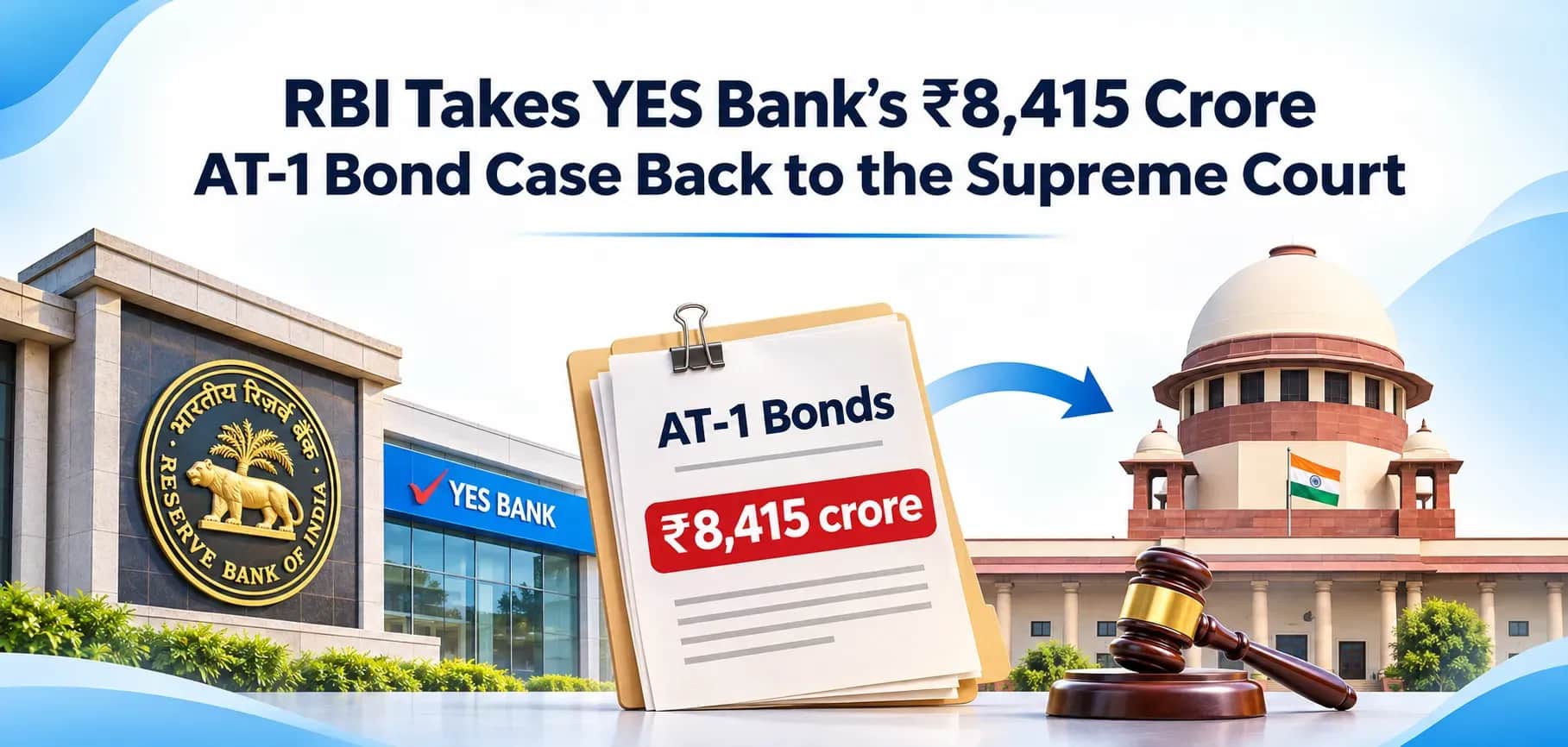
The RBI wants the Supreme Court to revisit its YES Bank bond ruling, arguing that uncertainty over how losses are allocated could complicate future rescues.
Key Highlights
The Reserve Bank of India (RBI) asked the Supreme Court on 13 November 2026 to review its ruling on YES Bank’s Additional Tier-1 (AT-1) bonds. The dispute dates to March 2020, when the bank’s administrator wrote down two bond issues worth a combined ₹8,415 crore. YES Bank disclosed a separate review petition under Article 137 of the Constitution on the same day.
A person familiar with the regulator’s grounds said the RBI was concerned about how the judgment could affect other bank rescues. Investors who supply fresh capital during a reconstruction need to know which losses have already been absorbed. The regulator argues that such investors may hesitate if rescue decisions can be reopened years later.
The RBI drew up a reconstruction plan after YES Bank was placed under a moratorium in March 2020. State Bank of India and other investors brought in fresh capital, and YES Bank later returned to profitability. The initial draft included a clause to write down AT-1 bonds. After objections from bondholders, a revised proposal provided for conversion into equity. The final scheme, notified by the Union government on 13 March 2020, left out that provision.
The bonds carried different terms. An earlier ₹280 crore issue fell outside the applicable Basel III framework. The ₹3,000 crore issue allowed conversion or a write-down when specified triggers were met, and the ₹5,415 crore issue provided for a write-down. According to the person familiar with the RBI’s position, dropping the clause avoided treating investors in the same class differently and left the terms of each issue in place. The Supreme Court read the omission as a deliberate decision by the government to leave the bonds untouched in the reconstruction.
The administrator wrote down the two Basel III issues on 14 March 2020, a day after the final scheme took effect. The Bombay High Court set that decision aside on 20 January 2023. On 15 October 2026, Justices Dipankar Datta and Augustine George Masih dismissed the appeals and upheld the High Court’s judgment.
The Supreme Court held that the administrator lacked the authority to write down the bonds in the way he did. The judges examined the timing of the decision, the administrator’s powers and the requirements in the RBI’s capital rules and bond documents. They also questioned the conduct of the RBI, the administrator and YES Bank during the exercise. The RBI’s review plea challenges findings concerning its role in the reconstruction.
Banks issue AT-1 bonds as part of their regulatory capital under Basel III. The bonds are perpetual, and their terms allow them to absorb losses if specified triggers are met. Depending on the instrument, that can involve conversion into equity or a reduction in the principal. A full write-down can wipe out the investor’s entire holding.
A person familiar with the RBI’s grounds said the capital infusion and the write-down were both needed to revive YES Bank and protect depositors. The judges accepted that both steps may have been necessary. They held that the write-down still had to follow the prescribed procedure.
Bondholders are still waiting for YES Bank to restore the two AT-1 bond issues. Axis Trustee Services has asked the Supreme Court to enforce its October judgment, while the RBI and YES Bank have separately sought a review.
The Supreme Court said annual coupon payments must follow the terms of the respective bond documents. The trustee said entitlement to historical coupons would need to be assessed for each year. It also said the two bond identifiers were still suspended and that YES Bank had yet to give a date for reactivation.
The review petitions ask the Supreme Court to revisit who had the authority to impose losses on YES Bank’s AT-1 bondholders during the rescue and when that authority could be exercised. For bondholders, the immediate issue is when YES Bank will restore the two bond issues.
The RBI filed its review petition on 13 November 2026. YES Bank separately disclosed it had also sought review under Article 137 of the Constitution.
The two issues were worth ₹3,000 crore and ₹5,415 crore. They were issued in December 2016 and October 2017 with coupons of 9.50% and 9.00%.
The Supreme Court said annual coupon payments are governed by the applicable bond documents. Entitlement to past coupons depends on the conditions for each year.
A perpetual bond has no fixed maturity date. The issuer may have an option to redeem it, subject to the bond terms and applicable rules.
YES Bank’s administrator wrote down both issues on 14 March 2020. The Bombay High Court later set aside that decision, and the Supreme Court agreed.
Start your journey today
Apply Now*T&C apply











