.png&w=3840&q=65)
By continuing, you agree to LoansJagat's Credit Report Terms of Use, Terms and Conditions, Privacy Policy, and authorize contact via Call, SMS, Email, or WhatsApp
Disclaimer: The information published on LoansJagat is intended for general informational and educational purposes only and should not be considered financial, legal, or investment advice. Interest rates, loan terms, statistics, and other data may change over time and may vary by lender or source. Please verify the latest information and consult a qualified financial advisor or the respective Bank/NBFC before making any financial decisions.
Subscribe Now
About the author

LoansJagat Team
‘Simplify Finance for Everyone.’ This is the common goal of our team, as we try to explain any topic with relatable examples. From personal to business finance, managing EMIs to becoming debt-free, we do extensive research on each and every parameter, so you don’t have to. Scroll up and have a look at what 15+ years of experience in the BFSI sector looks like.
Related News
Simplify All Your Loans Into One Affordable EMI

Customers Served

Debt Consolidated

1200+ Reviews

Locations in India
Club all Loans & Credit Card Bills into Single EMI

Quick Apply Loan
Consolidate your debts into one easy EMI.

Takes less than 2 minutes. No paperwork.

10 Lakhs+
Trusted Customers

2000 Cr+
Loans Disbursed

4.7/5
Google Reviews

50+
Banks & NBFCs Offers
Other services mentioned in this article
The Centre may get a record RBI dividend in FY27, giving Budget support, but experts warn it cannot replace stable revenue.
Key Takeaways
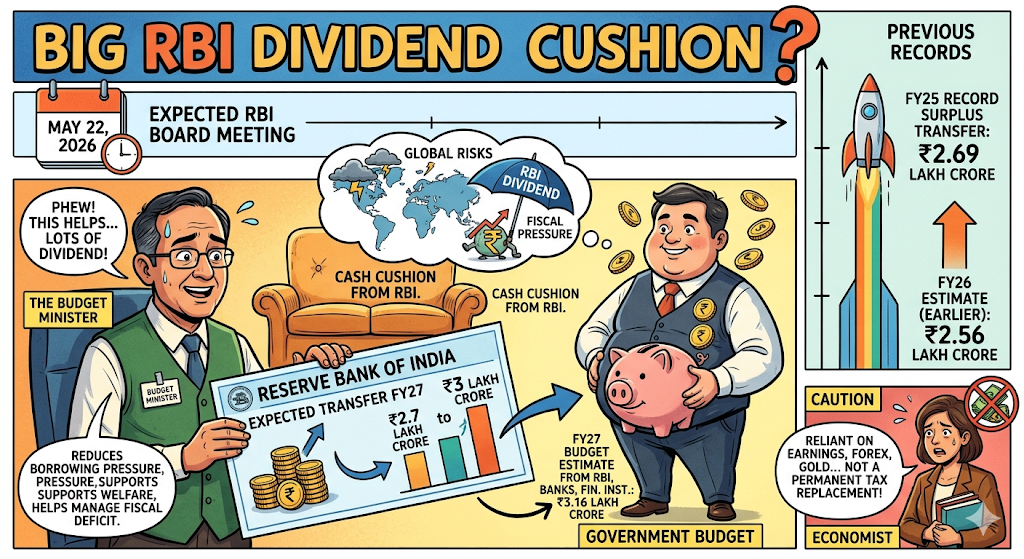
The government may receive one of its biggest dividend payouts from the Reserve Bank of India in FY27. As reported by The Economic Times on May 19, 2026, the RBI board is likely to meet on May 22, 2026, and economists expect a transfer between ₹2.7 lakh crore and ₹3 lakh crore.
In the short term, this can reduce pressure on government borrowing, support welfare spending and help manage the fiscal deficit. The negative side is that such transfers depend on central bank earnings, forex gains, gold valuation and risk buffers. That makes it useful, but not a permanent replacement for tax revenue.
These numbers show why the dividend has become a key Budget headline. LoansJagat reported on May 14, 2026, that a larger payout can give New Delhi a cash cushion at a time of global risks and fiscal pressure.
A bigger RBI dividend will not directly reduce household EMIs or put cash in people’s accounts. Its impact can come through the government’s Budget. If the Centre receives more non-tax revenue, it may have more room to fund roads, railways, rural schemes and social programmes without pushing borrowing too high.
For the common person, the positive effect can be indirect. Lower borrowing pressure can support bond markets and reduce pressure on interest costs. However, if the government treats this as recurring money, future Budgets may face gaps when RBI profits are lower.
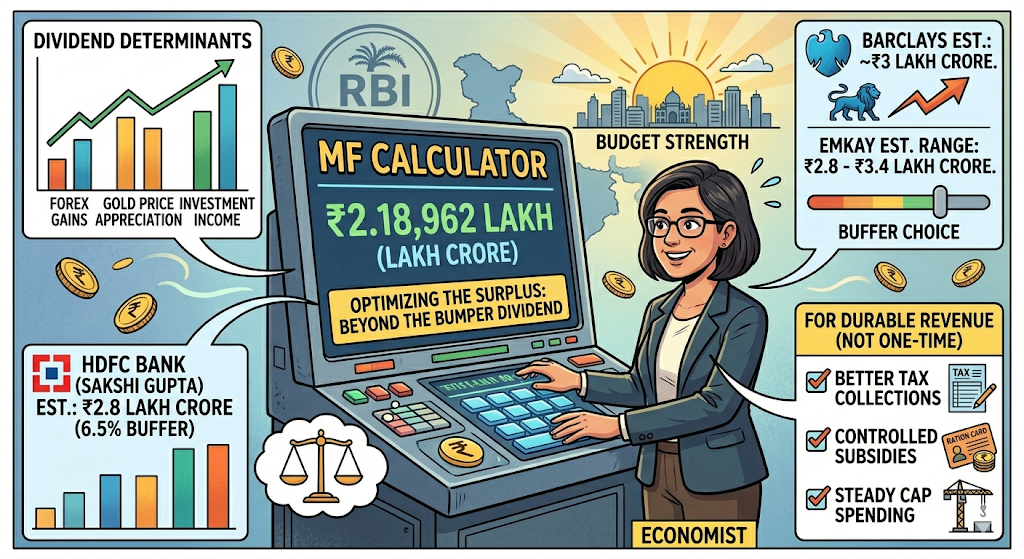
Economists quoted by Economic Times expect a large payout because of strong RBI earnings from forex operations, gold price gains and investment income.
Sakshi Gupta of HDFC Bank estimated a surplus transfer of ₹2.8 lakh crore, assuming the contingency risk buffer is kept at 6.5%. Barclays expects around ₹3 lakh crore, while Emkay sees ₹2.8 lakh crore to ₹3.4 lakh crore, depending on the buffer choice.
*T&C Apply
₹2.8 lakh crore estimate, assuming 6.5% buffer
The solution is not to build spending plans only around a bumper dividend. Experts usually look for better tax collections, controlled subsidies and steady capital spending. A one-time transfer can help the fiscal deficit, but long-term Budget strength needs durable revenue.
On May 23, 2025, the RBI approved a record ₹2.69 lakh crore surplus transfer to the government for FY25. Reuters reported that the contingency risk buffer was raised to 7.5% from 6.5%, while Financial Express said the payout could ease the fiscal deficit by around 20 basis points.
The final FY27 dividend number will be known after the RBI board decision. A near ₹3 lakh crore payout can help the Budget, but it remains a one-time fiscal support.
Why does the RBI give its surplus money to the Indian government?
The RBI gives surplus money to the government because the Centre owns it. The RBI earns income from government bonds, foreign assets and currency-related operations. It first keeps money aside for risks, reserves and day-to-day work. After that, the extra amount is transferred to the government.
This can help the Centre spend on schemes, reduce borrowing and manage the fiscal deficit. But this is not fixed income like taxes. Some years the payout can be high, and some years it can fall. So, the government cannot plan every Budget around RBI surplus.
Where Does RBI Get Its Income From?
The Reserve Bank of India earns money through interest on government bonds, returns from foreign currency assets, and gains made during foreign exchange operations. It also gets income from lending money to banks for short periods and from managing India’s foreign exchange reserves.
RBI is not like a normal bank that runs for profit. Its main job is to manage currency, control inflation, regulate banks and protect the financial system. After paying its expenses and keeping required funds aside, RBI transfers the remaining surplus to the Government of India. This yearly transfer is called RBI dividend or surplus transfer.









.png&w=3840&q=75)



