
By continuing, you agree to LoansJagat's Credit Report Terms of Use, Terms and Conditions, Privacy Policy, and authorize contact via Call, SMS, Email, or WhatsApp
Disclaimer: The information published on LoansJagat is intended for general informational and educational purposes only and should not be considered financial, legal, or investment advice. Interest rates, loan terms, statistics, and other data may change over time and may vary by lender or source. Please verify the latest information and consult a qualified financial advisor or the respective Bank/NBFC before making any financial decisions.
Subscribe Now
About the author

LoansJagat Team
‘Simplify Finance for Everyone.’ This is the common goal of our team, as we try to explain any topic with relatable examples. From personal to business finance, managing EMIs to becoming debt-free, we do extensive research on each and every parameter, so you don’t have to. Scroll up and have a look at what 15+ years of experience in the BFSI sector looks like.
Related News
Simplify All Your Loans Into One Affordable EMI

Customers Served

Debt Consolidated

1200+ Reviews

Locations in India
Club all Loans & Credit Card Bills into Single EMI

Quick Apply Loan
Consolidate your debts into one easy EMI.

Takes less than 2 minutes. No paperwork.

10 Lakhs+
Trusted Customers

2000 Cr+
Loans Disbursed

4.7/5
Google Reviews

50+
Banks & NBFCs Offers
Other services mentioned in this article
Banks may soon publish deeper capital, liquidity and risk numbers, giving depositors and investors more data before judging a lender’s strength.
Key Takeaways
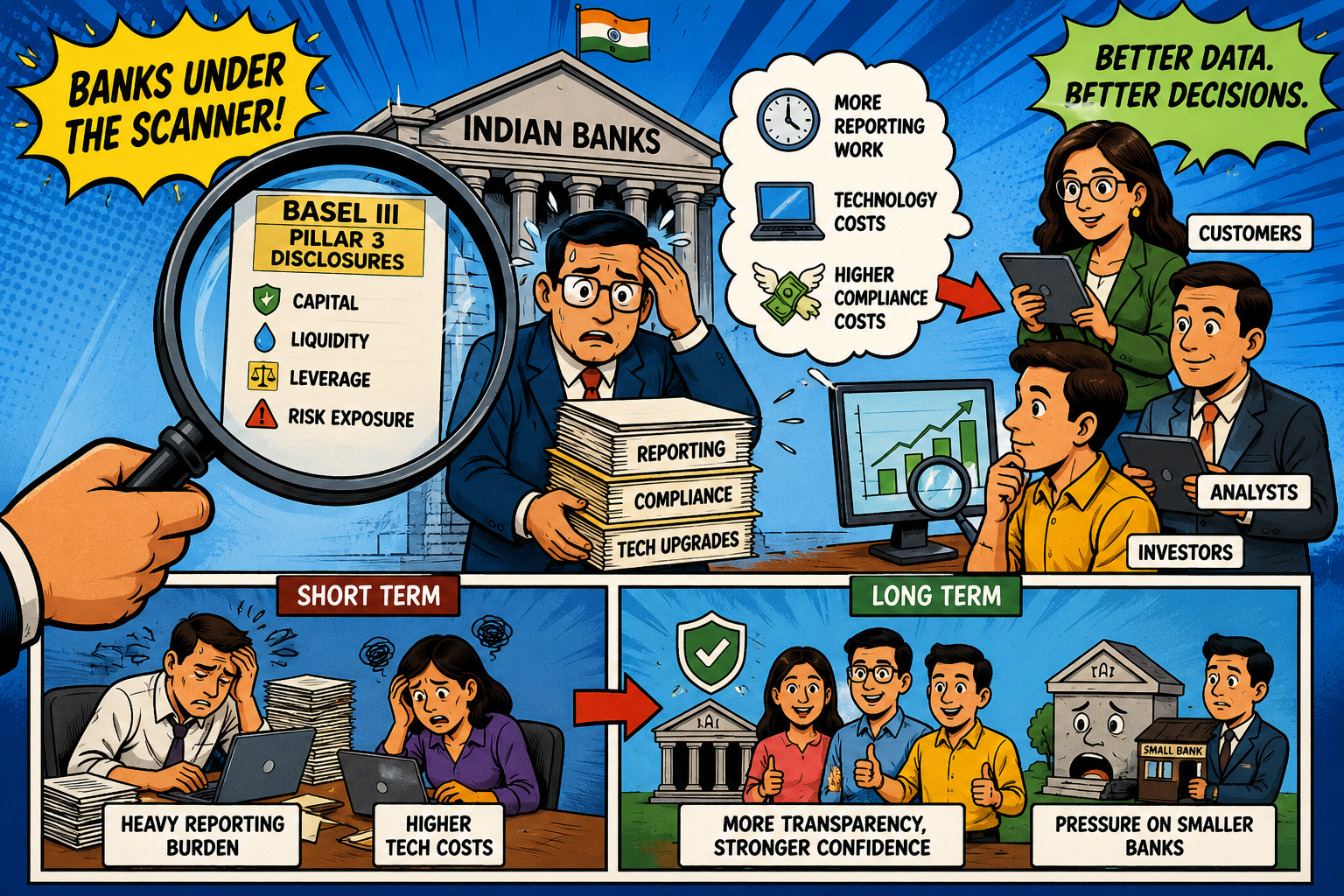
Indian banks may soon have to publish more detailed figures on capital, liquidity, leverage and risk exposure. The draft proposal, reported on May 19, 2026, seeks more uniform Basel III Pillar 3 disclosures across banks.
In the short term, banks may face higher reporting work and technology costs. In the long term, customers, analysts and investors may get better data on whether a lender has enough capital and liquidity. Smaller banks may feel more pressure if their disclosures look weaker than larger peers.
The proposal is about putting comparable bank numbers in public view. Times of India reported that banks may have to publish detailed information on capital adequacy, leverage, liquidity and risk exposure under Basel III norms.
These disclosures are expected to be made in standard templates, making bank-to-bank comparison easier. Economic Times reported on May 20, 2026, that the move may bring unlisted and foreign banks closer to listed bank disclosure standards.
For depositors, this can give more public data before choosing where to keep money. A bank showing strong capital and liquidity may attract more confidence, while weaker figures may push customers to ask harder questions.
For borrowers, there may be no instant EMI impact. However, if banks face higher compliance costs, some costs may gradually move into charges or pricing. The positive part is that riskier lending patterns may become easier to spot before they become a larger problem.
Before this disclosure proposal, the banking capital conversation had already started. LoansJagat reported on May 18, 2026, that RBI kept the Countercyclical Capital Buffer, or CCyB, inactive, so banks did not face an extra capital shock.
*T&C Apply
This shows a wider push around governance, capital reporting and public disclosure. The latest draft is not a capital hike, but it can make weak risk positions harder to hide.

RBI’s quoted view, reported by Business Standard, is that Basel Pillar 3 disclosures help market participants access key information on regulatory capital and risk exposure.
Experts are likely to watch data quality, not just the final tables. The solution for banks is stronger internal reporting, board-level checks and automated data systems so quarterly disclosures do not become a last-minute compliance burden.
The Basel III disclosure push can change how India judges bank health. Customers may not see instant changes, but banks will face sharper public scrutiny if the norms are finalised.
What Could Basel III Disclosure Changes Mean For Indian Bank Customers?
Basel III disclosure changes may push Indian banks to share more details about their capital, liquidity, leverage and risk exposure. For a normal customer, this can help in checking whether a bank looks financially strong before keeping large deposits. Investors may also compare banks with better public data, instead of depending only on quarterly profit numbers.
Banks may have to spend more on reporting systems and internal checks. Since the earlier CCyB update did not add extra capital pressure, this change is more about public reporting and showing bank risk numbers in a more open way.
Why Do Banks In India Put Limits On Customer Accounts?
Indian banks put limits on accounts for many practical reasons. Sometimes the KYC is not updated, sometimes the account has unusual transactions, or the customer is using a savings account for heavy business activity.
Banks also follow RBI rules to reduce fraud, money laundering and misuse of accounts. Basic savings accounts usually have limits on deposits, withdrawals and digital transfers. Current accounts may also be checked if the activity does not match the business profile. Customers can usually remove these limits by visiting the branch, updating KYC, giving income proof or submitting business documents.









.png&w=3840&q=75)



