By continuing, you agree to LoansJagat's Credit Report Terms of Use, Terms and Conditions, Privacy Policy, and authorize contact via Call, SMS, Email, or WhatsApp
Disclaimer: The information published on LoansJagat is intended for general informational and educational purposes only and should not be considered financial, legal, or investment advice. Interest rates, loan terms, statistics, and other data may change over time and may vary by lender or source. Please verify the latest information and consult a qualified financial advisor or the respective Bank/NBFC before making any financial decisions.
Subscribe Now
About the author

LoansJagat Team
‘Simplify Finance for Everyone.’ This is the common goal of our team, as we try to explain any topic with relatable examples. From personal to business finance, managing EMIs to becoming debt-free, we do extensive research on each and every parameter, so you don’t have to. Scroll up and have a look at what 15+ years of experience in the BFSI sector looks like.
Related News
Simplify All Your Loans Into One Affordable EMI

Customers Served

Debt Consolidated

1200+ Reviews

Locations in India
Club all Loans & Credit Card Bills into Single EMI

Quick Apply Loan
Consolidate your debts into one easy EMI.

Takes less than 2 minutes. No paperwork.

10 Lakhs+
Trusted Customers

2000 Cr+
Loans Disbursed

4.7/5
Google Reviews

50+
Banks & NBFCs Offers
Other services mentioned in this article
Indian banks may soon follow one common disclosure format, making capital, liquidity and risk data easier to compare across listed, unlisted and foreign banks.
Key Takeaways
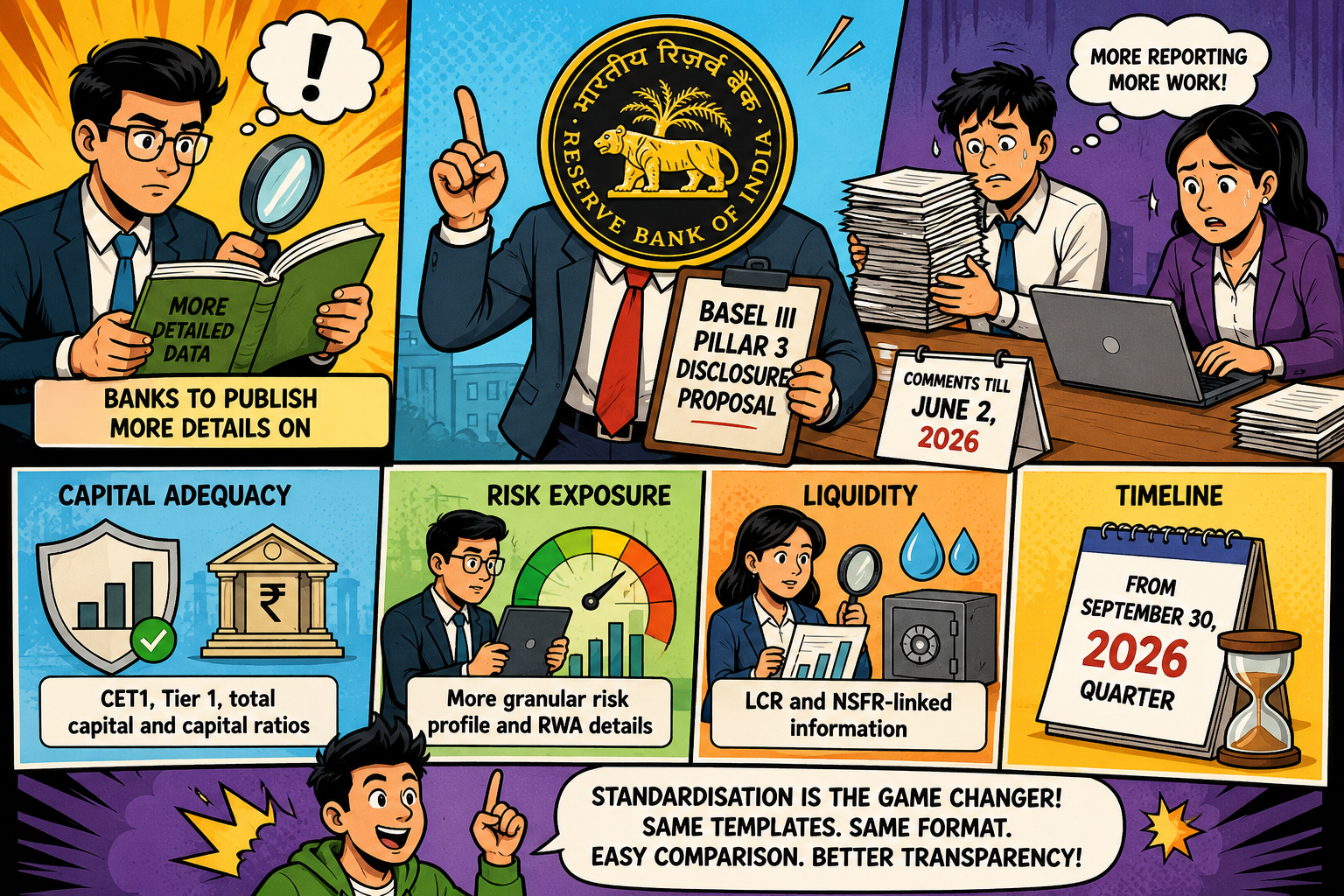
The Reserve Bank of India has proposed a revised disclosure framework under Basel III Pillar 3, asking banks to publish more detailed data on capital adequacy, leverage, liquidity and risk exposure. The proposal was reported on May 19, 2026by PTI and Business Standard.
In the short term, banks may face extra reporting work and higher compliance load. Over the long term, depositors, investors and analysts may get better access to bank-level risk data, especially for unlisted and foreign banks that may not follow the same public disclosure depth as listed peers.
The biggest change is standardisation. Banks may have to use common templates and reporting units, so that one bank’s numbers can be compared with another’s without digging through different formats.
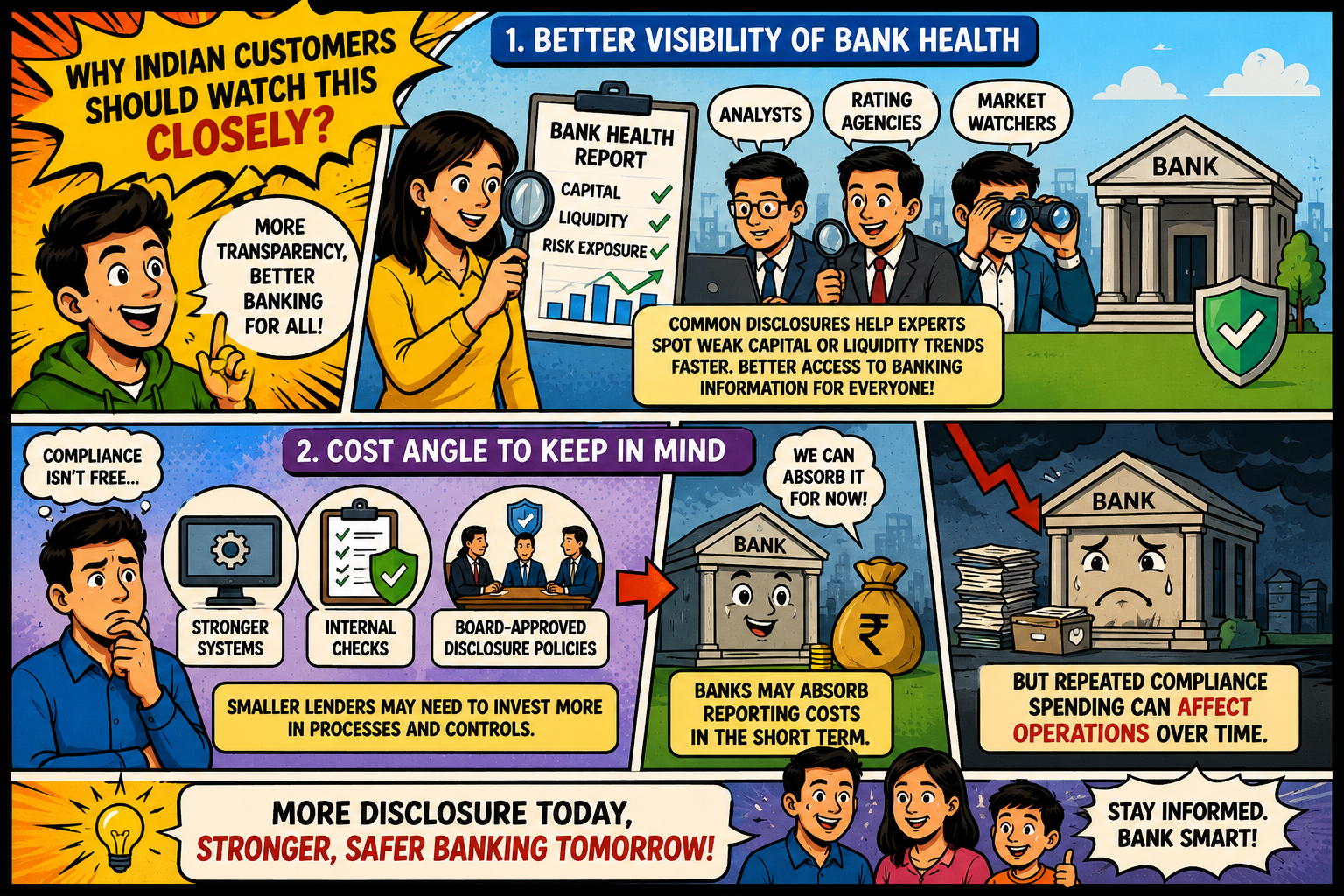
For customers, the proposal can make bank health data more visible. A depositor may not read every ratio, but common disclosures can help analysts, rating agencies and market watchers flag weak capital or liquidity trends faster. That can improve public access to banking information.
There is also a cost angle. Smaller lenders may need stronger systems, internal checks and board-approved disclosure policies. If reporting costs rise, banks may absorb them first, but repeated compliance spending can affect operations over time.
The proposal puts more responsibility on boards and senior management. Business Standard reported that banks would need an internal control structure for disclosures, while whole-time directors may need to attest to disclosure accuracy and controls.
Experts will likely track how banks upgrade systems before the proposed rollout. The practical solution is not only more disclosure, but cleaner source data, stronger audit trails and timely publication along with financial statements. ET LegalWorld reported that if a bank does not produce a financial report for a period, the Pillar 3 disclosure should be published as soon as practicable.
*T&C Apply
Banks and NBFCs must retain at least 10% of individual loan exposure
This earlier co-lending update showed the same regulatory direction: lenders must carry visible risk, disclose roles to borrowers and avoid opaque structures. The proposed Pillar 3 change now takes that approach to bank-level public disclosures.
The draft norms may make Indian bank disclosures sharper and more comparable from the September 30, 2026 quarter. For banks, the next task is simple but heavy: better data systems, faster reporting and fewer gaps in public disclosures.
What should a person check before keeping a big amount in any bank?
Before keeping a large amount in a bank, a person should first check how strong the bank looks on paper. Look at its capital adequacy ratio, bad loans, profit or loss, deposit growth and any recent RBI action.
A bank with low NPAs, regular profit and good capital position is usually safer. Also check if its financial results are easy to find. Do not keep all savings in 1 small bank. In India, deposit insurance is only up to ₹5 lakh for each depositor in each bank, so spreading money across 2 or 3 banks is safer.
At what point can a cash deposit in a bank get reported?
In India, there is no rule that says a person cannot deposit more cash. But banks can report high-value deposits. If cash deposits in a savings account reach ₹10 lakh or more in 1 financial year, it can be reported to the Income Tax Department.
For a current account, the level is ₹50 lakh or more. The deposit itself is not a problem if the money is genuine. Keep proof like salary records, sale papers, business receipts or tax return details. If the bank or tax officer asks, the source should be easy to explain.









.png&w=3840&q=75)



