
By continuing, you agree to LoansJagat's Credit Report Terms of Use, Terms and Conditions, Privacy Policy, and authorize contact via Call, SMS, Email, or WhatsApp
Disclaimer: The information published on LoansJagat is intended for general informational and educational purposes only and should not be considered financial, legal, or investment advice. Interest rates, loan terms, statistics, and other data may change over time and may vary by lender or source. Please verify the latest information and consult a qualified financial advisor or the respective Bank/NBFC before making any financial decisions.
Subscribe Now
About the author

Arshathul Afia
Arshathul Afia is a journalism graduate and fintech content writer with 4+ years of experience in digital publishing and research-led writing. She has written 200+ articles covering personal finance, lending, banking, digital payments, credit, insurance, and major financial developments in India. At LoansJagat, she focuses on simplifying complex fintech news, RBI updates, loan-related changes, policy developments, and industry trends for everyday readers. Her journalism background helps her approach stories with research, context, and clarity, while her SEO experience ensures content remains discoverable and relevant. She aims to make financial news easier to understand, practical, and useful for readers across India.
Related News
Simplify All Your Loans Into One Affordable EMI

Customers Served

Debt Consolidated

1200+ Reviews

Locations in India
Club all Loans & Credit Card Bills into Single EMI

Quick Apply Loan
Consolidate your debts into one easy EMI.

Takes less than 2 minutes. No paperwork.

10 Lakhs+
Trusted Customers

2000 Cr+
Loans Disbursed

4.7/5
Google Reviews

50+
Banks & NBFCs Offers
Other services mentioned in this article
From 1 October 2026, the Reserve Bank of India will allow bank boards to delegate selected reviews and focus on strategy, risk, compliance, financial performance and customer protection.
Key Highlights
India’s banking regulator announced the final board agenda framework through Press Release 2026-2027/668, dated 14 July 2026. The accompanying amendment directions are numbered RBI/2026-27/177 to RBI/2026-27/180. They apply to commercial banks, small finance banks, payments banks and local area banks.
The change will happen inside board meetings, not at branches or on banking apps. Loan rates, fixed deposit returns and EMIs will not shift simply because meeting agendas have been revised. The longer effect may come through earlier action on risky lending, technology failures, customer complaints and financial pressure.
Delegation still carries a weakness. The full board may hear about a warning late when committee reports are brief or delayed. Banks will need firm escalation rules and complete reporting.
Most account holders will notice no visible change on 1 October. Savings accounts, loan instalments and branch operations will continue as before.
Directors with more time for risk review can examine digital outages, fraud complaints, aggressive loan growth and repeated audit findings before those problems spread. Specialised committees may also respond faster instead of waiting for a full board meeting.
Product design may receive closer scrutiny. Directors can test default risk, disclosures and recurring digital complaints. Management will run daily operations, while the board checks compliance with approved policies.
Borrowers may face stricter checks in a few loan categories when internal data show rising defaults or fraud. Approval could take longer for some applicants, though earlier caution may prevent sudden lending cutbacks later.
RBI Governor Sanjay Malhotra said in April 2026 that banks had requested a review of the board agenda framework. Reuters reported on 8 April that the proposed structure would let directors spend more time on policy while management handled operating work.
That division depends on the information directors receive. Reports should identify the problem, financial exposure, responsible executive, proposed action and deadline.
Committees also need escalation triggers. A routine technology review can become a board-level concern after repeated outages. A lending concentration may appear manageable, then rise quickly after several large approvals.
Independent directors should have direct access to the chief risk officer, chief compliance officer and internal audit head, especially when an inquiry involves senior management.
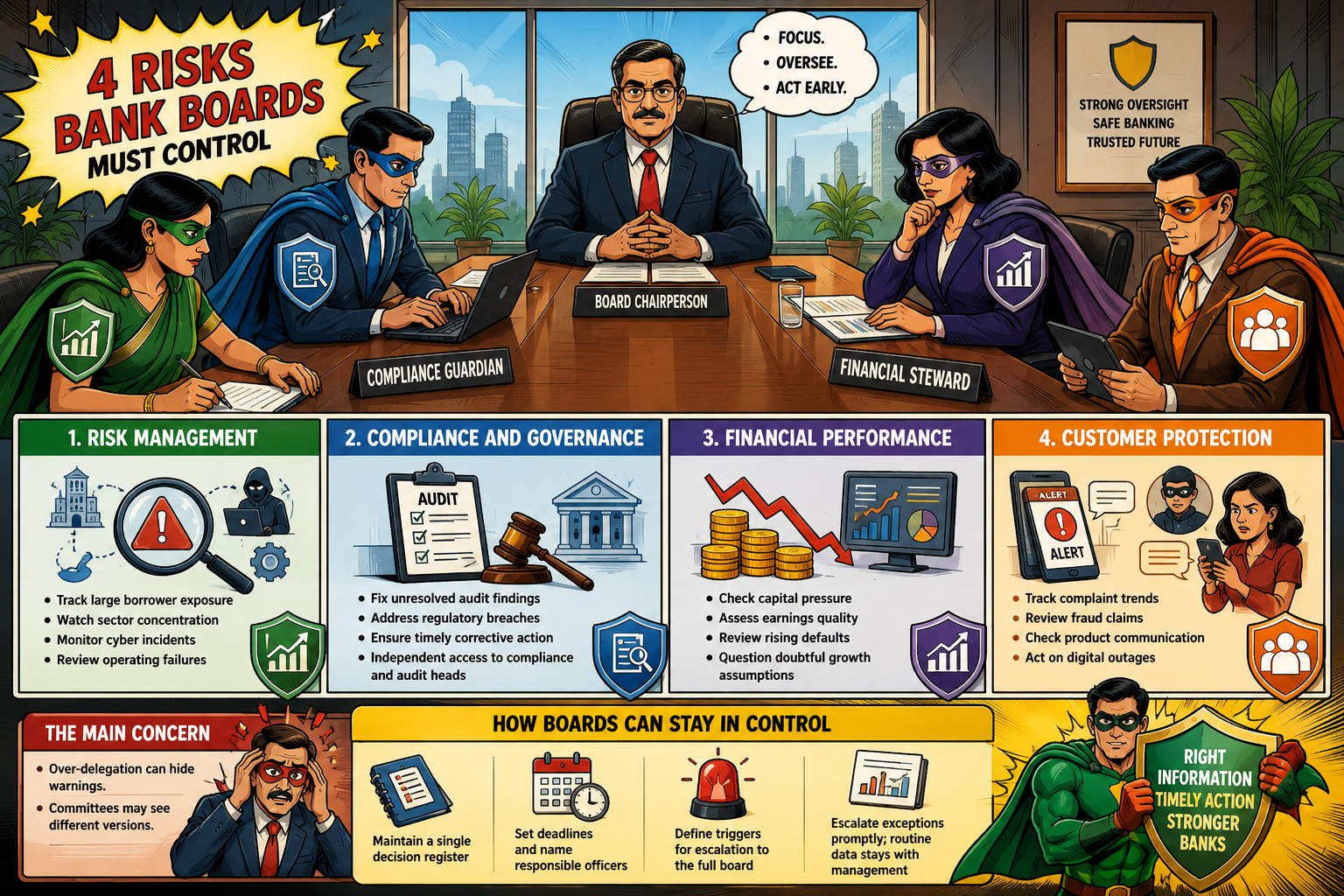
The revised framework gives boards more freedom to move routine reviews to committees. That can improve meeting quality, but poor delegation may hide a growing problem.
The 4 areas below cover the main risks boards will continue to supervise. Banks will need named decision owners, reporting deadlines and escalation limits before the new system begins.
Over-delegation remains the main concern. A bank may send too many reviews to committees, leaving the full board with summaries that omit disagreements, delays or rising exposure. Different committees may also receive conflicting accounts of the same event.
A single decision register can reduce that gap. It should state which approvals remain with the board, which belong to committees and which management can handle. Every delegated decision needs a deadline, a named officer and a trigger for returning the issue to directors.
Stable operating data can remain with management. Missed deadlines, policy breaches, repeated outages and unusual financial movements should reach the board promptly.
Earlier agendas carried recurring reviews, policy renewals and operating updates. Directors could spend much of a meeting on required items even when nothing unusual appeared.
The revised approach gives banks more freedom to prepare agendas around their business model and risk profile. A payments bank may spend more time on technology resilience and fraud controls. A commercial lender may focus on borrower concentration, connected entities and capital use.
Boards must identify decisions reserved for their own approval. Without a written list, management and committees may interpret their authority differently during an urgent transaction or an emerging loss.
Delegated powers also need regular review. The board should set financial limits, customer harm triggers and reporting deadlines before 1 October.
The policy shift began publicly on 8 April 2026. RBI announced its plan to review board agenda requirements and issued draft amendment directions through Press Release 2026-2027/47.
Banks, industry bodies, professionals and members of the public could submit comments until 7 May 2026. The draft proposed a wider separation between board oversight and daily management. Directors would spend more time on risk, strategy, related-entity exposure and governance, while executives handled routine work.
The proposal arrived amid renewed attention on relationships between chairpersons, chief executives and independent directors. Boards should challenge management and approve major policies, not run business units.
Consultation respondents asked for wider board involvement while the chairperson prepared meeting agendas. The final position kept primary responsibility with the chairperson but expected consultation with the board.
Stakeholders also questioned whether each bank should create its own definition of materiality. Different definitions could produce inconsistent treatment of similar decisions, so the separate requirement was removed.
Some respondents wanted a compulsory action-taken report showing whether management had acted on board decisions. The final directions did not retain one common format. Each board can choose its tracking process.
That flexibility needs controls. Every decision should carry a named owner, completion date and escalation route. Otherwise, an instruction may remain unfinished for months.

Banks can begin with a written decision register showing which items remain with the full board, which move to committees and which management can approve.
Escalation triggers should be specific. A financial loss above an approved limit, repeated policy breach, cyber incident, regulatory notice or pattern of customer harm should reach the board quickly.
Committee minutes should record disagreements, not only final decisions. Banks should also track whether management completed the action requested by the committee.
The board reset is unlikely to cut lending rates immediately. Its early effect may appear in approval policies, product reviews and the way banks respond to warning signs.
A previous LoansJagat report on governance pressure in Indian banking, published on 26 March 2026, examined how leadership exits and oversight concerns could affect investor reactions. The October framework gives boards more time to question strategy, risk limits and control failures.
Borrowers may see tighter approval rules in risky loan categories. Weak checks often lead to sudden cutbacks, higher losses and tougher recovery action later.
Depositors may gain when boards study financial stress and operating failures sooner. Complaint trends may also receive board attention instead of remaining only a branch-level issue.
The wider governance push is visible in a Press Information Bureau backgrounder published on 4 December 2025, which linked banking law changes with stronger governance, audit quality and depositor protection.
The October reset gives directors more room to study risk and strategy. It does not reduce their responsibility when a bank makes a poor decision or ignores an early warning.
The result will depend on reporting quality. Committees need defined authority, directors need direct access to risk officials, and unresolved issues must return to the full board quickly.
A shorter agenda alone changes little. Better questions, timely escalation and named accountability will decide whether the framework protects customers or simply moves paperwork between meetings.
What changes for bank boards on 1 October 2026?
Boards may delegate selected reviews but must retain oversight of strategy, risk, compliance, performance and customers.
Will the new rules reduce home loan EMIs?
No direct EMI reduction follows from the rules. Loan pricing will still depend on each lender.
Can a bank board delegate every decision?
No. Major policies, strategic decisions and high-risk issues must remain under full board supervision.
Which banks are covered by the new framework?
Commercial banks, small finance banks, payments banks and local area banks come under the directions.
Why should depositors follow bank governance news?
Board decisions affect financial stability, fraud controls, service failures, complaint handling and the safety of customer deposits.










.png&w=3840&q=75)


