By continuing, you agree to LoansJagat's Credit Report Terms of Use, Terms and Conditions, Privacy Policy, and authorize contact via Call, SMS, Email, or WhatsApp
Disclaimer: The information published on LoansJagat is intended for general informational and educational purposes only and should not be considered financial, legal, or investment advice. Interest rates, loan terms, statistics, and other data may change over time and may vary by lender or source. Please verify the latest information and consult a qualified financial advisor or the respective Bank/NBFC before making any financial decisions.
Subscribe Now
About the author

Arshathul Afia
Arshathul Afia is a journalism graduate and fintech content writer with 4+ years of experience in digital publishing and research-led writing. She has written 200+ articles covering personal finance, lending, banking, digital payments, credit, insurance, and major financial developments in India. At LoansJagat, she focuses on simplifying complex fintech news, RBI updates, loan-related changes, policy developments, and industry trends for everyday readers. Her journalism background helps her approach stories with research, context, and clarity, while her SEO experience ensures content remains discoverable and relevant. She aims to make financial news easier to understand, practical, and useful for readers across India.
Related Blog Post
Simplify All Your Loans Into One Affordable EMI

Customers Served

Debt Consolidated

1200+ Reviews

Locations in India
Club all Loans & Credit Card Bills into Single EMI

Quick Apply Loan
Consolidate your debts into one easy EMI.

Takes less than 2 minutes. No paperwork.

10 Lakhs+
Trusted Customers

2000 Cr+
Loans Disbursed

4.7/5
Google Reviews

50+
Banks & NBFCs Offers
Other services mentioned in this article
Taxpayers receiving income tax notifications must verify the portals and DIN and PAN first to avoid fake notifications, which can cause wrong payments, missed responses and data leaks, etc.
Key Highlights
Taxpayers who receive an income tax notice should check DIN, PAN, assessment year and the official portal record before replying or paying.
Indian taxpayers who receive an income tax notice, order, summons, letter or demand message should verify it on the official e-Filing portal before taking action. The check is available through the Income Tax e-Filing Portal, where taxpayers can authenticate a notice using PAN, document type, assessment year, issue date and mobile number, or through DIN and mobile number. This is the first step before uploading papers, clicking a payment link, or sending any reply.
The short-term risk is direct loss of money. A taxpayer may pay a fake tax demand after seeing a threatening email. The longer risk is data misuse, because PAN, bank information, return details and login credentials can be used again. The Income Tax Department also warns through Income Tax India that it does not ask taxpayers for PINs, passwords or similar access information for bank accounts, credit cards or other financial accounts through email.
Tax notices now reach people through email, SMS and the e-Filing portal. That helps faster communication. It also gives fraudsters a format to copy. A fake tax message can look official at first glance. It may carry a logo, mention a refund, show a demand amount, or ask the taxpayer to open an attachment before a short deadline.
The genuine route is different. The taxpayer should go to the official portal directly and use the notice-authentication facility. If the notice is real, the portal shows the document number and date of issue after OTP validation. If the details do not match, the taxpayer gets an early warning that the communication may not be genuine.
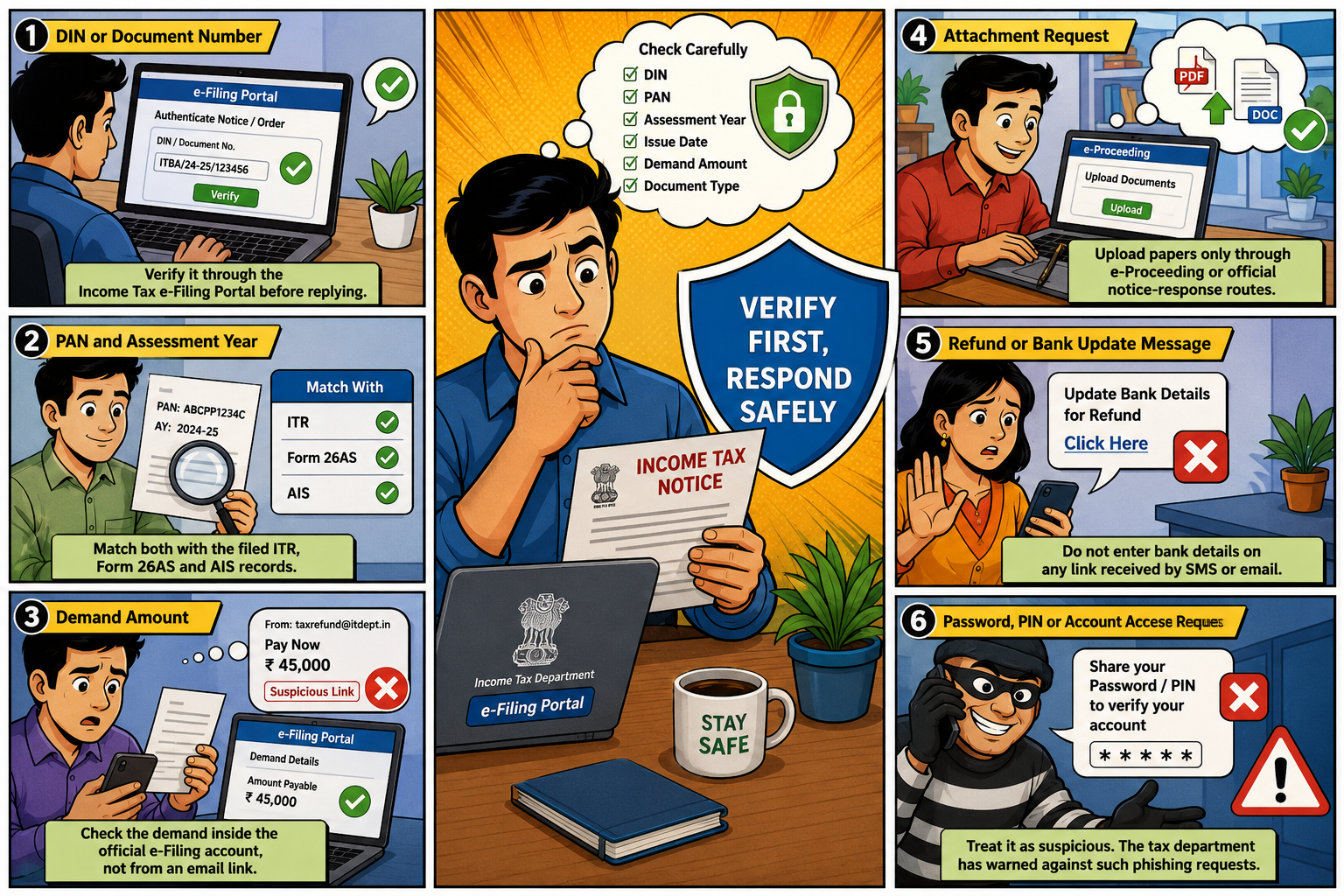
The DIN check should come before any reply. DIN means Document Identification Number. PAN is the second check. The taxpayer should also match the assessment year, issue date, section, demand amount and document type with the return filed and the records available in the e-Filing account.
A fake notice often fails at this stage. It may use the wrong PAN format, wrong assessment year, a random demand amount or an unofficial payment link. Some fake messages also ask for bank account access in the name of refund release.
After the table check, the taxpayer should keep the response focused. If the notice is genuine, the person can reply through the relevant portal section. If the demand is wrong, documents such as Form 16, Form 26AS, AIS, challans, bank statements and investment proofs should be kept ready. A LoansJagat guide on tax demand notices also advises taxpayers to check the DIN and compare the notice with tax documents before accepting the demand.
Salaried taxpayers, pensioners, small traders, freelancers and first-time return filers may face the biggest problem because many do not deal with notices regularly. A person in Pune may receive a fake refund email during ITR season. A retired taxpayer in Jaipur may receive a fake demand message mentioning an old assessment year. The pressure works because the message sounds official and urgent.
The positive side is that the verification process does not need a tax office visit. A taxpayer can authenticate the notice from the portal before calling a consultant or replying. This gives people a safer first filter. It also reduces the chance of paying a fake demand only because the email looked official.
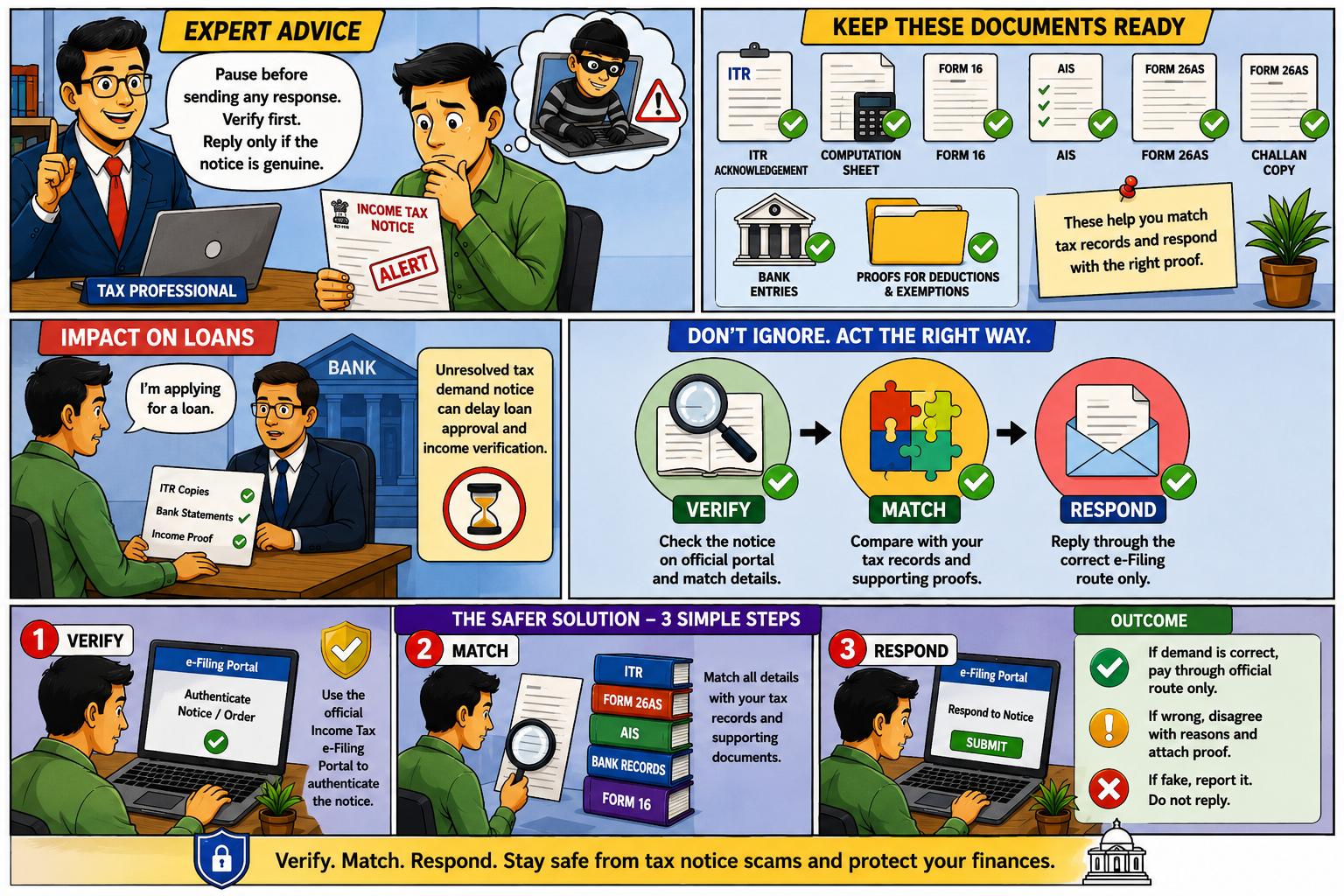
Tax professionals usually advise taxpayers to pause before sending a response. A genuine notice may still need a proper reply, while a fake notice should not receive any personal information at all. The safer route is to collect the ITR acknowledgement, computation sheet, Form 16, AIS, Form 26AS, challan copy, bank entries and proofs linked to deductions or exemptions.
For borrowers, the effect can travel beyond tax compliance. If a taxpayer is applying for a loan and a lender asks for ITR copies, bank statements or income documents, an unresolved demand notice can delay paperwork. LoansJagat’s tax demand explainer looks at this from a financial-document angle too: a taxpayer should not accept a demand in haste if the mismatch can be explained through tax records. That is a useful borrower-side view, because a clean paper trail helps during loan checks, income verification and future credit discussions.
The solution is not to ignore the notice. It is to verify, match, then respond. If the demand is correct, payment should happen only through the official e-Filing route. If it is wrong, the taxpayer should disagree with reasons and attach supporting proof. If the message is fake, the taxpayer should report it instead of replying.
The DIN system came into force for income tax communication from 1 October 2019. The earlier government update said tax notices and other official communication would carry a computer-generated DIN to improve transparency and maintain an audit trail. That change gave taxpayers a stronger way to check whether a communication was actually issued by the department.
That earlier step is relevant now because fake notices have become easier to create. A logo and a tax-style subject line are no longer enough. The official record is the safer proof. A taxpayer should check the portal first, then decide whether the notice needs payment, documents, correction, disagreement or reporting.
The Income Tax Department says the notice-authentication service is available as a pre-login facility. That point helps both registered and unregistered users because they can verify a notice without depending on a link sent in an email.
The department has also warned taxpayers that it does not ask for PINs, passwords or similar access details for credit cards, banks or other financial accounts through email. It also asks users not to enter confidential information after clicking suspicious links.
CBDT’s DIN system added another layer to this process. The taxpayer now has a reference number to verify before responding. That does not remove the need to read the notice carefully, but it reduces blind trust in emails and printed-looking PDFs.
An income tax notice should be taken seriously, but not in panic. The taxpayer should first check the DIN, PAN, assessment year, issue date and official portal record. Only after that should the person reply, upload documents or pay any demand.
Fake tax emails work because they copy official wording and create urgency. A portal check can stop that trap early. For taxpayers across India, those 2 minutes can protect money, documents and future tax compliance.
What should a taxpayer do first after receiving an income tax notice?
The taxpayer should verify the DIN, PAN, issue date and assessment year on the official e-Filing portal.
Can a taxpayer ignore a notice if it looks fake?
No. The taxpayer should first authenticate it officially. If no record appears, the message should be treated as suspicious.
Should tax demand be paid through an email link?
No. Tax demand should be checked and paid only through the official e-Filing portal.
What documents should be kept before replying?
The taxpayer should keep ITR acknowledgement, Form 16, AIS, Form 26AS, challans, bank entries and investment proofs.
Does the Income Tax Department ask for bank passwords by email?
No. The department warns that it does not ask for PINs, passwords or bank-access details by email.









.png&w=3840&q=75)


