By continuing, you agree to LoansJagat's Credit Report Terms of Use, Terms and Conditions, Privacy Policy, and authorize contact via Call, SMS, Email, or WhatsApp
Disclaimer: The information published on LoansJagat is intended for general informational and educational purposes only and should not be considered financial, legal, or investment advice. Interest rates, loan terms, statistics, and other data may change over time and may vary by lender or source. Please verify the latest information and consult a qualified financial advisor or the respective Bank/NBFC before making any financial decisions.
Subscribe Now
About the author

Arshathul Afia
Arshathul Afia is a journalism graduate and fintech content writer with 4+ years of experience in digital publishing and research-led writing. She has written 200+ articles covering personal finance, lending, banking, digital payments, credit, insurance, and major financial developments in India. At LoansJagat, she focuses on simplifying complex fintech news, RBI updates, loan-related changes, policy developments, and industry trends for everyday readers. Her journalism background helps her approach stories with research, context, and clarity, while her SEO experience ensures content remains discoverable and relevant. She aims to make financial news easier to understand, practical, and useful for readers across India.
Related News
Simplify All Your Loans Into One Affordable EMI

Customers Served

Debt Consolidated

1200+ Reviews

Locations in India
Club all Loans & Credit Card Bills into Single EMI

Quick Apply Loan
Consolidate your debts into one easy EMI.

Takes less than 2 minutes. No paperwork.

10 Lakhs+
Trusted Customers

2000 Cr+
Loans Disbursed

4.7/5
Google Reviews

50+
Banks & NBFCs Offers
Other services mentioned in this article
The rupee’s 39-paise slide on 13 July 2026 signals dearer dollar payments for oil, imports, foreign travel and overseas education bills across Indian households now.
Key Highlights
The Indian rupee slid to 95.77 against the U.S. dollar on the morning of July 13, 2026, after it finished the last trading session at 95.38. The dollar’s price surge was attributed to an increase in the price of crude oil after tensions erupted in the Strait of Hormuz, which is a critical passage for global oil supply.
For India, the rupee’s value is not isolated to international currency exchanges. It severely impacts the price of every good imported to India: oil, freight, airline travel, machinery, chemicals, electronics, and every other good that requires overseas payments. One day of trading at a poor price will not impact the price of goods on a day-to-day basis. However, persistently sliding prices, especially if the dollar is expensive, will impact the average Indian’s wallet in a slow, more painful manner.
The rupee had opened the day near 95.72, and then, in early trades, had hit a price of 95.77, a 39-paise fall from the previous day’s close. The fall was attributed by currency traders to a crude oil price surge and increased dollar demand by Indian importers.
In the interbank foreign exchange market, where currencies are traded by banks, businesses, and traders, a fall was observed. Oil-importing businesses require huge amounts of dollar payments. When the price of crude oil increases, the dollar requirement increases. The rupee comes under pressure unless the demand is met with strong dollar inflows.
The timing made traders more cautious. West Asia tensions returned just as the rupee had started to recover from earlier weakness. A few days of relief disappeared quickly because energy-linked shocks often move faster than domestic data.
Since India imports a majority of its crude oil, it was a key trigger. A Press Information Bureau release from 29 October 2025 states that imports fulfilled around 88% of India’s crude oil needs. The exporting countries made the dependence of the rupee more vulnerable.
The latest pressure came after reports of renewed U.S.-Iran tension and concern around the Strait of Hormuz. Oil traders reacted first. Currency traders followed. When crude gets dearer, refiners and importers need more dollars, and the rupee often weakens if dollar supply does not keep pace.
There is also a sentiment angle. During conflict scares, global investors usually prefer the U.S. dollar. Emerging-market currencies then face selling. The rupee had both problems on Monday, higher oil and a stronger dollar mood.
The first mention of inflation usually does not occur at the grocery store. There, families face the difficulty of purchasing necessities at increasingly higher prices. The cost of goods imported to India and goods manufactured in India but relying on imports along with transportation costs and fuel, will also increase due to inflation. As the Indian rupee weakens over consecutive trading days, companies importing components, chemicals or machinery will most likely pay higher prices for the same imports. These costs will ultimately be borne by the customers.
Inflation will be felt most acutely by families sending money to India from abroad. Currently, to pay an Indian student $10,000 would cost an Indian family approximately ₹9.58 lakhs. This is based on a conversion rate of $1.00 = ₹95.77. In comparison, at $1.00 = ₹95.38, the payment would cost ₹9.54 lakh. This is a low and insignificant rate of difference on a single payment. Spread out over the multiple payments when factoring in a student’s yearly tuition, housing and living expenses, the difference becomes very significant and noticeable.
Travelers face the same problem when trying to send money abroad. Inflation will cause a noticeable increase in the cost of travel due to America’s reliance on other countries to supply goods in foreign currency which will cause a direct and noticeable increase in the cost of travel.
Exporters stand on the other side of this move. IT firms, pharma companies and other dollar earners may get more rupees for their overseas revenue. Still, companies that import raw material may not enjoy the full benefit.
The table below shows where the rupee’s fall can first show up. The impact depends on how long the currency stays close to 96 and whether crude oil cools down.
The TradeStat platform from the Department of Commerce features import data segmented by commodity. The platform, following its update of June 29, 2026, includes data for May 2026. With crude prices increasing, there is often a renewed focus on the rupee-dollar exchange rate, as petroleum products are a major import item.

Currency dealers expect the rupee to stay under watch if crude remains expensive. Their concern is not only the 95.77 level. The next question is whether the market starts testing 96 and then moves beyond it if oil buyers continue chasing dollars.
Some traders also expect companies to increase hedging. Importers with payments due in the next 30 to 90 days may lock part of their dollar requirement instead of waiting until the final week. That does not guarantee the cheapest rate. It protects them from a sudden jump.
Exporters may do the opposite. A weaker rupee gives them a better conversion rate, so they may sell dollars in parts. Many businesses prefer this route because currency markets can reverse quickly if oil prices fall or foreign inflows improve.
A borrower-facing reading is also needed. A LoansJagat report on rupee weakness had earlier explained how a falling rupee can raise import costs and strain household budgets when oil prices stay high. For borrowers, the risk comes through inflation pressure, business costs and future loan-rate expectations.
The rupee had seen some relief before this fall. On 10 July 2026, it was near 95.33 against the dollar. Traders were still cautious, but the market was not as tense as it looked on Monday morning.
That changed after crude oil moved up again. The rupee had already crossed 95 earlier in July, so traders were watching the 96 level closely. Monday’s 39-paise drop brought that number back into the conversation.
The earlier recovery faded because the pressure came from outside India. A local data point usually moves through the market slowly. A conflict-linked oil shock moves at once. Importers react, banks quote wider ranges, and traders cut risk.
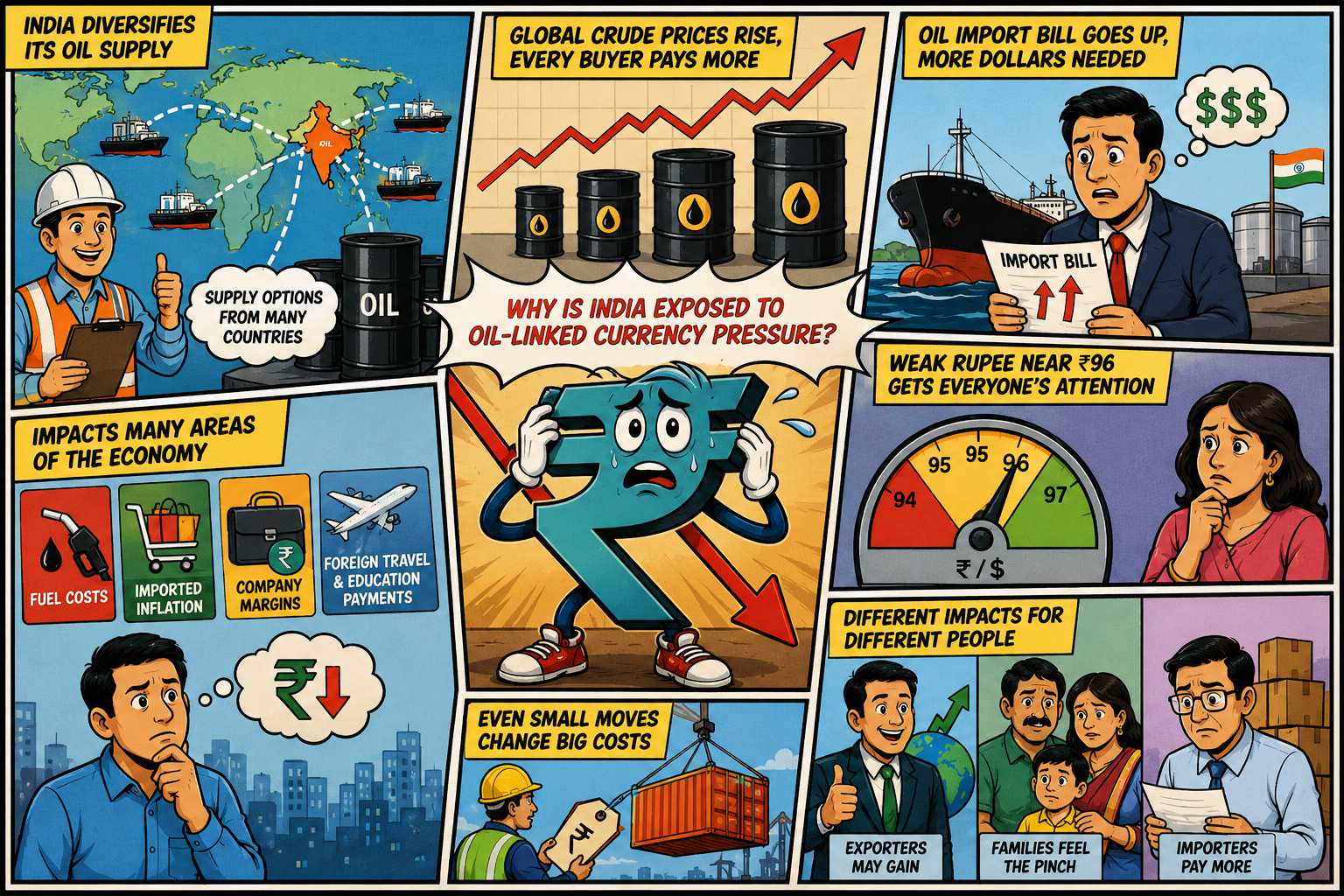
India has widened its oil-supply network in recent years, which reduces dependence on one route or region. That helps with shipping trouble. Price pressure is different. When global crude rises, buyers across countries pay more, even if cargoes arrive on time.
This is why a weak rupee near 96 gets attention. It links to imported inflation, fuel costs, company margins, foreign travel and education payments. It also affects how businesses plan their next dollar purchase.
For a large importer, even a small currency move can change the cost of a shipment. For a family paying an overseas university, the difference appears in the bank transfer slip. For exporters, the same move can improve revenue conversion. The rupee fall does not hit every group in the same way.
The rupee’s fall to 95.77 on 13 July 2026 shows how quickly crude oil can disturb India’s currency market. A 39-paise fall may look small in daily conversation, but for importers, students abroad and oil buyers, it changes actual payment amounts.
The coming sessions will depend on crude oil prices, West Asian news, and dollar demand from Indian companies. If oil cools, the rupee may recover some lost ground. If crude stays high and the dollar remains firm, traders will keep watching the 96 mark.
For now, households with foreign payments and businesses with import bills have a simple signal. Do not leave every dollar decision to the last day.
What happened to the rupee on 13 July 2026?
The rupee fell 39 paise and touched 95.77 against the U.S. dollar in early trade.
Why did the rupee fall against the dollar?
The rupee weakened because crude oil became costlier and importers needed more dollars for payments.
Will petrol and diesel prices rise immediately?
Retail fuel prices may not rise at once. Longer oil and currency pressure can increase cost strain later.
Who gains when the rupee weakens?
Exporters earning in dollars may gain because their overseas revenue converts into more rupees.
What can importers do now?
Importers can split dollar purchases and hedge part of future payments rather than waiting till the due date.










.png&w=3840&q=75)


