
By continuing, you agree to LoansJagat's Credit Report Terms of Use, Terms and Conditions, Privacy Policy, and authorize contact via Call, SMS, Email, or WhatsApp
Disclaimer: The information published on LoansJagat is intended for general informational and educational purposes only and should not be considered financial, legal, or investment advice. Interest rates, loan terms, statistics, and other data may change over time and may vary by lender or source. Please verify the latest information and consult a qualified financial advisor or the respective Bank/NBFC before making any financial decisions.
Subscribe Now
About the author

LoansJagat Team
‘Simplify Finance for Everyone.’ This is the common goal of our team, as we try to explain any topic with relatable examples. From personal to business finance, managing EMIs to becoming debt-free, we do extensive research on each and every parameter, so you don’t have to. Scroll up and have a look at what 15+ years of experience in the BFSI sector looks like.
Related News
Simplify All Your Loans Into One Affordable EMI

Customers Served

Debt Consolidated

1200+ Reviews

Locations in India
Club all Loans & Credit Card Bills into Single EMI

Quick Apply Loan
Consolidate your debts into one easy EMI.

Takes less than 2 minutes. No paperwork.

10 Lakhs+
Trusted Customers

2000 Cr+
Loans Disbursed

4.7/5
Google Reviews

50+
Banks & NBFCs Offers
Other services mentioned in this article
Key Takeaways
The Indian rupee has entered unfamiliar territory again. On Monday, the domestic currency slipped to a fresh all-time low of 96.20 against the US dollar in early trade, extending a relentless fall that has unsettled markets, policymakers, and businesses alike.
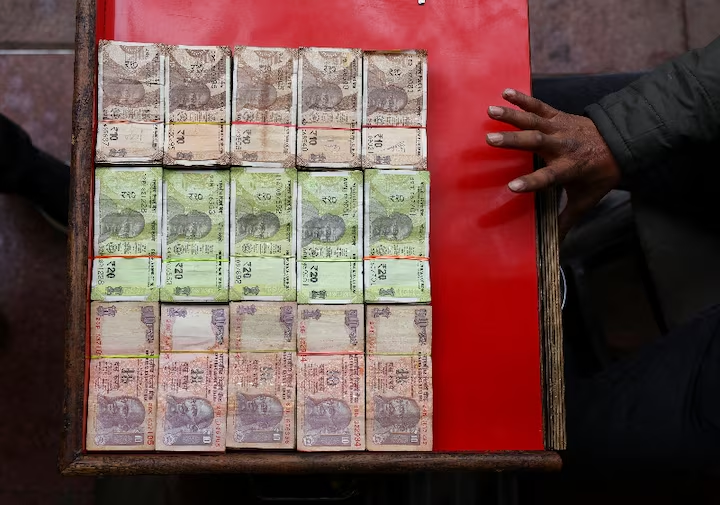
What initially looked like a temporary reaction to geopolitical tensions is now beginning to resemble a deeper macroeconomic concern. The rupee’s depreciation is no longer just a currency-market story. It is rapidly becoming a reflection of global oil shocks, foreign capital flight, inflation fears, and India’s growing vulnerability to external pressures.
According to market data cited by multiple financial platforms, the rupee has already weakened by nearly 5.5% since the Iran conflict intensified earlier this year.
For an economy heavily dependent on imported crude oil, that decline carries consequences far beyond Dalal Street.
The biggest trigger remains crude oil.
Brent crude prices have surged sharply amid escalating tensions in the Middle East, with reports suggesting prices briefly moved near the $110-per-barrel mark.
India imports nearly 85% of its crude oil requirement. When oil prices rise globally, India needs more dollars to pay for those imports. That increases demand for the US currency and weakens the rupee.
At the same time, global investors are increasingly moving money toward safer US assets because of rising American bond yields and geopolitical uncertainty. Reuters reported that foreign investors have already pulled out more than $23 billion from Indian equities and bonds since March.
That outflow creates another layer of pressure on the rupee.
A stronger dollar globally has only worsened the situation.
Think of India as a family that earns in rupees but buys essentials in dollars.
Now imagine petrol, cooking gas, electronics, fertilisers, and imported machinery suddenly becoming more expensive because the dollar has become costlier overnight.
That is exactly what happens when the rupee weakens sharply.
Even if international oil prices remain unchanged, India still ends up paying more in rupee terms because each dollar now costs more.
For ordinary consumers, this eventually translates into higher fuel prices, expensive flights, rising logistics costs, and inflation across daily essentials.
For businesses, imported raw materials become costlier, squeezing profit margins.
And for the government, managing inflation becomes significantly harder.
*T&C Apply
Brent Crude Oil
The Reserve Bank of India is believed to have intervened repeatedly in forex markets to reduce volatility by selling dollars through state-run banks.
However, central bank intervention can only slow the pace of depreciation. It cannot permanently reverse global macroeconomic trends.
The concern is no longer whether the rupee is weakening.
The bigger question now is how far the slide can continue.
Analysts at BofA Global Research have reportedly projected the rupee could weaken further toward the 98-per-dollar level by the end of 2026 if oil prices remain elevated and foreign capital inflows stay weak.
That has revived fears of the psychologically important ₹100-per-dollar level.
While such milestones are symbolic, they carry strong emotional and market impact. A breach of that level could hurt investor confidence further and intensify inflation expectations.
It could also force the RBI into tougher monetary decisions.
The rupee’s weakness is also spilling into the broader financial system.
Indian equity markets opened sharply lower alongside the currency decline, with the Sensex dropping over 800 points in early trade while the Nifty slipped below 23,400.
Bond yields have also risen as investors fear imported inflation and tighter monetary conditions ahead. Reuters reported India’s 10-year government bond yield climbing above 7.1%.
Higher bond yields typically mean higher borrowing costs across the economy — from corporate loans to home financing.
That can eventually slow consumption and investment growth.
Much will depend on three variables, crude oil prices, geopolitical stability, and foreign capital flows.
If tensions in the Middle East ease and oil prices cool, pressure on the rupee may reduce gradually.
But if crude prices remain elevated and global investors continue shifting money toward the US, the rupee may stay under stress for longer than policymakers would like.
For now, India’s currency markets are sending a clear signal: global shocks are no longer distant headlines. They are beginning to directly shape domestic inflation, investor sentiment, and economic stability.
And the closer the rupee moves toward 100 against the dollar, the louder that warning may become.
Q1. How do I defend my portfolio against rupee depreciation ?
You can hedge against rupee depreciation through international equity exposure, gold, export-oriented stocks, and dollar-linked assets.
Q2. Is rupee depriciation a game played by Indian government to attract FDI?
No, rupee depreciation is primarily market-driven, though governments sometimes tolerate moderate weakness because it can improve export competitiveness and attract foreign capital.









.png&w=3840&q=75)



