

By continuing, you agree to LoansJagat's Credit Report Terms of Use, Terms and Conditions, Privacy Policy, and authorize contact via Call, SMS, Email, or WhatsApp
Disclaimer: The information published on LoansJagat is intended for general informational and educational purposes only and should not be considered financial, legal, or investment advice. Interest rates, loan terms, statistics, and other data may change over time and may vary by lender or source. Please verify the latest information and consult a qualified financial advisor or the respective Bank/NBFC before making any financial decisions.
Subscribe Now
About the author

Arshathul Afia
Arshathul Afia is a journalism graduate and fintech content writer with 4+ years of experience in digital publishing and research-led writing. She has written 200+ articles covering personal finance, lending, banking, digital payments, credit, insurance, and major financial developments in India. At LoansJagat, she focuses on simplifying complex fintech news, RBI updates, loan-related changes, policy developments, and industry trends for everyday readers. Her journalism background helps her approach stories with research, context, and clarity, while her SEO experience ensures content remains discoverable and relevant. She aims to make financial news easier to understand, practical, and useful for readers across India.
Related News
Simplify All Your Loans Into One Affordable EMI

Customers Served

Debt Consolidated

1200+ Reviews

Locations in India
Club all Loans & Credit Card Bills into Single EMI

Quick Apply Loan
Consolidate your debts into one easy EMI.

Takes less than 2 minutes. No paperwork.

10 Lakhs+
Trusted Customers

2000 Cr+
Loans Disbursed

4.7/5
Google Reviews

50+
Banks & NBFCs Offers
Salaried Indians with side income must report both earnings correctly, as wrong ITR choices, GST misses and advance tax gaps can raise bills later.
A salary earner who receives freelance payments, tuition fees, consulting income, creator money or online selling receipts may need more than a simple salary return. According to the Income Tax Department, ITR-4 for AY 2026-27 is available only to eligible resident taxpayers with income up to ₹50 lakh and presumptive income under Sections 44AD, 44ADA or 44AE.
The short-term effect is usually felt during filing season. A person may suddenly find extra tax payable because the employer deducted TDS only on salary. The long-term risk is harsher. If side receipts appear in AIS, Form 26AS, client TDS records or bank trails, missed reporting can lead to mismatch notices, revised returns and avoidable interest.
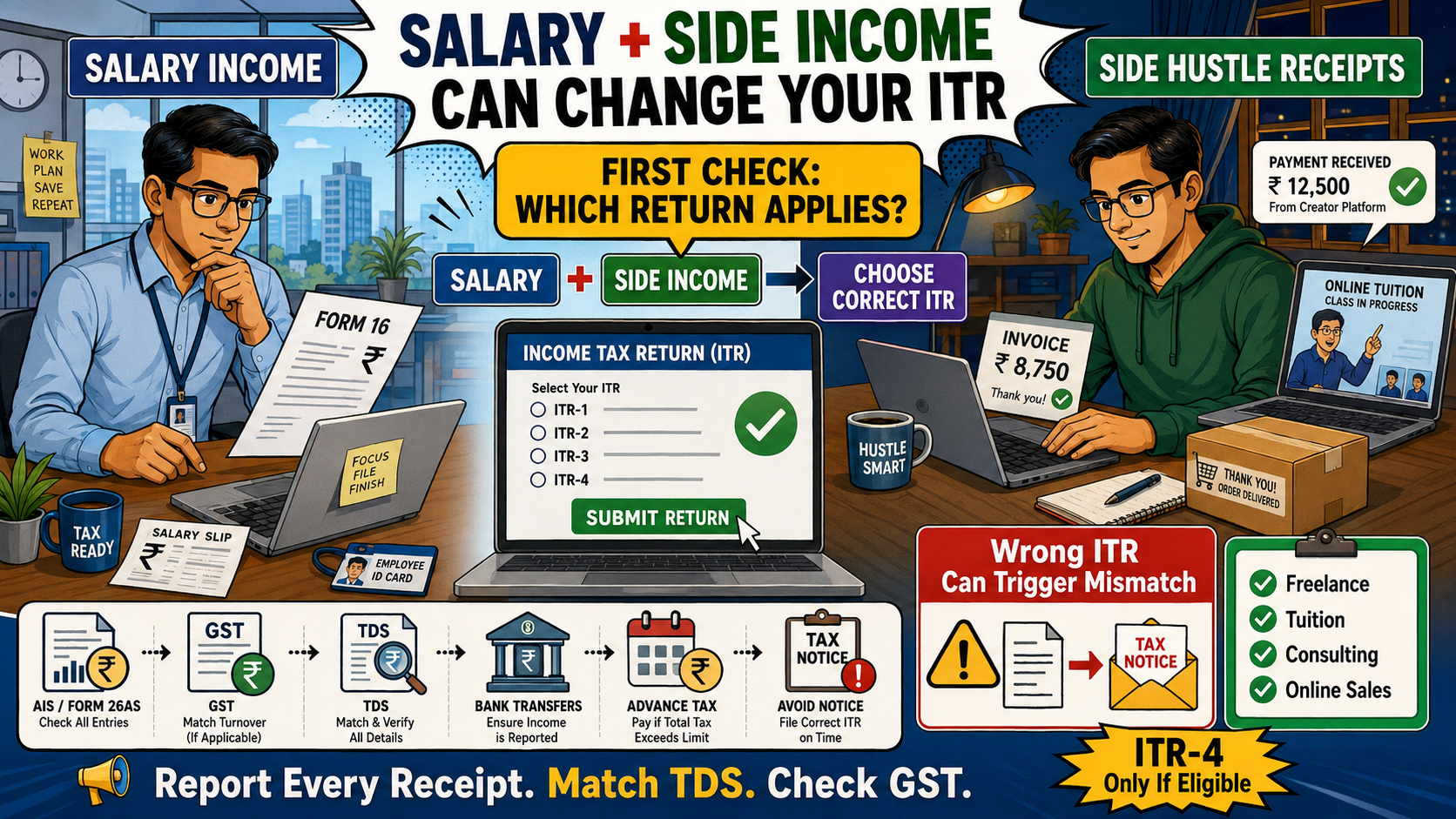
A growing number of salaried Indians now earn outside their jobs. The examples are familiar. A software employee takes weekend coding work. A school teacher runs paid classes. A designer creates logos after office hours. A finance employee writes paid content. A sales executive sells products online.
The tax issue begins when these receipts are treated as casual money. Under income tax filing, salary remains salary. Freelance, professional, business and tuition receipts may fall under profits and gains from business or profession. Once that happens, the return form, tax calculation and record-keeping may change.
This affects who can use ITR-4. The same official ITR-4 guidance says the form is not available to several categories, including non-residents, company directors and taxpayers whose total income exceeds ₹50 lakh. A person with short-term capital gains, foreign assets, business losses or other excluded income may also need another form.
That means the first question is not “how much tax is payable?” The first question is "Which return applies?” Many taxpayers reverse this order. That is where filing trouble starts.
Side income gets added to the taxpayer’s total income. If salary already places the person in a higher slab, even a modest side income can attract tax at the applicable slab rate. Employer TDS may not cover this extra amount unless the taxpayer discloses it to the employer or pays tax separately.
There is another layer. If tax payable after TDS crosses the advance tax threshold, the taxpayer may need to pay advance tax. Waiting until the final ITR filing date can bring interest and cash pressure. For a salaried person, this feels unfair at first, but the reason is basic: salary tax and side-income tax are not always deducted by the same payer.
The problem grows when clients deduct TDS on professional fees. Those entries can appear in tax records. If the taxpayer leaves out the related income, the return may not match the data already available with the department.
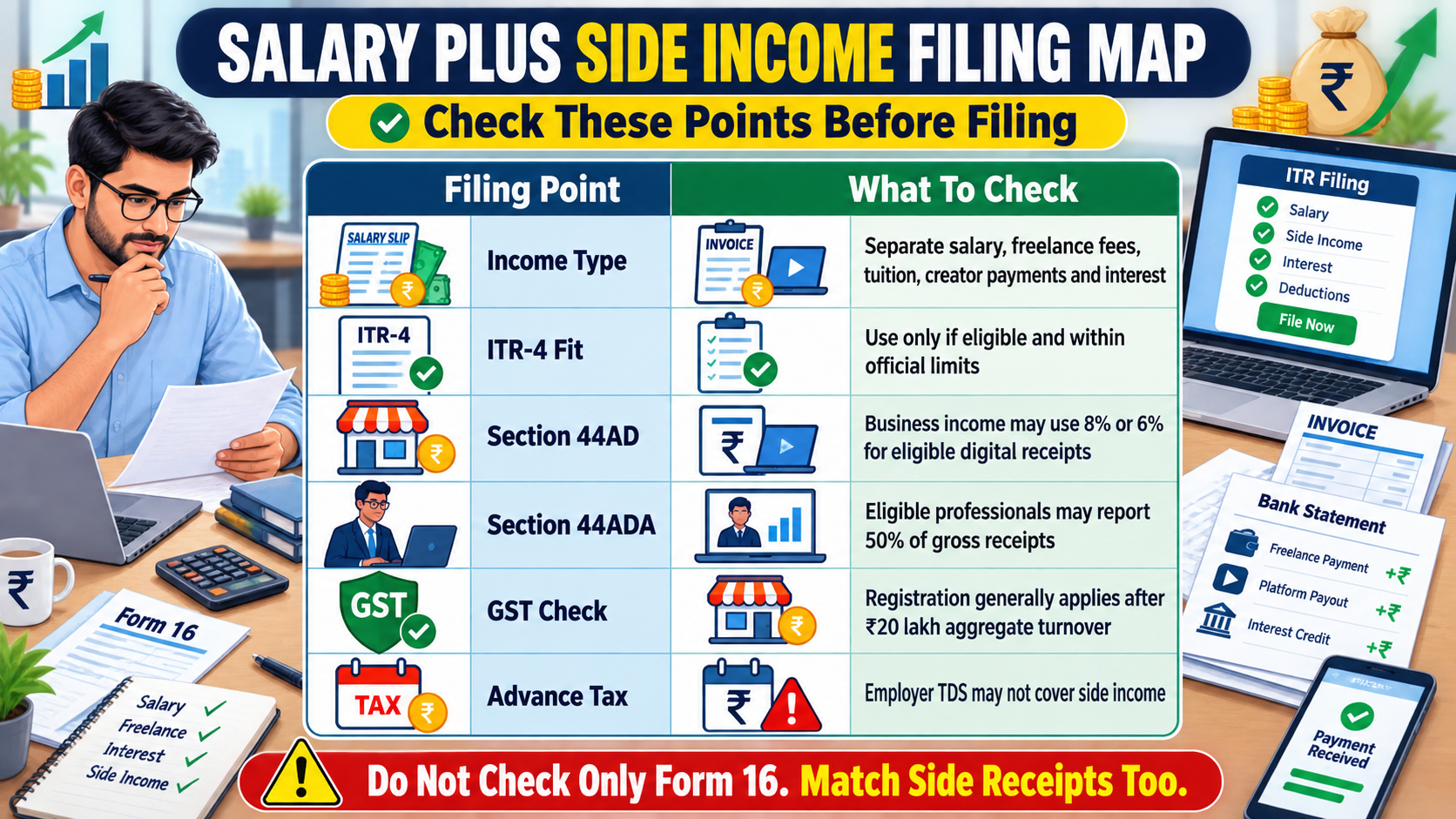
A taxpayer should check these points before filing. This is a first-level filter, not a substitute for a professional review.
This table helps salaried workers avoid a common mistake. They often check only their Form 16 and ignore side receipts. That approach can fail if outside income has already been reported by clients, banks or platforms.
For working Indians, the effect is both financial and procedural. Financially, side income can push up tax payable. Procedurally, it can move the taxpayer from a simple return to a business or professional return. That shift may require invoices, expense records, bank entries and TDS matching.
The positive side is that small earners do have legal routes. Presumptive taxation can reduce paperwork for eligible taxpayers. A low-expense consultant, tutor or digital professional may not need to maintain detailed books if Section 44ADA applies. A small eligible business may check Section 44AD. Still, the choice should be made after reviewing expenses, not by guesswork.
Families using side income for rent, EMIs or school fees should also plan cash flow. If the full side receipt is spent during the year, the tax due at filing time can hurt. Setting aside tax from every payment is boring advice. It works.
The legal route starts with classification. A taxpayer should first decide whether the side income is business income, professional income or income from other sources. After that, the person can compare presumptive taxation with actual profit.
Under Section 44AD, eligible business income can be calculated at 8% of turnover, or 6% for eligible digital receipts. Under Section 44ADA, eligible professionals can report 50% of gross receipts as taxable income. The Income Tax India page explains these presumptive options and their limits.
This may help people with low expenses. But it can hurt those with high costs. A content writer using a laptop and internet may prefer presumptive taxation. An online seller with stock, courier charges, returns, packaging, platform fees and ads may need actual books. Once presumptive taxation is chosen, extra business expenses cannot be claimed again.
LoansJagat’s editorial view, based on recurring reader queries on tax and credit planning, is that salaried borrowers often underestimate the timing problem. Extra income can improve loan eligibility, but unplanned tax outgo can disturb EMI planning. That is why side earners should estimate tax before taking larger repayment commitments.
Tax professionals usually advise 3 simple actions. Keep a separate bank account for side work, issue invoices where relevant, and check AIS or Form 26AS before filing. This is not fancy planning. It prevents basic mismatches.
A chartered accountant’s review becomes useful when receipts are high, GST may apply, foreign clients are involved, capital gains exist or the taxpayer wants to choose between old and new tax regimes. Business and professional taxpayers also need to be careful about regime selection rules, because switching options may not be as flexible as in simple salary cases.
The safer solution is early sorting. By March, a taxpayer should already know total side receipts, estimated tax, possible GST exposure and whether presumptive taxation is better than actual expenses. July filing then becomes a reporting exercise, not a scramble.
This is not a new tax on side hustles. The law already required income to be reported under the correct head. The latest relevance comes from AY 2026-27 filing guidance, wider use of digital payments and more salaried earners taking paid work outside their jobs.
The Income Tax Department’s ITR-4 guidance for AY 2026-27 confirms the income types and exclusions for the simplified form. The GST guidance also uses aggregate turnover across India for registration checks. So a person cannot treat each app, client or city separately while checking the threshold.
Earlier, many small cash-based side jobs stayed informal. Digital payments have changed that. Bank transfers, UPI receipts, platform records and TDS entries leave a trail. Filing should match that trail.
The taxpayer is the first stakeholder. Salary earners must report income correctly and choose the proper return. Employers remain responsible for salary TDS, but they may not know about outside income unless the employee discloses it through permitted channels.
Clients and platforms form the second group. They may deduct TDS on professional fees or generate payment records. Banks and payment systems create another layer of traceability.
The Income Tax Department and GST authorities are the official stakeholders. Their role is not to stop side income. Their role is to ensure that taxable income and taxable supplies are reported under the correct law.
Salary plus side hustle income can support a household, but casual filing can raise the final tax bill. The taxpayer should report all receipts, choose the right ITR, compare presumptive taxation with actual expenses, check GST rules and pay advance tax where needed.
For most salaried Indians, legal tax saving starts before the return is filed. Clean records, correct classification and early tax estimates reduce panic later. Risky shortcuts may look easy in July, but they can become costly after processing.
The person should separate salary and side receipts, check ITR eligibility, review TDS records and estimate tax before filing season.
Yes, but only if the taxpayer is eligible, income stays within limits and presumptive taxation conditions are met.
Yes. Freelance income is added separately and taxed according to the applicable income head and slab.
Yes, if the taxpayer uses actual profit calculation. Under presumptive taxation, extra expense claims are not allowed.
GST should be checked once aggregate turnover approaches ₹20 lakh, or earlier if special registration rules apply.









.png&w=3840&q=75)


