

By continuing, you agree to LoansJagat's Credit Report Terms of Use, Terms and Conditions, Privacy Policy, and authorize contact via Call, SMS, Email, or WhatsApp
Disclaimer: The information published on LoansJagat is intended for general informational and educational purposes only and should not be considered financial, legal, or investment advice. Interest rates, loan terms, statistics, and other data may change over time and may vary by lender or source. Please verify the latest information and consult a qualified financial advisor or the respective Bank/NBFC before making any financial decisions.
Subscribe Now
About the author

Arshathul Afia is a journalism graduate and fintech content writer with 4+ years of experience in digital publishing and research-led writing. She has written 200+ articles covering personal finance, lending, banking, digital payments, credit, insurance, and major financial developments in India. At LoansJagat, she focuses on simplifying complex fintech news, RBI updates, loan-related changes, policy developments, and industry trends for everyday readers. Her journalism background helps her approach stories with research, context, and clarity, while her SEO experience ensures content remains discoverable and relevant. She aims to make financial news easier to understand, practical, and useful for readers across India.
Related News
Simplify All Your Loans Into One Affordable EMI

Customers Served

Debt Consolidated

1200+ Reviews

Locations in India
Club all Loans & Credit Card Bills into Single EMI

Quick Apply Loan
Consolidate your debts into one easy EMI.

Takes less than 2 minutes. No paperwork.

10 Lakhs+
Trusted Customers

2000 Cr+
Loans Disbursed

4.7/5
Google Reviews

50+
Banks & NBFCs Offers
September brings tax payments, SGB exit windows and nomination changes, giving Indian taxpayers and investors several separate dates to check properly before the month closes.
India enters September 2026 with several financial deadlines affecting taxpayers, business owners, professionals and small investors. The month has 5 Sovereign Gold Bond premature redemption dates, the second advance-tax instalment on 15 September and the tax-audit report deadline on 30 September. Revised nomination rules for new single-holder demat accounts and mutual fund folios also apply from 1 September. The Income Tax Department confirms that audit reports for AY 2026-27 must be filed 1 month before the related 31 October ITR deadline.
Missing these dates carries different costs. A taxpayer may pay interest on an advance-tax shortfall. An SGB investor who misses the request period may have to wait for another permitted exit. Over time, the nomination rules could make investment transfers easier for families. Yet each date applies to a defined group, and the calendar alone cannot show who must act.
Most salaried taxpayers completed regular ITR filing by 31 July 2026, while eligible non-audit business and professional taxpayers had until 31 August. September shifts attention to advanced tax, audits and investment records. People earning rent, interest, professional fees or realised capital gains may still owe tax after TDS. They should estimate the gap before 15 September.
The calendar below keeps the main events together. It does not create a new obligation for every reader. Someone with no audit requirement, for example, does not need to file an audit report merely because 30 September appears in the tax calendar.
For households, nomination may offer the longest benefit. A nominee does not replace a legal heir, but the recorded name can reduce transmission paperwork. A single holder can nominate up to 3 people or record an opt-out.
The SGB dates need closer reading. The redemption date and the application deadline are not the same. By the time 4 of the September payment dates arrive, their submission windows will already be closed. That gap can catch an investor who only checks the maturity calendar and ignores the earlier request period.
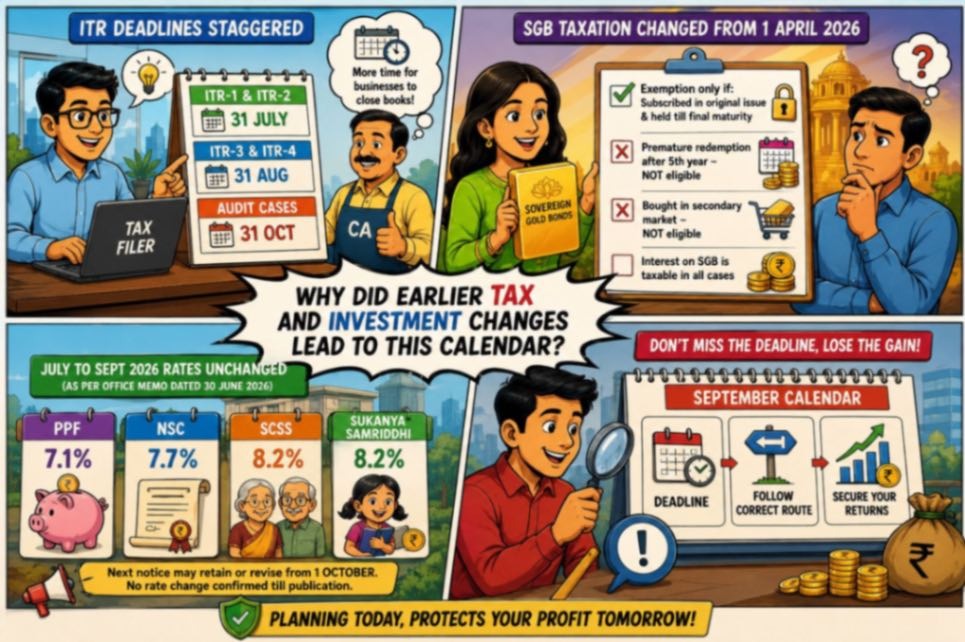
Budget 2026 staggered the ITR schedule. ITR-1 and ITR-2 filers generally retained 31 July, while eligible non-audit business or professional taxpayers filing ITR-3 or ITR-4 received time until 31 August. Audit cases kept on 31 October. The change gave small businesses longer to close their books, though it also caused confusion over categories.
SGB taxation changed from 1 April 2026 as well. The capital-gains exemption now applies only when an individual subscribed during the original issue and continued holding the bond until final maturity. Premature redemption after the fifth year does not satisfy that full-maturity condition. Bonds bought through the secondary market also fall outside the narrowed exemption. Interest paid on an SGB remains taxable, even when the final redemption gain qualifies for relief.
An earlier LoansJagat report on SGB premature redemption showed how issue price, interest receipts and the official exit value can produce very different results for the same holding. LoansJagat’s reading of the September calendar is straightforward: the biggest avoidable loss may come from confusing the payment date with the request deadline. A profitable bond is of little help to someone who misses the permitted route for cashing it early.
The Department of Economic Affairs kept July to September rates unchanged through an office memorandum dated 30 June 2026. PPF carries 7.1% and NSC 7.7%, while SCSS and Sukanya Samriddhi carry 8.2%. The next notice may retain or revise them from 1 October. Until publication, no rate change is confirmed.

Deepa Jain, an FCA and taxation adviser associated with Kavach, told Moneycontrol that “July 31 was never a universal deadline.” Her comment addresses a common filing error. A return date depends on the person’s income, form and audit requirement. Aarjav Jain, Executive Director and NRI tax specialist at Dinesh Aarjav & Associates, also advised taxpayers to examine business income, audit coverage and transfer-pricing exposure instead of choosing a deadline only from the name of an ITR form.
For 15 September, the estimate should include salary, professional income, rent, interest and realised gains available so far. TDS in Form 26AS and the Annual Information Statement should be checked first. If income changes later, the December and March calculations can be updated. Deliberately estimating too low may cost more after interest applies.
SGB holders have a shorter checklist. First, they should match the series in the certificate or demat statement with the notified September tranche. Next comes the request status, followed by the linked bank account and tax position. Those who bought in the secondary market, received bonds through a transfer or plan an early redemption should calculate the possible capital gain before approving the exit.
Demat and mutual fund investors should not rush nominations. Names, relationships and allocation percentages should match the holder’s plan. Joint holders must approve changes together. The nominee should also know where the records are kept.
September 2026 brings several financial dates, but they do not apply to everyone in the same way. SGB holders need to check both the redemption date and the earlier request window. Taxpayers should separate the 15 September advance-tax payment from the 30 September audit-report filing. New demat and mutual fund investors must also record a nomination choice from 1 September.
A short review before the first week ends is safer. Tax records, SGB details, nomination entries and bank accounts can be checked early. That leaves time to fix a mismatch before it becomes interest, a delayed filing or a missed redemption.
No. It is mainly the audit-report deadline for eligible AY 2026-27 cases. Their ITR is generally due on 31 October. Salaried filers largely had 31 July, while eligible non-audit business cases had 31 August.
Interest may apply to the shortfall. The taxpayer can pay later, but delay may raise the cost. The new estimate should account for TDS and tax already deposited.
No. The periodic interest is taxable as income. The capital-gains treatment at redemption is a separate calculation and now depends on how the bond was acquired and if it was held until final maturity.
No. The fifth year only opens the premature-redemption facility on specified interest-payment dates. The investor must submit a request during the announced window. Without that request, the bond continues unless it is sold through another permitted route.
The calculation uses estimated tax for the full year, while payment happens through cumulative instalments. By 15 September, an eligible taxpayer generally needs to cover 45% of the estimated annual liability after available credits and earlier payments.









.png&w=3840&q=75)


