Disclaimer: The information published on LoansJagat is intended for general informational and educational purposes only and should not be considered financial, legal, or investment advice. Interest rates, loan terms, statistics, and other data may change over time and may vary by lender or source. Please verify the latest information and consult a qualified financial advisor or the respective Bank/NBFC before making any financial decisions.
Subscribe Now
About the author

Arshathul Afia is a journalism graduate and fintech content writer with 4+ years of experience in digital publishing and research-led writing. She has written 200+ articles covering personal finance, lending, banking, digital payments, credit, insurance, and major financial developments in India. At LoansJagat, she focuses on simplifying complex fintech news, RBI updates, loan-related changes, policy developments, and industry trends for everyday readers. Her journalism background helps her approach stories with research, context, and clarity, while her SEO experience ensures content remains discoverable and relevant. She aims to make financial news easier to understand, practical, and useful for readers across India.
Related News
Simplify All Your Loans Into One Affordable EMI

Customers Served

Debt Consolidated

1200+ Reviews

Locations in India
Club all Loans & Credit Card Bills into Single EMI

Quick Apply Loan
Consolidate your debts into one easy EMI.

Takes less than 2 minutes. No paperwork.

10 Lakhs+
Trusted Customers

2000 Cr+
Loans Disbursed

4.7/5
Google Reviews

50+
Banks & NBFCs Offers
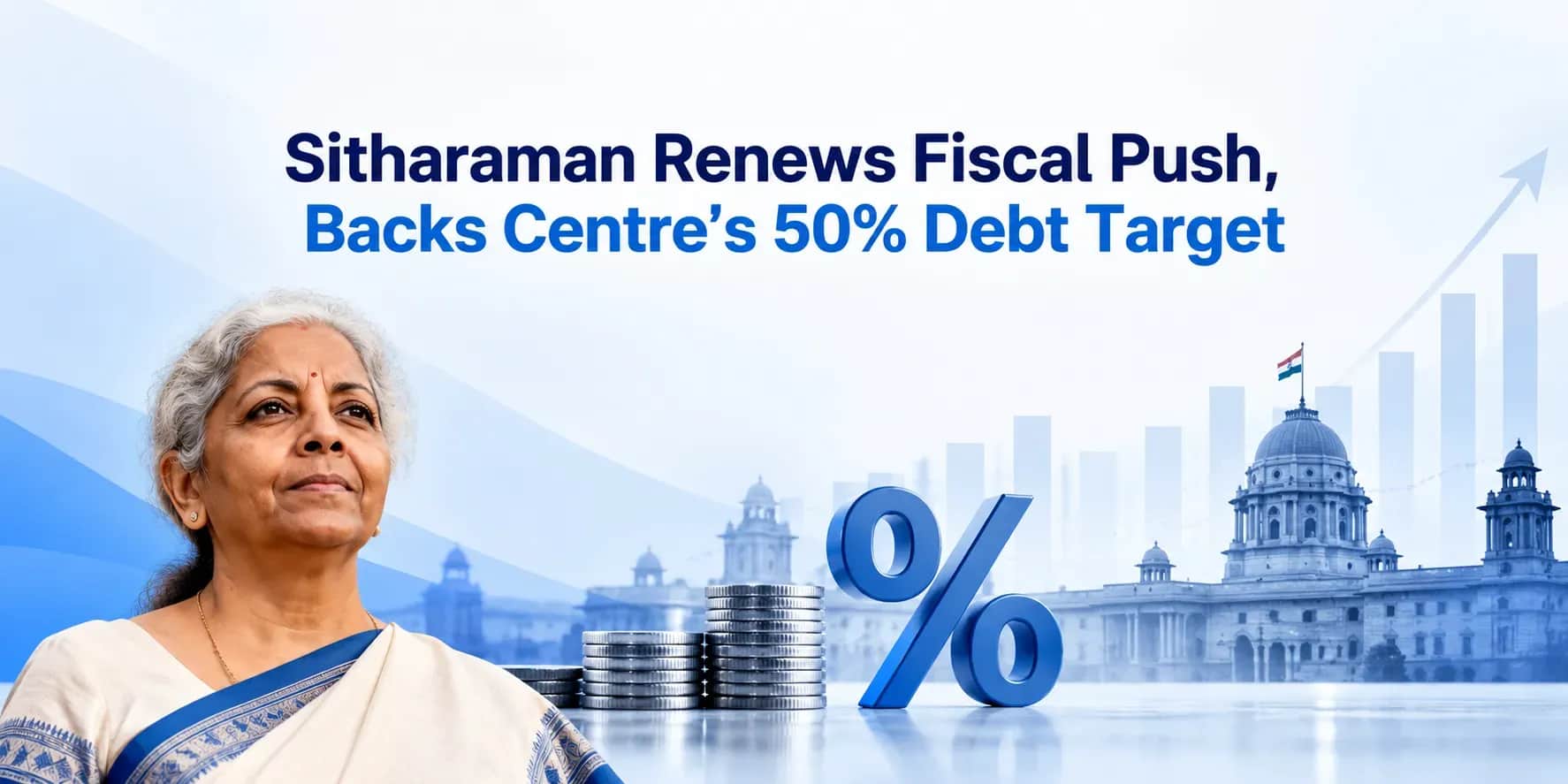
Sitharaman reaffirmed on 26 October 2026: the Centre targets debt of 50% of GDP by FY 2030–31, allowing a 1 percentage point variation on either side.
Key Highlights
Speaking to reporters in Tiruchirappalli on 26 October 2026, Finance Minister Nirmala Sitharaman cited annual budgets as evidence of the Centre’s efforts to bring down the fiscal deficit. The Union Budget Speech presented on 1 February 2026 places the Central government’s debt target at 50% of GDP by FY 2030–31. It permits a range of 49%–51%.
Sitharaman referred to reaching 50% “by 2030” during her Tiruchirappalli remarks. The published Budget sets the fuller deadline and scope. For households, the government’s stated benefit is gradual: a lower interest burden would release resources for priority expenditure.
The Centre’s policy connects debt reduction with its capacity to fund public priorities. In its release dated 1 February 2026, the Ministry of Finance said a declining debt-to-GDP ratio would gradually free resources by reducing interest outgo. That places public spending at the heart of the policy’s longer-term benefit.
Capital expenditure remains part of the same plan. The February 2026 Fiscal Policy Statements, paragraphs 37–38, pair debt reduction with continued investment and retaining funds to respond to global economic shocks. For households using public facilities and infrastructure, the government’s approach concerns both the sustainability of its finances and the expenditure those finances support.
For borrowers, the distinction is between the government’s balance sheet and a household’s loan contract. The 50% target measures Central government debt against economic output. For someone reviewing personal loan options, the calculation concerns repayments on a specific amount borrowed. The lender’s interest charges and the repayment period determine what is payable.
The Centre’s commitment concerns public finances over several financial years. It should not be read as a loan-pricing decision that lowers a borrower’s monthly repayments. The relevant benefit described in the Budget is greater capacity for priority spending as the interest burden eases. That is the connection to household finances supported by the policy document.
The International Monetary Fund’s release No. 25/392 of 26 November 2025 records its support for continued fiscal consolidation in India. It formed part of the 2025 Article IV consultation. Its Executive Board advised that the pace in FY 2026–27 should reflect the impact of tariffs on economic activity. This was an earlier assessment, separate from Sitharaman’s October remarks.
The IMF’s recommendations covered raising more domestic revenue and improving expenditure efficiency, with social protection directed more closely towards those it is intended to support. Debt servicing puts pressure on development budgets, particularly capital investment, the 16th Finance Commission warned. Read alongside the IMF’s advice, that concern puts the focus on collecting revenue and spending it effectively without squeezing investment needed for growth.
The Ministry of Finance’s release dated 1 February 2026 sets out the target alongside annual deficit estimates. These are the figures published with Budget 2026–27, with their original classifications retained.
The fiscal deficit is the gap between the government's total expenditure and its total receipts, excluding borrowings. Outstanding obligations accumulated over time make up debt. By managing the annual financing gap, the government seeks to bring down debt relative to GDP. The Budget identifies the fiscal deficit as an operational instrument for pursuing that goal.
The debt plan dates to Budget 2025–26 and spans FY 2026–27 to FY 2030–31. In the February 2025 Fiscal Policy Statements, the Centre examined how debt would change with different nominal growth rates and levels of fiscal consolidation. Budget 2026–27 followed the same framework.
Sitharaman’s October remarks reaffirmed this existing direction. After attending celebrations at Seethalakshmi Ramaswami College, she said the Centre had been working to reduce its fiscal deficit and debt burden. The formal framework continues to link annual deficit decisions with a declining Central government debt ratio.
The Centre’s commitment remains a debt ratio of around 50% by FY 2030–31, within the published tolerance band. Sitharaman has restated that commitment. Capital expenditure also remains part of the plan, together with retaining financial room for the government to respond to economic shocks.
The Centre targets debt of 50% of GDP, with a tolerance of 1 percentage point on either side. The deadline is FY 2030–31.
The Budget’s 50% target applies to Central government debt. Combining Central and State government liabilities produces a different debt figure, outside the scope of this target.
No. Sitharaman’s 26 October 2026 remarks repeated the commitment from Budget 2025–26. The government had already carried that roadmap into Budget 2026–27.
The ratio compares debt with economic output. The government’s roadmap also considers growth and fiscal consolidation, while the Finance Commission examines debt-servicing pressure.
The total amount shows outstanding obligations, while debt-to-GDP relates them to the economy’s size. The Centre’s published target uses the latter measure.
Start your journey today
Apply Now*T&C apply