
By continuing, you agree to LoansJagat's Credit Report Terms of Use, Terms and Conditions, Privacy Policy, and authorize contact via Call, SMS, Email, or WhatsApp
Disclaimer: The information published on LoansJagat is intended for general informational and educational purposes only and should not be considered financial, legal, or investment advice. Interest rates, loan terms, statistics, and other data may change over time and may vary by lender or source. Please verify the latest information and consult a qualified financial advisor or the respective Bank/NBFC before making any financial decisions.
Subscribe Now
About the author

Arshathul Afia
Arshathul Afia is a journalism graduate and fintech content writer with 4+ years of experience in digital publishing and research-led writing. She has written 200+ articles covering personal finance, lending, banking, digital payments, credit, insurance, and major financial developments in India. At LoansJagat, she focuses on simplifying complex fintech news, RBI updates, loan-related changes, policy developments, and industry trends for everyday readers. Her journalism background helps her approach stories with research, context, and clarity, while her SEO experience ensures content remains discoverable and relevant. She aims to make financial news easier to understand, practical, and useful for readers across India.
Related News
Simplify All Your Loans Into One Affordable EMI

Customers Served

Debt Consolidated

1200+ Reviews

Locations in India
Club all Loans & Credit Card Bills into Single EMI

Quick Apply Loan
Consolidate your debts into one easy EMI.

Takes less than 2 minutes. No paperwork.

10 Lakhs+
Trusted Customers

2000 Cr+
Loans Disbursed

4.7/5
Google Reviews

50+
Banks & NBFCs Offers
Smartphone financing has become extremely popular in Tier 2 India. High purchase prices of mobile phones and long payment terms have offered flexibility on how families purchase their next mobile phone.
In the short run, instalments let a buyer take home a better phone without paying the full price at once. The risk builds over time. A 24-month or 30-month commitment can outlive the excitement around a new device, while processing charges, missed-payment fees or interest may raise the final bill.
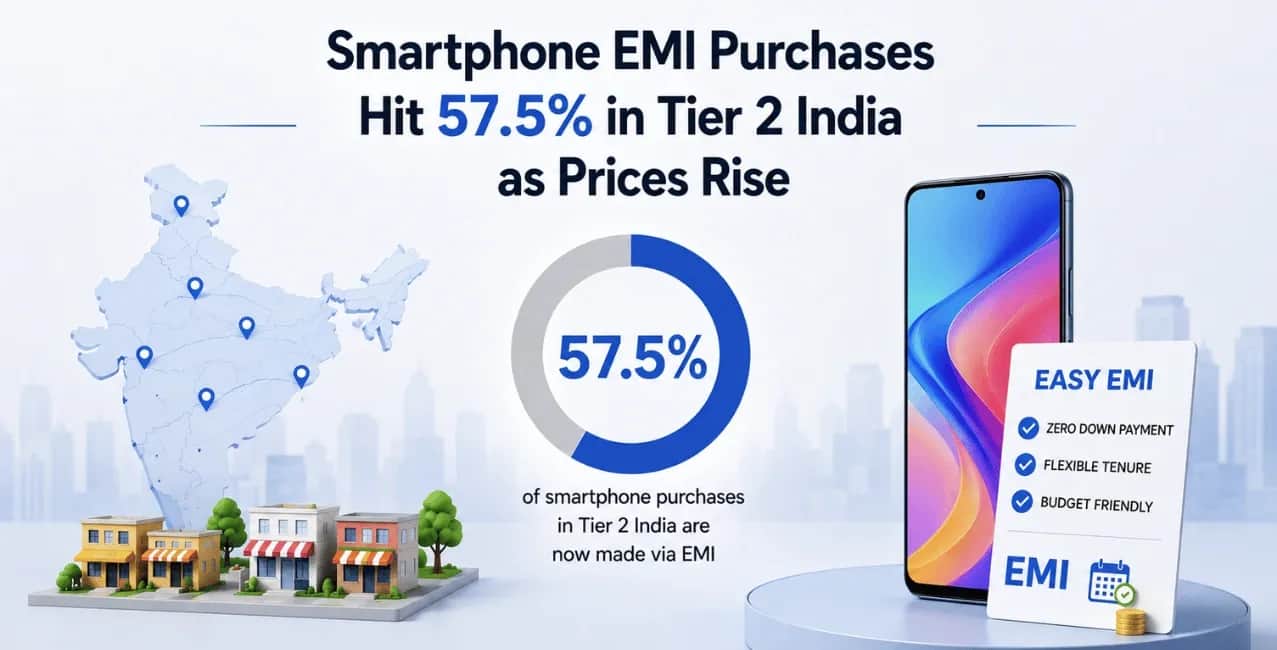
The share of financed Tier 2 purchases rose from 44% in Q2 2025 to 57.5% in Q2 2026. Tier 3 and smaller markets also moved above halfway, reaching 55% from 50%. Tier 1 increased at a slower pace, from 37% to 41%. Counterpoint Senior Analyst Prachir Singh linked the non-metro rise to wider NBFC coverage, demand for higher-value phones and more affordability offers from retailers and brands.
The channel definition needs attention. Mainline retail broadly refers to physical stores, where staff can assist with paperwork and connect shoppers to lenders. The 57.5% figure does not mean that the same share of every phone sold in Tier 2 India used EMI. Online financing remains lower. That difference explains why Counterpoint’s forecast for the full Indian market, across channels, is 42% during 2026.
Recent rises in component and memory prices have made phone prices jump. According to the Ministry of Statistics and Programme Implementation, inflation in June 2026 was at 4.38%. This is a large inflation rate carried over to a basket of goods, which doesn't include inflation for smartphones. Even though this is a loose analogy to the cost of phones, people don't have large, upfront, discretionary funds, so a plan that splits larger purchases into smaller monthly payments is more attractive.
Brands responded by stretching repayment periods, sometimes up to 30 months, and pairing them with bank cashback or exchange bonuses. Counterpoint Research Director Tarun Pathak said financing now focuses on “making monthly ownership more affordable." Apple’s average financed tenure reached 17.2 months, compared with the 10-month mainline average. Samsung led by the number of financed units, followed by Vivo and Apple.
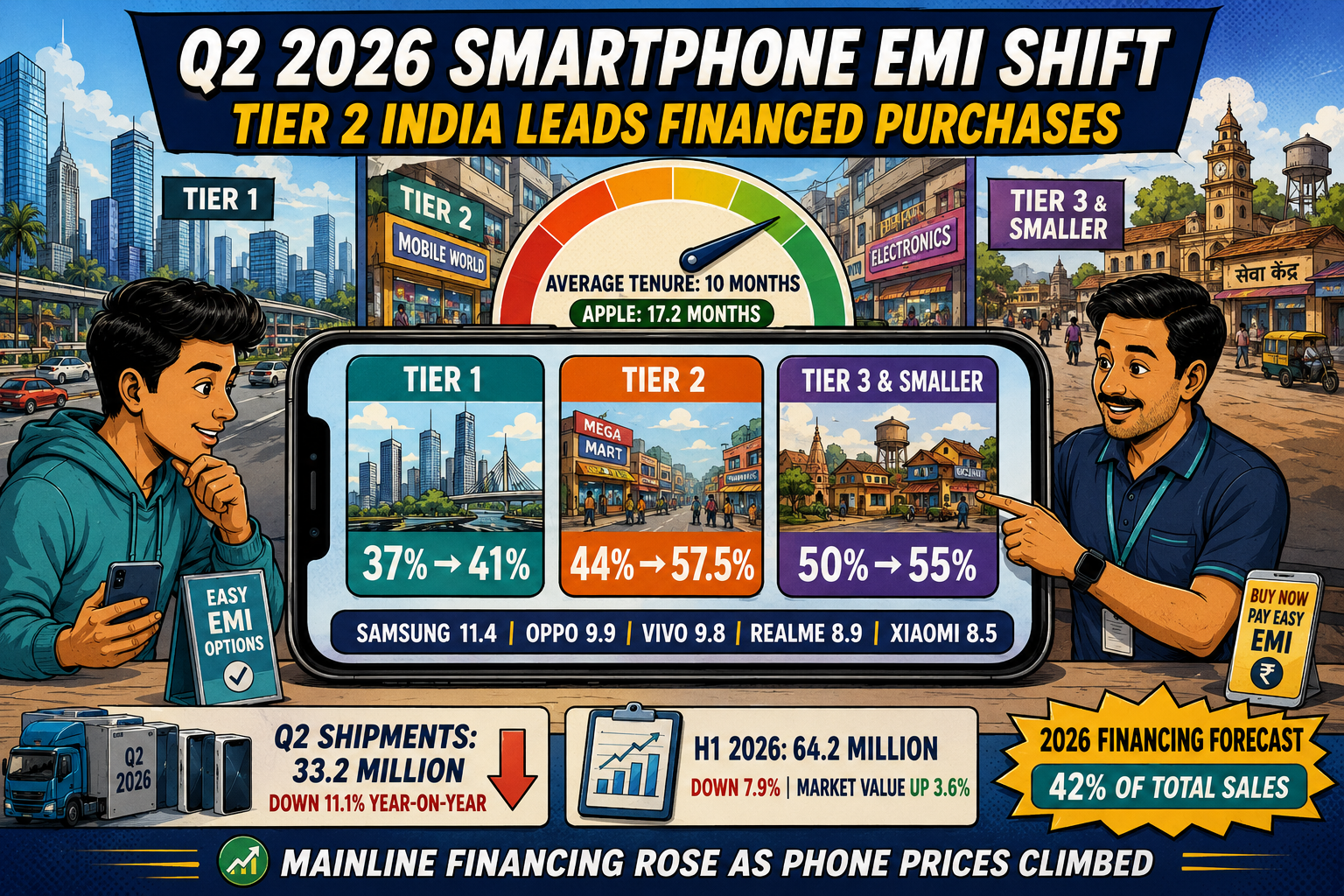
The figures below separate city-tier financing from shipment performance. Keeping those measures apart is important because financing penetration describes how purchases were paid for, while shipment data records devices entering sales channels.
IDC published its India shipment findings on 11 August 2026. Omdia’s separate release dated 21 July 2026 estimated 33.9 million Q2 shipments, down 13%. The totals differ because the firms use separate tracking methods. Both found weaker volumes as prices rose and buyers delayed upgrades.
Financing can widen access to phones with larger storage, stronger batteries and longer software support. A shop owner may use the device for payments and customer orders. A delivery partner needs reliable maps and mobile data throughout a shift. For these buyers, spreading the cost may be practical, particularly when the phone helps generate income and replaces an older device that has begun to fail.
There is another side. A buyer can focus on ₹3,000 a month and overlook the full repayment, lost cash discount or processing fee. Device value also falls during a long tenure. If the phone breaks or is stolen after 8 months, the installments continue. Buyers should compare the cash price with the complete EMI outgo, then check whether the tenure fits their income without depending on uncertain bonuses or overtime.
LoansJagat’s borrower-focused reading of the Counterpoint figures adds a useful comparison. The rise from 44% to 57.5% equals 13.5 additional financed purchases for every 100 Tier 2 mainline sales. Rounded to whole purchases, about 14 more buyers used credit than a year earlier. This is a calculation from Counterpoint’s published figures, not a separate LoansJagat survey. Its guidance on whether a longer tenure really makes an EMI cheaper also points buyers towards the total interest outgo, rather than the monthly instalment alone.
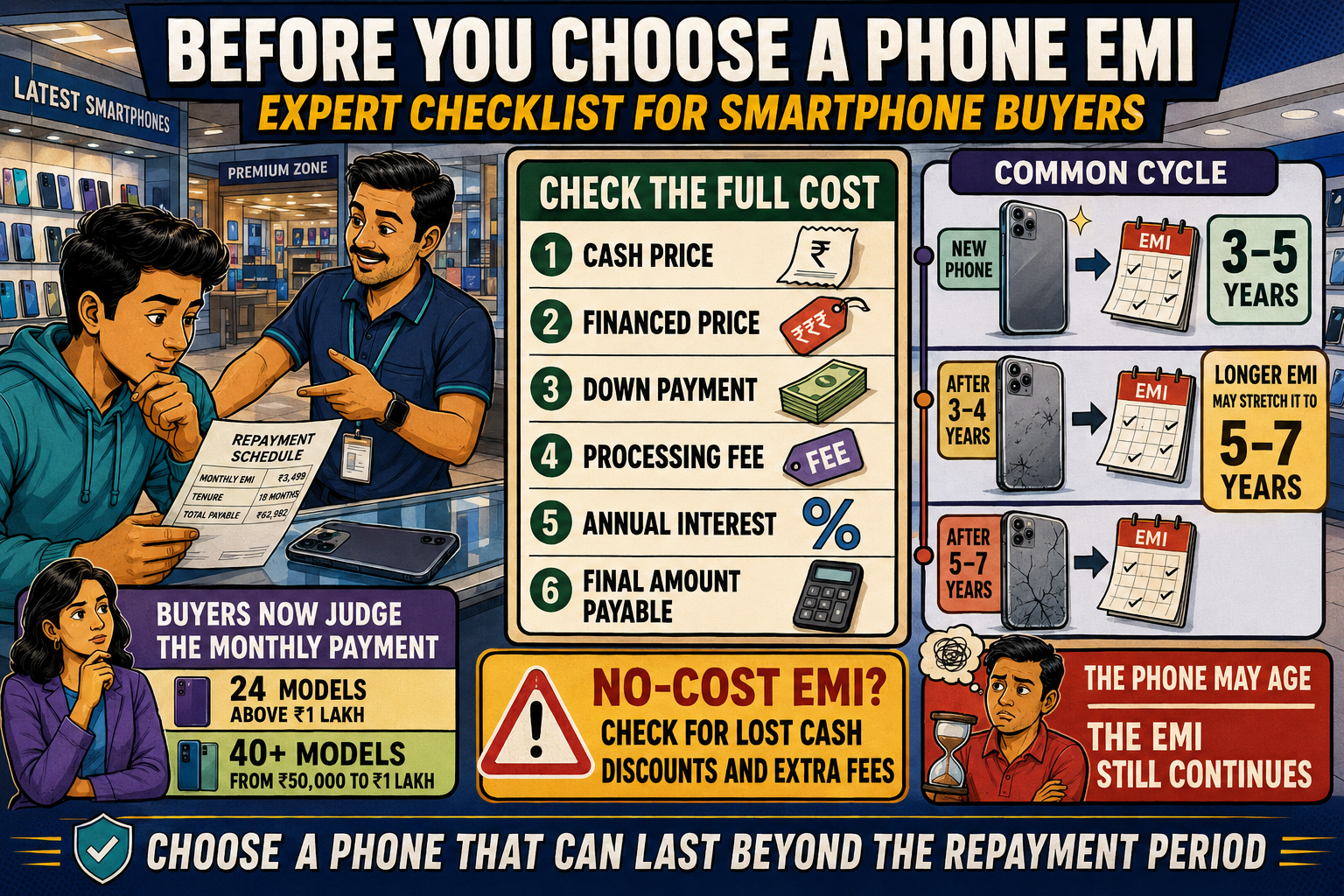
Pathak said customers increasingly judge affordability through the monthly payment. Singh added that NBFC expansion and stronger aspiration for costlier devices were driving Tier 2 growth. Techarc Founder and Chief Analyst Faisal Kawoosa told Business Standard, in its 11 August 2026 report, that India had 24 phone models priced above ₹1 lakh and more than 40 between ₹50,000 and ₹1 lakh. Longer plans have therefore become an important sales tool for premium brands.
The solution is fairly direct. Buyers should ask the retailer for the cash price, financed price, down payment, processing charge, annual interest and final amount payable. A “no-cost EMI” may remove a cash discount or carry a fee even when the interest is subsidised. If one missed instalment would disturb rent, food or school payments, the selected phone is probably too expensive for that household.
Kawoosa expects longer EMIs to delay replacement purchases because many customers will wait until the old loan ends. He suggested that some replacement periods could stretch towards 5 to 7 years, compared with a common 3-to-5-year range. The phone should remain serviceable for the full loan period.
India’s handset market was already losing momentum. IDC reported a 4.1% shipment decline in Q1 2026 before the Q2 fall deepened to 11.1%. Yet Q2 market value increased 3.6%, showing that higher-priced phones kept attracting spending even as fewer units moved. The average selling price reached $315, according to IDC’s 11 August release.
Domestic assembly has expanded, though imported and internationally priced parts still affect retail prices. A Press Information Bureau release dated 21 July 2026 said 99.2% of mobile phones used in India were manufactured domestically and finished-phone imports had fallen by about 77%. The government is also supporting local component capacity through the Ministry of Electronics and Information Technology’s Electronics Component Manufacturing Scheme. Local component output may reduce some overseas supply exposure over time, but it cannot reverse current handset prices overnight.
EMI funded 57.5% of Tier 2 mainline smartphone purchases in Q2 2026, a sharp rise from 44% one year earlier. Wider NBFC access and longer tenures helped buyers cope with higher prices while phone shipments fell.
The financing route works best when a buyer treats the final repayment as the real price. A smaller monthly figure can support a necessary purchase. It can also hide an expensive commitment. Cash price, fees, interest, tenure and expected device life should all be checked before the invoice is signed.
EMI financed 57.5% of purchases in the Tier 2 mainline retail channel, according to Counterpoint Research.
No. It refers to mainline retail, largely physical stores. Counterpoint expects a lower 42% share across all Indian sales channels in 2026.
Brands and lenders have started to extend EMI periods to as much as 30 months to accommodate longer payment periods for the high cost of smart devices.
Not always. EMI can fund a necessary work or study device, but the final repayment and fees must fit the buyer’s regular income.
It may work if no cash discount is lost and fees remain low. The phone should also last beyond the repayment period.









.png&w=3840&q=75)


