
By continuing, you agree to LoansJagat's Credit Report Terms of Use, Terms and Conditions, Privacy Policy, and authorize contact via Call, SMS, Email, or WhatsApp
Disclaimer: The information published on LoansJagat is intended for general informational and educational purposes only and should not be considered financial, legal, or investment advice. Interest rates, loan terms, statistics, and other data may change over time and may vary by lender or source. Please verify the latest information and consult a qualified financial advisor or the respective Bank/NBFC before making any financial decisions.
Subscribe Now
About the author

Arshathul Afia
Arshathul Afia is a journalism graduate and fintech content writer with 4+ years of experience in digital publishing and research-led writing. She has written 200+ articles covering personal finance, lending, banking, digital payments, credit, insurance, and major financial developments in India. At LoansJagat, she focuses on simplifying complex fintech news, RBI updates, loan-related changes, policy developments, and industry trends for everyday readers. Her journalism background helps her approach stories with research, context, and clarity, while her SEO experience ensures content remains discoverable and relevant. She aims to make financial news easier to understand, practical, and useful for readers across India.
Related News
Simplify All Your Loans Into One Affordable EMI

Customers Served

Debt Consolidated

1200+ Reviews

Locations in India
Club all Loans & Credit Card Bills into Single EMI

Quick Apply Loan
Consolidate your debts into one easy EMI.

Takes less than 2 minutes. No paperwork.

10 Lakhs+
Trusted Customers

2000 Cr+
Loans Disbursed

4.7/5
Google Reviews

50+
Banks & NBFCs Offers
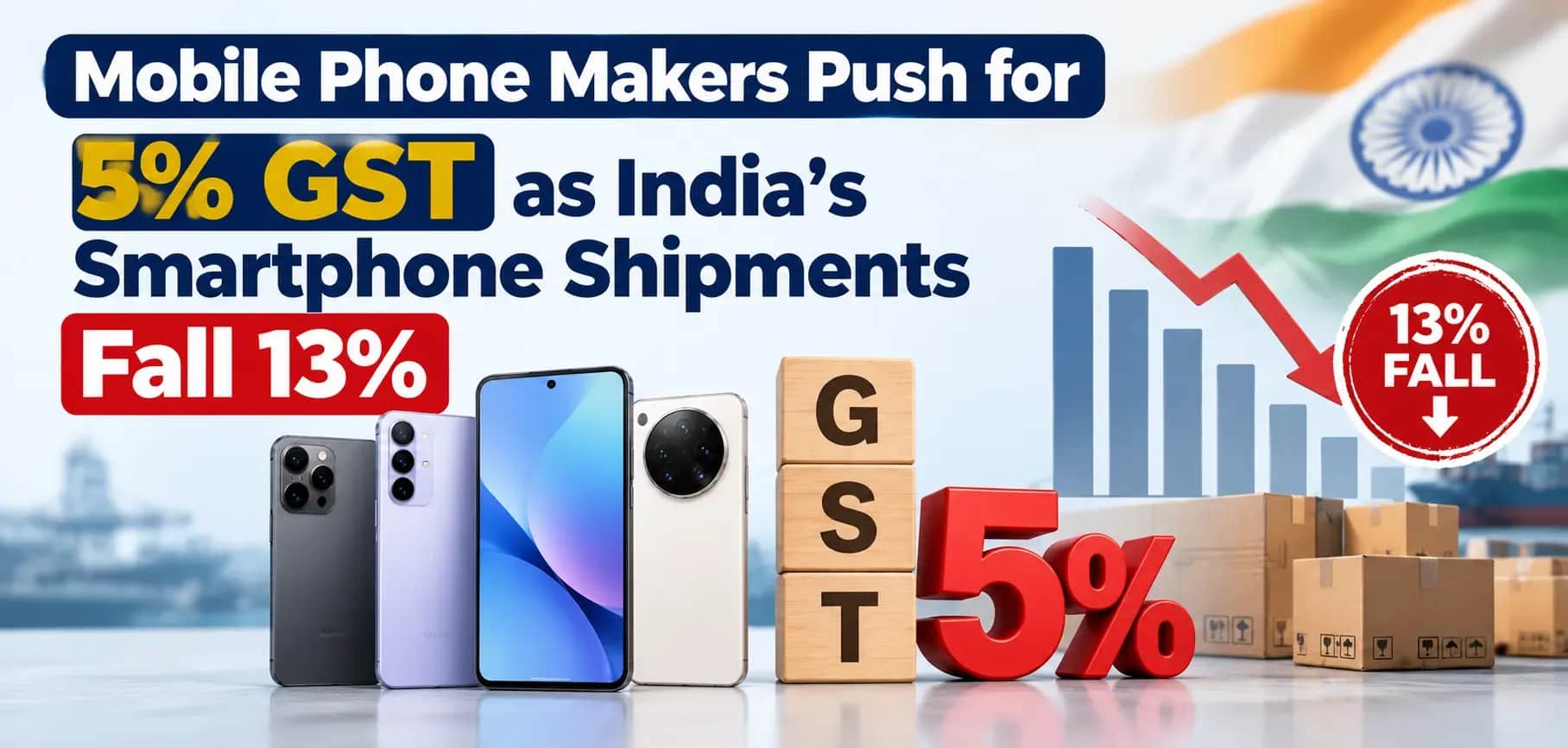
India’s mobile phone makers want GST cut from 18% to 5% as higher handset prices coincide with falling shipments; the government has not approved it.
Key Highlights
ICEA has asked for a sharp cut in the tax on mobile phones, from 18% GST to 5%. The industry group put that request in letters dated 2 and 3 September 2026 to Finance Minister Nirmala Sitharaman and Electronics and IT Minister Ashwini Vaishnaw, seeking a place for it on the GST Council’s agenda. ICEA represents makers including Apple, Xiaomi, Oppo, Vivo and Lava. A few weeks earlier, Omdia had reported that 33.9 million smartphones were shipped in India in the April-to-June quarter, 13% below the previous year. That measures phones sent into the market, rather than sales to buyers.
If the Council agrees and retailers pass on the reduction, a cheaper handset could reduce what households borrow. For now, shoppers face the existing tax and dearer hardware. When families postpone upgrades, local retailers also lose sales. A proposal offers no checkout discount.
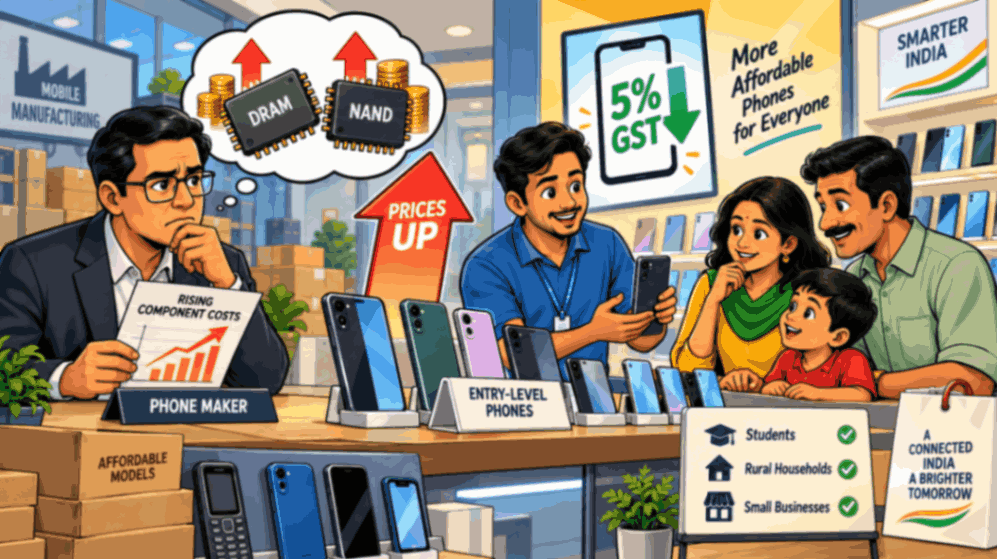
ICEA says its members are struggling to keep affordable models within reach. In representations reported on 14 September 2026, it said mobile DRAM and NAND flash memory prices had risen roughly 4 times since September 2025, partly because AI data centres were absorbing global supply. ICEA estimated entry-level handset prices had climbed 35% to 45% across brands. These are industry estimates, not a government price series or a measured rise for every model.
Memory goes into the cheapest phones too. As chip costs push up the pre-tax price, the GST amount rises with it. ICEA says smartphones below ₹10,000 now account for less than 5% of supply, though it did not specify the denominator. It wants component GST reviewed too, since mismatched rates can complicate manufacturers’ input tax credit. First-time buyers and rural households stand to gain from affordable entry-level stock if it returns to shops.
There is a cost to waiting. A parent using an ageing feature phone may struggle with a school form that requires an app, while a shopkeeper could lose access to a payment service when an older handset stops working. A cheaper smartphone would ease those purchases if available nearby. The tax cut cannot force brands to restore a withdrawn model.
For a household, the price at the counter counts. The table holds a phone’s pre-tax price at ₹20,000. This is an illustration, not a retail quote or announced cut.
The ₹2,600 difference assumes the pre-tax price stays unchanged and sellers pass on the entire cut. A 13-point reduction in GST is not a 13% discount on today’s sticker price. Rising chip costs could offset some, or all, of the tax saving. Buyers would need the final invoice to see what reached them.
Borrowers could gain too. Financing the whole ₹23,600 purchase today, against a conditional ₹21,000 purchase later, would reduce principal by ₹2,600 on identical terms. Interest might fall; tenure, rate and charges decide how much. A no-cost EMI might involve a processing fee or lost cash discount. The total repayable amount tells the fuller story.
That comparison protects shoppers against a misleading offer. An exchange bonus depends on the condition of the old phone. Cashback may arrive only after payment. Someone borrowing for the full bill cannot treat a later refund as cash at checkout. If tax changes, buyers should inspect both the pre-tax price and the payable total before accepting finance.
Phone prices rose, and many buyers kept their old devices longer. Omdia’s 21 July 2026 release points to dearer handsets, a weaker rupee and strained household budgets behind the shipment decline. Principal analyst Sanyam Chaurasia said brands were narrowing their entry-level ranges. He recommended exchange deals, cashback and financing to help buyers afford an upgrade. Those offers can ease the payment at checkout, though the higher cost of memory chips remains.
The slowdown had appeared in shops earlier. Counterpoint Research reported on 30 March 2026 that smartphone retail sales fell 9% in the first 9 weeks of 2026. Its senior research analyst Prachir Singh cited repeated price increases, fewer launches and limited promotions. More than 8 brands had raised prices on selected models by roughly ₹1,500 on average. Counterpoint counted sales to buyers; Omdia counted shipments into the market. Their figures describe different parts of the same difficult year for phone makers.
ICEA argues that higher sales, more purchases in formal channels and GST on digital services might offset tax revenue lost per handset. It has not supplied a verified recovery figure. The Council would have to weigh that forecast against revenue for the Centre and states and the price paid by first-time buyers.
Phones entered the 12% GST slab in July 2017. ICEA estimates the weighted average pre-GST handset tax at around 7%, though states differed. The GST Council’s 39th meeting, recorded in its 14 March 2020 release, recommended an increase from 12% to 18% effective 1 April 2020 to correct an inverted duty structure involving components.
ICEA requested 12% on phones and 5% on components in 2021, then pursued handset relief during 2025 restructuring. Phones remained at 18%. A government news account dated 21 September 2025 recorded Commerce Minister Piyush Goyal urging businesses to pass tax reductions to consumers. He was discussing that year’s reforms, not the September 2026 request.
The Ministry of Electronics and IT reported on 15 July 2026 that phone production reached ₹6.27 lakh crore in FY2025-26 against ₹18,900 crore in FY2014-15. Exports rose from ₹1,566 crore to ₹2.60 lakh crore. Those government figures show manufacturing success, not a rise in Indian household purchases. That gap underpins ICEA’s domestic-demand argument.
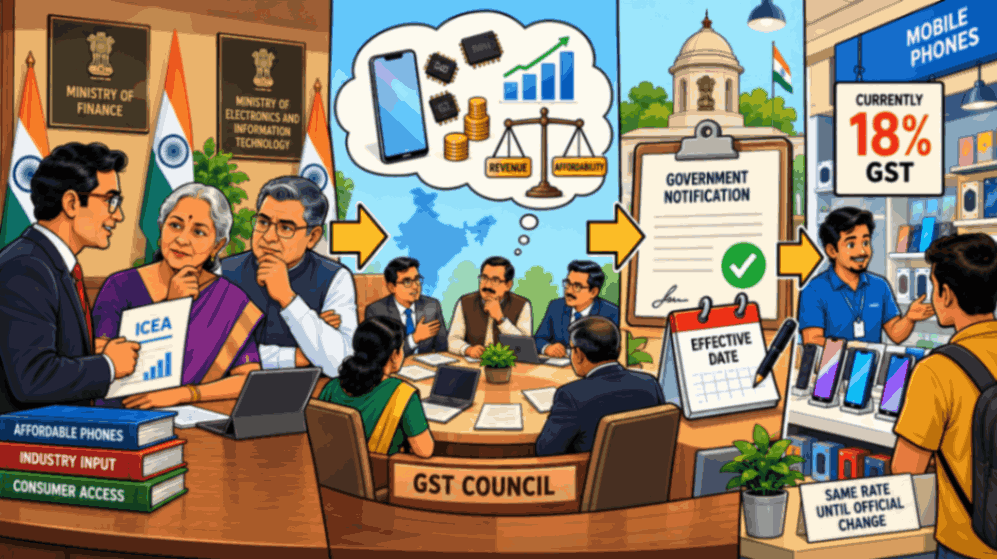
The GST Council must recommend any rate change before the government can notify it. Sitharaman and Vaishnaw can consider ICEA’s letters, but neither letter sets the rate. A related 2025 LoansJagat news account explained the Council’s role in a different GST proposal. That distinction applies here too: ministerial consideration and an approved rate are 2 separate steps.
The Council would need to examine component tax and central and state collections. It might seek evidence about budget handsets and whether higher sales would compensate for a lower tax per phone. A government notification would set any effective date. Until then, retailers must continue charging the existing 18% rate.
Higher entry-level prices and falling shipments have given phone makers a case for lower GST. The rate remains 18%. Households need a Council decision, an effective date and a lower invoice before counting any savings. A tax cut without a cheaper final phone would miss its intended buyer.
No. As of 15 September 2026, the handset rate remains 18%. ICEA requested 5% in letters dated 2 and 3 September, and the GST Council has not announced an approved cut. A promotional message about a future discount does not change the tax shown on a present-day bill.
No. The ₹2,600 difference in the table applies only to a handset with an unchanged ₹20,000 pre-tax price and full pass-through from 18% to 5%. Different models have different base prices, and higher component costs could absorb part of any tax saving.
A cheaper final price can reduce the amount financed if the buyer takes the same loan on the same terms. It does not require lenders to cut interest rates. The actual EMI and total interest depend on the amount borrowed, tenure, rate, fees and any discount lost by choosing instalments.
GST is charged on the pre-tax price. Moving from 18% to 5% changes the tax by 13 points of that base price, while the sticker price already includes the original tax. The seller’s base price could change too. Buyers need the final invoice to calculate their real saving.
A personal buyer cannot claim a GST refund simply by purchasing a phone. An eligible GST-registered business may be able to claim input tax credit on a genuine business purchase, subject to invoice, business-use and other GST requirements. A proposed change in the handset rate does not remove those conditions.









.png&w=3840&q=75)


