
By continuing, you agree to LoansJagat's Credit Report Terms of Use, Terms and Conditions, Privacy Policy, and authorize contact via Call, SMS, Email, or WhatsApp
Disclaimer: The information published on LoansJagat is intended for general informational and educational purposes only and should not be considered financial, legal, or investment advice. Interest rates, loan terms, statistics, and other data may change over time and may vary by lender or source. Please verify the latest information and consult a qualified financial advisor or the respective Bank/NBFC before making any financial decisions.
Subscribe Now
About the author

Arshathul Afia
Arshathul Afia is a journalism graduate and fintech content writer with 4+ years of experience in digital publishing and research-led writing. She has written 200+ articles covering personal finance, lending, banking, digital payments, credit, insurance, and major financial developments in India. At LoansJagat, she focuses on simplifying complex fintech news, RBI updates, loan-related changes, policy developments, and industry trends for everyday readers. Her journalism background helps her approach stories with research, context, and clarity, while her SEO experience ensures content remains discoverable and relevant. She aims to make financial news easier to understand, practical, and useful for readers across India.
Related Blog Post
Simplify All Your Loans Into One Affordable EMI

Customers Served

Debt Consolidated

1200+ Reviews

Locations in India
Club all Loans & Credit Card Bills into Single EMI

Quick Apply Loan
Consolidate your debts into one easy EMI.

Takes less than 2 minutes. No paperwork.

10 Lakhs+
Trusted Customers

2000 Cr+
Loans Disbursed

4.7/5
Google Reviews

50+
Banks & NBFCs Offers
Other services mentioned in this article
SS Retail’s IPO drew 13.75 times bids on Day 3 as its ₹137 grey premium raised hopes of a strong September 23 stock market debut.
Key Highlights
SS Retail’s 3-day initial public offering entered its final session on September 18 with a sudden rise in applications. Bidding data at 11:11 AM showed 13.75 times subscription, up from 5.78 times at the end of September 17. The Kolhapur-based mobile and electronics retailer offered shares at ₹403 to ₹424 through a public issue containing fresh shares and an offer for sale.
Non-institutional and retail applicants drove the rush. In the short term, high subscription reduces the probability of retail allotment and puts more attention on the September 23 debut. Over the longer run, SS Retail must show that its store expansion can produce cash and protect thin retail margins. A high opening price may reward successful applicants, though a weaker-than-expected debut could lead to early selling.
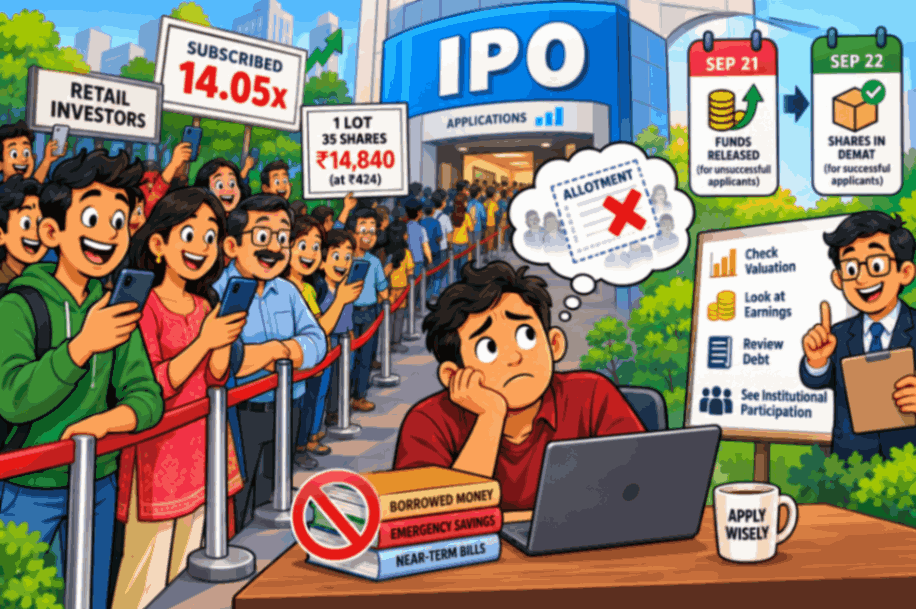
The retail category was subscribed 14.05 times by 11:11 AM on September 18. One application lot contained 35 shares, which required ₹14,840 at the upper price of ₹424. With applications far above the shares reserved for retail bidders, a large number of valid applicants may receive no allotment.
Oversubscription does not allow the company to issue extra shares beyond the approved offer. The registrar must follow the prescribed allotment process. Unsuccessful bidders should receive the release of their blocked funds after allotment, expected on September 21. Shares are due to reach successful applicants’ demat accounts on September 22.
For a household investor, the immediate effect is fairly direct. The application amount stays blocked for several days, yet the chance of receiving shares falls as demand climbs. That makes borrowed money, emergency savings or funds kept for near-term bills unsuitable for a speculative IPO application.
A March 26, 2025 investment guide published by LoansJagat advises readers to examine valuation, earnings, debt and institutional participation before applying. Its view fits this offer closely. A 13.75 times subscription figure shows heavy demand, but it does not show whether ₹424 is an attractive price for the underlying business.
Swastika Investmart gave the offer a neutral view on September 16. The brokerage calculated a valuation of approximately 46.5 times FY2026 earnings and said much of the expected operational growth appeared priced in. It also flagged the company’s high dependence on mobile phone sales, a category that generally produces narrower margins than larger consumer appliances.
SBI Securities recommended subscribing at the cut-off price. Its assessment referred to SS Retail’s revenue growth, store additions, improving store economics, rising contribution from higher-margin products and healthy return ratios. The opposing views leave investors with a simple task: compare the business performance with the price being demanded, rather than treating the GMP as a substitute for research.
The 4 metrics to be considered after listing are: same-store sales, inventory turnover, operating cash flow, and rate of store closures. Sales can increase rapidly with store expansion. Profitability and long-term growth can be challenged with increased levels of inflation and expansion.
The red herring prospectus dated September 8, 2026, and filed on September 9, describes a public offer of approximately ₹500 crore. The issue combines fresh equity of up to ₹360 crore with an offer for sale of up to ₹140 crore. Only the fresh-issue amount goes to SS Retail. The OFS proceeds go to existing shareholders selling their holdings.
The main offer details are placed below for quick reading. The subscription figure is the intraday position at 11:11 AM on September 18, not the final closing number.
SS Retail plans to use ₹241.35 crore from the net proceeds for incremental working capital during FY2027 and FY2028. Another ₹12.45 crore is proposed for store fit-outs, covering furniture, office equipment and technology systems. The remaining amount will support general corporate requirements within the limit stated in the offer document.
The working-capital allocation tells its own story. Mobile and electronics retailers must keep new models available across stores without holding ageing devices for too long. Inventory loses appeal quickly when manufacturers release updated phones or cut prices on older models.
The grey market premium moved sharply before the offer closed. It was reported at ₹80 on September 11 and rose to ₹140 by September 14. The premium slipped to ₹128 on September 15, dropped to ₹90 on September 16 and then recovered to ₹137 on September 17. The September 18 reference reading remained ₹137.
Adding ₹137 to the ₹424 cap price produced an implied price of ₹561. That calculation represented an informal premium of 32.31%. It was not an exchange-traded quote, an offer-document projection or a promised return.
Grey-market transactions take place outside recognised stock exchanges. Dealer quotes, demand, available supply and wider market movement can change the premium within hours. The actual listing price will come through the exchange price-discovery process on September 23.
By the end of September 17, the IPO received bids for 5.78 times the shares. Retail investors bid 7.55 times, NIIs 9.91 times, employees 0.86 times and QIBs 0.23 times. Later, on the same day, bids climbed to 13.75 times. This strong investor interest was mainly for the shares allotted on Day 3.
Prior to the public bidding process, SS Retail allotted 34.52 lakh shares to anchor investors at ₹424 each and raised ₹146.21 crore. The public offer was open for bids between September 16 and 18.
The company had 503 stores as of March 2026, as against 347 stores as of March 2025. The company is in the business of selling new and pre-owned mobile phones, accessories, consumer durables (television, laptop & tablet), etc. As of now, it has its operations in Maharashtra, Goa, Karnataka and Madhya Pradesh. It started operations in Gujarat during FY2027.
The revenue for FY2025 and FY2026 was ₹1,597.93 crore and ₹2,351.03 crore, respectively. The PAT for the said period was ₹39.86 crore and ₹59.28 crore, respectively. The margin for FY2026 was 2.52%.
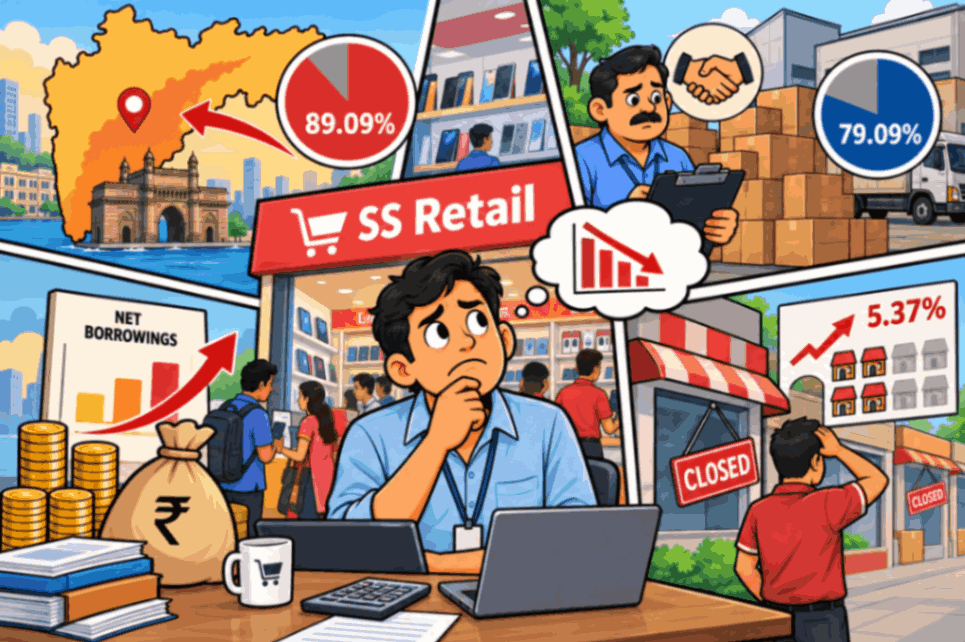
Maharashtra accounts for 89.09% of total revenues for FY2026, and the top 10 supplier accounts for 79.09% of total purchases. Consequently, any disruption in supply from major suppliers or softness in handset/Maharashtra market demand may rapidly impact the business.
Net borrowings increased from ₹125.36 crore in FY2025 to ₹162.59 crore in FY2026. The improvement in cash outflow from operations to ₹32.52 crore from ₹1.42 crore in the previous year is positive. However, with the ongoing business strategy, cash outflows are expected to remain high due to the need for working capital for the inventory and the outlets.
The closure rate of the outlets also increased to 5.37% from 3.46% in the previous year. While failure of the overall strategy to expand the business may be evident from the overall store closure, it may not be appropriate to come to such conclusions based on individual store performance. For example, it may be necessary for a newly opened store to achieve break-even or profits to justify the location.
SS Retail’s 13.75 times intraday subscription and ₹137 GMP created a busy final bidding day. NIIs supplied the largest share of demand, while retail applications moved well beyond the reserved portion.
Allotment is expected on September 21, followed by refunds and share credits on September 22. The September 23 listing will test the grey-market estimate. After that, store productivity, inventory movement, cash generation and margins will decide whether the expansion supports the price investors paid.
The issue was subscribed 13.75 times by 11:11 AM on September 18, 2026. This was an intraday figure, not the final closing subscription.
A ₹137 GMP added to the ₹424 cap price indicated an informal price of ₹561. The estimate did not guarantee a 32.31% listing gain.
The company expects to finalise allotment on September 21. Share credits are scheduled for September 22, followed by the proposed BSE and NSE listing on September 23.
No. An early application may avoid last-minute payment trouble, but allotment follows the approved process after subscription closes.
No. GMP is unregulated and may change quickly. Investors should also examine valuation, profit margins, debt, cash flow and business concentration.








.png&w=3840&q=75)


