
By continuing, you agree to LoansJagat's Credit Report Terms of Use, Terms and Conditions, Privacy Policy, and authorize contact via Call, SMS, Email, or WhatsApp
Disclaimer: The information published on LoansJagat is intended for general informational and educational purposes only and should not be considered financial, legal, or investment advice. Interest rates, loan terms, statistics, and other data may change over time and may vary by lender or source. Please verify the latest information and consult a qualified financial advisor or the respective Bank/NBFC before making any financial decisions.
Subscribe Now
About the author

Arshathul Afia
Arshathul Afia is a journalism graduate and fintech content writer with 4+ years of experience in digital publishing and research-led writing. She has written 200+ articles covering personal finance, lending, banking, digital payments, credit, insurance, and major financial developments in India. At LoansJagat, she focuses on simplifying complex fintech news, RBI updates, loan-related changes, policy developments, and industry trends for everyday readers. Her journalism background helps her approach stories with research, context, and clarity, while her SEO experience ensures content remains discoverable and relevant. She aims to make financial news easier to understand, practical, and useful for readers across India.
Related News
Simplify All Your Loans Into One Affordable EMI

Customers Served

Debt Consolidated

1200+ Reviews

Locations in India
Club all Loans & Credit Card Bills into Single EMI

Quick Apply Loan
Consolidate your debts into one easy EMI.

Takes less than 2 minutes. No paperwork.

10 Lakhs+
Trusted Customers

2000 Cr+
Loans Disbursed

4.7/5
Google Reviews

50+
Banks & NBFCs Offers
Other services mentioned in this article
TFCI’s FY27 loan plan signals stronger hospitality credit demand as smaller Indian cities, religious travel and rising hotel costs reshape tourism-linked borrowing across lenders.
TFCI is aiming for loan sanctions of nearly ₹3,000 crore in FY27, and the push is coming at a time when hotel demand is no longer limited to the usual big-city markets. Smaller cities, pilgrimage belts and leisure destinations are now drawing more hotel projects. Mint reported this on 27 July 2026, quoting Anoop Bali, TFCI’s Managing Director and Chief Financial Officer. The company had already crossed ₹2,000 crore in sanctions in FY26. So, FY27 is being planned as a stronger lending year for the tourism financier.
The short-term impact can be seen in hotel funding. More credit may help developers build resorts, branded hotels and travel-linked properties in places where demand has grown faster than room supply. In the long term, this can support jobs, local transport, restaurants and small service businesses. The weak spot is cost. Bali said hotel construction costs have risen 15-20%, and that can strain projects before they start earning regular revenue.

For Indian travellers, the impact may show up in places where hotel choice is still thin. A family visiting a temple town, a sales team travelling to an industrial district, or a wedding group booking rooms in a smaller leisure market often faces limited supply during busy months. Fresh hotel finance can add rooms in such locations, though it will take time before new projects open.
The larger travel base supports the lender’s view. The Ministry of Tourism dashboard shows 4,287 million domestic tourist visits in 2025, with 45.55% year-on-year growth. That number explains why hotel finance is shifting beyond Mumbai, Delhi, Bengaluru and Goa. Domestic travellers are driving demand through short holidays, pilgrimage routes, work trips and family functions.
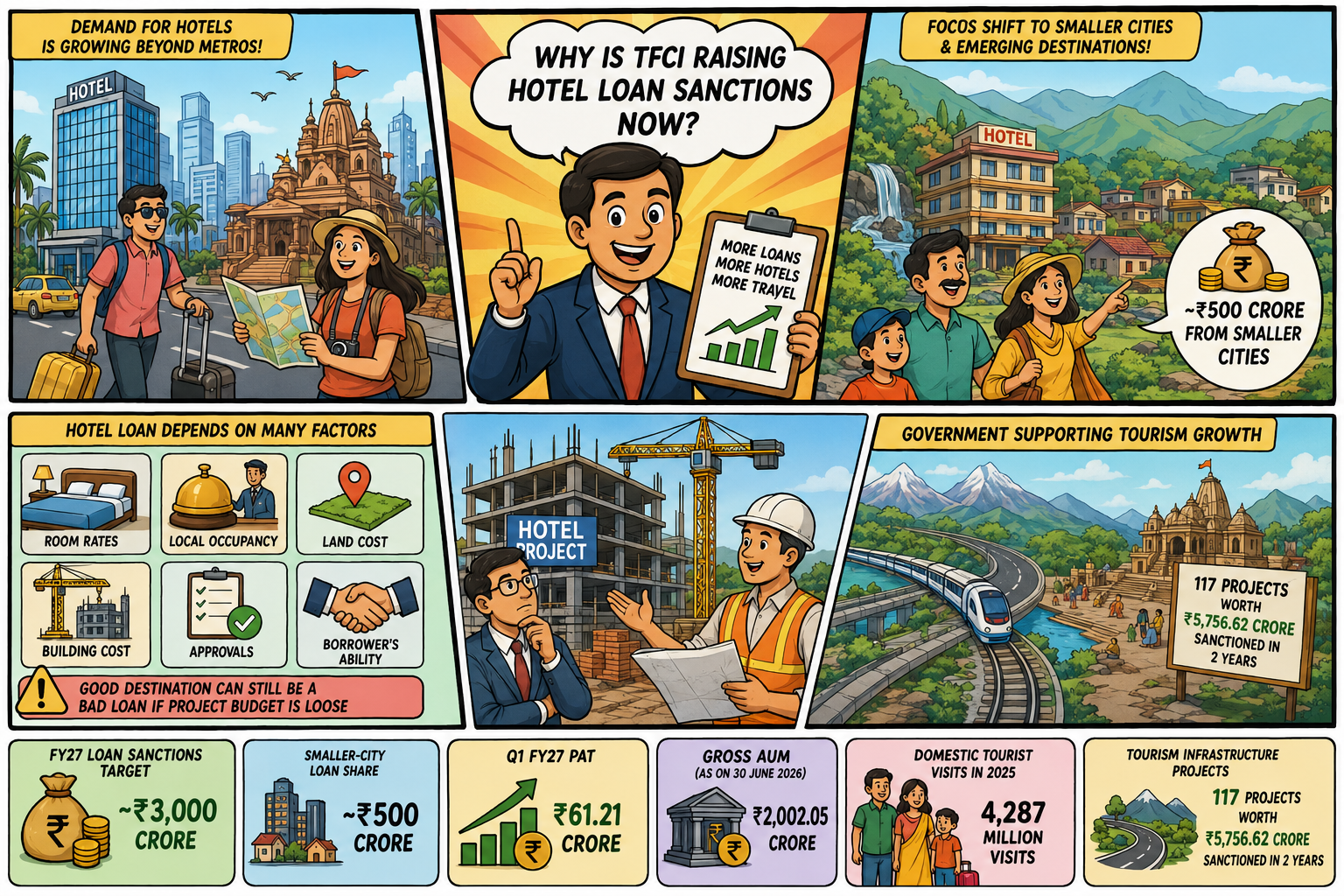
TFCI expects nearly ₹500 crore of its proposed FY27 sanctions to come from smaller cities and emerging tourism destinations. This is the part that gives the story its weight. Branded hotel companies are not only chasing luxury travellers in big markets. They are also entering locations where organised hotel supply remained low for years.
A hotel loan depends on room rates, local occupancy, land cost, building cost, approvals and the borrower’s ability to survive slow seasons. A good destination can still become a poor loan if the project budget is loose.
TFCI is expanding when both private hotel chains and the government are looking at destination growth. The Press Information Bureau said the Ministry of Tourism sanctioned 117 tourism infrastructure projects worth ₹5,756.62 crore over the last 2 years. Better tourist facilities can help hotels in smaller locations attract steadier demand, although public spending alone cannot make every project profitable.
Bali’s comments show confidence in domestic travel. He said young travellers, premium leisure demand, religious tourism and business movement have helped hotels maintain healthy demand. He also pointed out that India has around 200,000 branded hotel rooms, while annual room additions remain below expected demand. That gap is one reason hotel chains are looking at smaller cities more seriously.
The solution is tighter lending, not easy money for every project. Lenders have to check whether a hotel can earn outside peak months, whether local transport supports visitor flow, and whether the developer has enough margin for cost overruns. A pilgrimage hotel may fill quickly during festival periods but slow down later. A business hotel near an industrial belt needs weekday demand. The loan has to match that pattern.
TFCI had already reported a stronger first quarter for FY27 before the latest lending target came into focus. Its Q1 FY27 investor presentation showed ₹115.15 crore total income, ₹61.21 crore PAT and ₹2,002.05 crore gross AUM as of 30 June 2026. Gross loan book stood at ₹1,901.55 crore, gross NPL was 0.41%, and net NPL was 0%.
The tourism policy backdrop also turned more active before this FY27 target. The Press Information Bureau said on 5 February 2026 that the Ministry of Tourism had sanctioned 53 projects worth ₹2,208.31 crore under Swadesh Darshan 2.0. Such destination projects help build the base around which hotels, restaurants and travel businesses can plan expansion.
TFCI’s management believes hospitality investment is moving beyond older city markets. Bali said greenfield hotel investments are entering smaller destinations, while resorts and branded hotels are spreading into locations where organised supply was earlier limited. His comments also flagged religious tourism and new destinations in eastern India as areas to watch.
For borrowers, the lesson is more grounded. A hotel project needs land, approvals, construction finance, interiors, staffing and launch money before stable room revenue arrives. Smaller businesses around hospitality, such as restaurants, transport firms and service vendors, may also need working capital when a destination grows. A LoansJagat business loan resource fits naturally here for readers comparing credit options before expansion, especially where cash flow is uneven across seasons.
TFCI’s FY27 loan target shows that India’s hospitality boom has moved into the lending lane. The company is not only looking at large cities. It is following hotel demand into smaller markets where domestic travel, business visits and religious tourism are creating new room demand.
The next phase will depend on loan quality. Strong travel numbers can support new hotel projects, but higher construction costs can hurt repayment planning. TFCI’s low net NPL gives it room to grow, yet FY27 will need careful project selection. More lending can help the sector. Poorly planned hotels can quickly turn the same growth story into a balance-sheet problem.
TFCI is targeting around ₹3,000 crore in loan sanctions in FY27, mainly backed by hotel demand.
Smaller cities are seeing more religious travel, business movement and branded hotel expansion than before.
Nearly ₹500 crore of TFCI’s proposed FY27 sanctions may come from smaller cities and emerging destinations.
Higher construction costs are the main risk, especially when projects face delays before opening.
A Tier-2 hotel and restaurant needs steady local business, not just tourists. Weddings, corporate bookings, family functions and good food can keep revenue coming when room demand slows. Tight cost control and sensible room pricing help protect profits.










.png&w=3840&q=75)


