
By continuing, you agree to LoansJagat's Credit Report Terms of Use, Terms and Conditions, Privacy Policy, and authorize contact via Call, SMS, Email, or WhatsApp
Disclaimer: The information published on LoansJagat is intended for general informational and educational purposes only and should not be considered financial, legal, or investment advice. Interest rates, loan terms, statistics, and other data may change over time and may vary by lender or source. Please verify the latest information and consult a qualified financial advisor or the respective Bank/NBFC before making any financial decisions.
Subscribe Now
About the author

LoansJagat Team
‘Simplify Finance for Everyone.’ This is the common goal of our team, as we try to explain any topic with relatable examples. From personal to business finance, managing EMIs to becoming debt-free, we do extensive research on each and every parameter, so you don’t have to. Scroll up and have a look at what 15+ years of experience in the BFSI sector looks like.
Related News
Simplify All Your Loans Into One Affordable EMI

Customers Served

Debt Consolidated

1200+ Reviews

Locations in India
Club all Loans & Credit Card Bills into Single EMI

Quick Apply Loan
Consolidate your debts into one easy EMI.

Takes less than 2 minutes. No paperwork.

10 Lakhs+
Trusted Customers

2000 Cr+
Loans Disbursed

4.7/5
Google Reviews

50+
Banks & NBFCs Offers
Other services mentioned in this article
Key Insights
One Hundred and Fifty Licences Gone. The RBI Means Business.
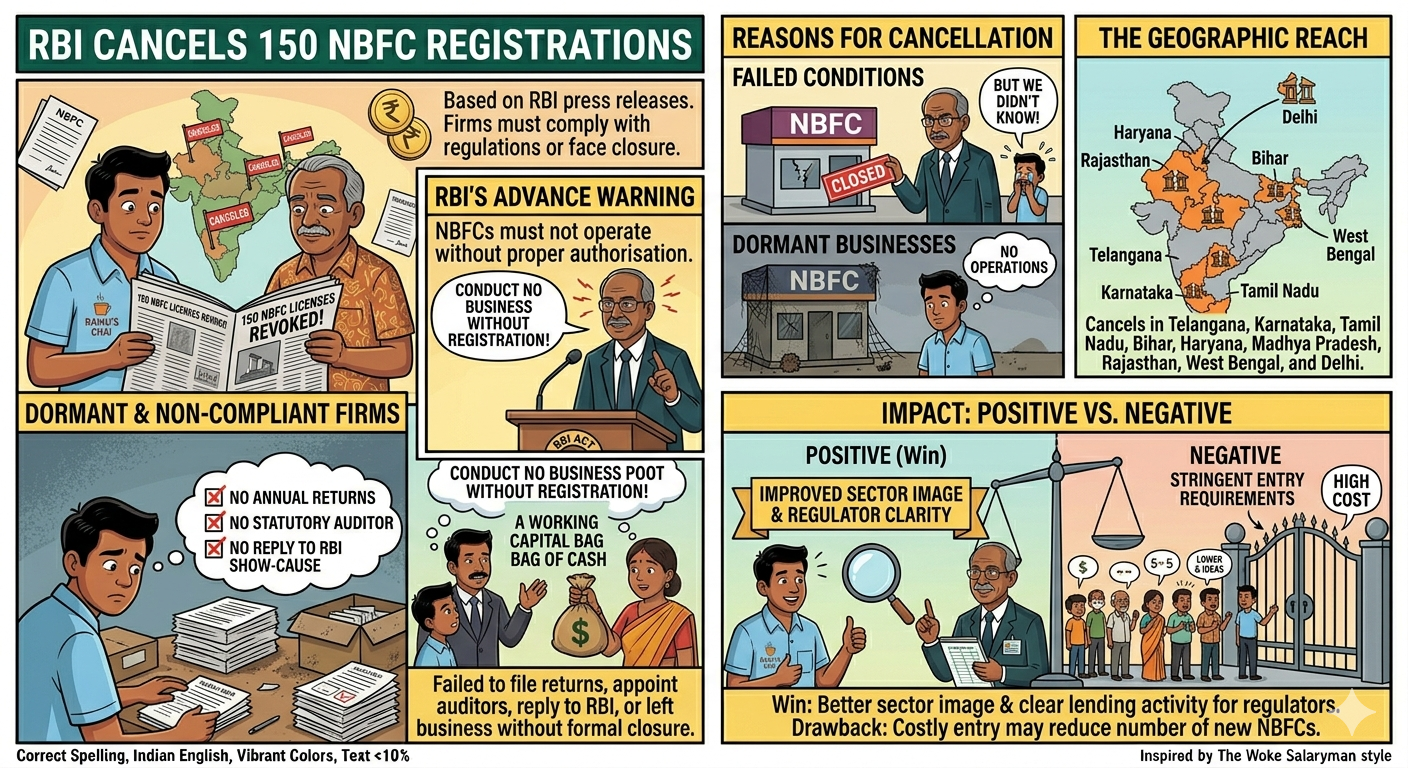
According to two separate press releases of the RBI, the registrations of 150 NBFCs were cancelled due to non-compliance with regulations.
The reasons for cancelling included the non-compliance with the conditions on which their registrations had been done and their discontinuation of business operations.
The RBI already warned the NBFCs that they should not conduct the business of a non-banking financial institution as per the RBI Act.
In Telangana, Karnataka, Tamil Nadu, Bihar, Haryana, Madhya Pradesh, Rajasthan, West Bengal, and Delhi, those 150 NBFCs include firms registered.
Some of the firms received NBFC licenses for business operations, failed to get working capital, and left the business without formally closing it.
Such dormant NBFCs failed to file annual returns, to appoint statutory auditors, and to reply to the RBI’s show-cause notice for several years.
On the one hand, the removal of such NBFCs will improve the sector's image and provide regulators with a clearer idea of lending activities.
On the other hand, stringent registration requirements will make entry costly for new NBFCs, potentially reducing their number.
The table shows you how to understand the breakdown of the 150 cancellations and 7 surrenders by category and geography, giving a clear picture of where the regulatory sweep was most concentrated.
The RBI has not provided specific individual reasons for each cancellation but cited Section 45-IA(6) powers across all cases.
Read More : RBI Can Return Your Money
The geographic concentration in West Bengal and Delhi reflects where shell and dormant entities historically clustered.
However, for millions of Indians who take out loans from NBFCs to purchase homes, cars, gold, and other personal items, this regulatory step is actually a protective one.
A Section 45-IA(6) revocation means the death knell for the future financial aspirations of the business entity.
This impacts every stakeholder connected to the entity in some way, be it as a depositor, creditor, or borrower with pending dues.
In case you have an open loan or a deposit account with a revoked NBFC, it is imperative that you check your outstanding balance and get in touch with the Reserve Bank of India's grievance portal if necessary.
*T&C Apply
For shareholders of listed NBFCs and mutual funds supported by NBFCs, it is good news that the industry is becoming cleaner now.
It is easier for the remaining participants to function in a streamlined environment when the non-working firms are stripped from the books.
The sheer volume of cancellations signals that the era of treating an NBFC licence as a passive asset, a shell corporation, or a regulatory arbitrage tool is decisively over.
The RBI is aggressively weeding out undercapitalised, dormant, and non-compliant entities to build a more resilient shadow banking sector.
This is not a one-off action. The RBI has been progressively tightening NBFC oversight through its Scale-Based Regulatory framework.
The RBI's new Scale-Based Regulatory framework demands intense capital adequacy and reporting.
Also Read : Sending Money Abroad Just Got Simpler
Honest promoters who realise they cannot organically raise their net owned funds to Rs 10 crore are choosing graceful surrender over a public cancellation.
Going forward, NBFCs that want to survive and grow must invest in compliance infrastructure, governance, and capital adequacy, not just customer acquisition.
The cancellation of 150 non-banking financial companies by the RBI is an important move towards cleaning up and regulating the shadow banking industry. For compliant companies, it provides room for growth through trust. For the borrower, it ensures a robust system that meets their basic financial requirements.
How would you rate the Fixed Deposit and savings account services of the Small Finance Bank?
The Fixed Deposit and Savings Accounts of the Small Finance Bank are superior to those of other commercial banks because of their high interest rates, which range from 1.5% to 2%.
Why does the RBI revoke the registrations of many NBFCs in India?
The Reserve Bank of India (RBI) revokes the registration of some NBFCs in India based on certain criteria, such as regulatory compliance issues and lack of activity.









.png&w=3840&q=75)



