

By continuing, you agree to LoansJagat's Credit Report Terms of Use, Terms and Conditions, Privacy Policy, and authorize contact via Call, SMS, Email, or WhatsApp
Disclaimer: The information published on LoansJagat is intended for general informational and educational purposes only and should not be considered financial, legal, or investment advice. Interest rates, loan terms, statistics, and other data may change over time and may vary by lender or source. Please verify the latest information and consult a qualified financial advisor or the respective Bank/NBFC before making any financial decisions.
Subscribe Now
About the author

Arshathul Afia
Arshathul Afia is a journalism graduate and fintech content writer with 4+ years of experience in digital publishing and research-led writing. She has written 200+ articles covering personal finance, lending, banking, digital payments, credit, insurance, and major financial developments in India. At LoansJagat, she focuses on simplifying complex fintech news, RBI updates, loan-related changes, policy developments, and industry trends for everyday readers. Her journalism background helps her approach stories with research, context, and clarity, while her SEO experience ensures content remains discoverable and relevant. She aims to make financial news easier to understand, practical, and useful for readers across India.
Related News
Simplify All Your Loans Into One Affordable EMI

Customers Served

Debt Consolidated

1200+ Reviews

Locations in India
Club all Loans & Credit Card Bills into Single EMI

Quick Apply Loan
Consolidate your debts into one easy EMI.

Takes less than 2 minutes. No paperwork.

10 Lakhs+
Trusted Customers

2000 Cr+
Loans Disbursed

4.7/5
Google Reviews

50+
Banks & NBFCs Offers
Unregulated loan apps are sending real money into workers’ bank accounts, then demanding higher repayments, exposing daily-wage earners to harassment, data misuse and financial loss.
A 14 September 2026 investigation by The New Indian Express found unregulated loan apps targeting blue-collar and daily-wage workers in India by transferring real money into bank accounts and then demanding much larger repayments. In one reported case involving apps identified as Rupeeline and Rupeelaon, ₹2,400 reached a user’s account even though the user had not approved a loan. The user later paid ₹9,500. The bank credit can make an unknown app look genuine at the exact moment a worker needs urgent cash.
The damage can go beyond the amount received. A worker may lose money meant for rent, food, medicines, or travel, while Aadhaar, PAN, bank information, photographs and phone permissions can create another source of pressure. Apps can also disappear, return under another name, or shift payment routes, leaving users unsure who they are dealing with.
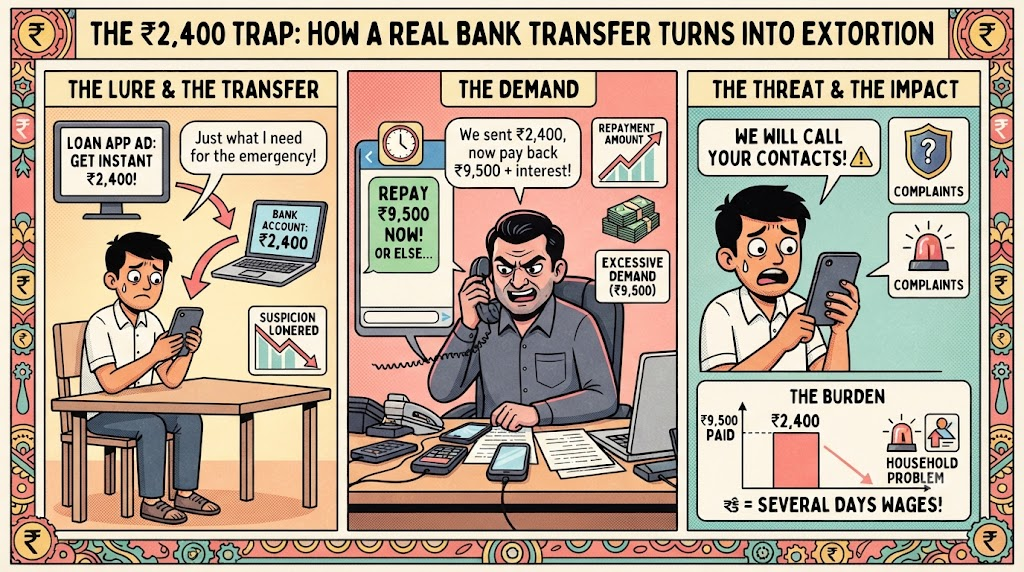
The ₹2,400 transfer is what separates this case from a routine fake-loan advertisement. Money actually entered the bank account. Once that happened, the operator had something tangible to point to while demanding repayment. For someone already short of cash, a real credit alert can lower suspicion quickly.
The difference between ₹2,400 received and ₹9,500 later paid shows how a small emergency can become a household problem. For a daily-wage worker, another ₹7,100 may equal several days of earnings. Similar complaints describe short deadlines, changing caller numbers, and threats involving contacts.
A borrower who sees these signs should preserve screenshots, bank entries, UPI details, emails and WhatsApp messages. Those records can help the bank and police trace what happened. Deleting everything in panic can remove useful evidence.
Small-ticket credit becomes attractive when income is irregular. A construction worker, driver, cleaner, delivery rider or another daily-paid worker may not be able to wait through a long loan process when rent or a hospital bill is due. An app promising money in minutes appears useful. That urgency gives a dishonest operator room to rush the user through forms and permissions.
There is a better route when something looks wrong. The Press Information Bureau, National Cyber Crime Reporting Portal and Ministry of Home Affairs have published government information covering illegal digital lending or cyber financial fraud. Borrowers have official reporting channels, but early reporting becomes important because repeated payments made only to stop calls can push the loss higher.
A borrower-facing view from LoansJagat also fits the latest case closely. Its coverage of fraudulent loan-app scams has flagged forced repeat disbursals, hidden charges, blackmail, and public shaming through misuse of personal information. The point is useful for borrowers because the danger cannot be reduced to a high repayment amount. It grows when a person loses control over both the money demand and the information already shared with the app.
Himachal Pradesh Cybercrime DIG Mohit Chawla warned in May 2025 that fraudulent loan apps could steal personal and financial information and then mentally harass or threaten people over repayment. The State Cyber Cell had identified 15 such apps while asking users to remain cautious. That warning came more than a year before the latest investigation, showing that data misuse and aggressive recovery were already recognised concerns.
The first response after a suspicious transfer should be practical. The borrower should contact the bank, retain the transaction reference, and preserve messages. The National Cyber Crime Reporting Portal asks victims of cyber financial fraud to call 1930 for immediate reporting. It also lets people report suspicious websites, phone numbers, WhatsApp numbers, Telegram handles, email IDs and social-media URLs.
A borrower should not keep sending “late fee”, “closure” or “settlement” payments simply because a caller threatens to contact family members or colleagues. Public complaints involving similar apps describe fresh demands even after earlier payments were made.
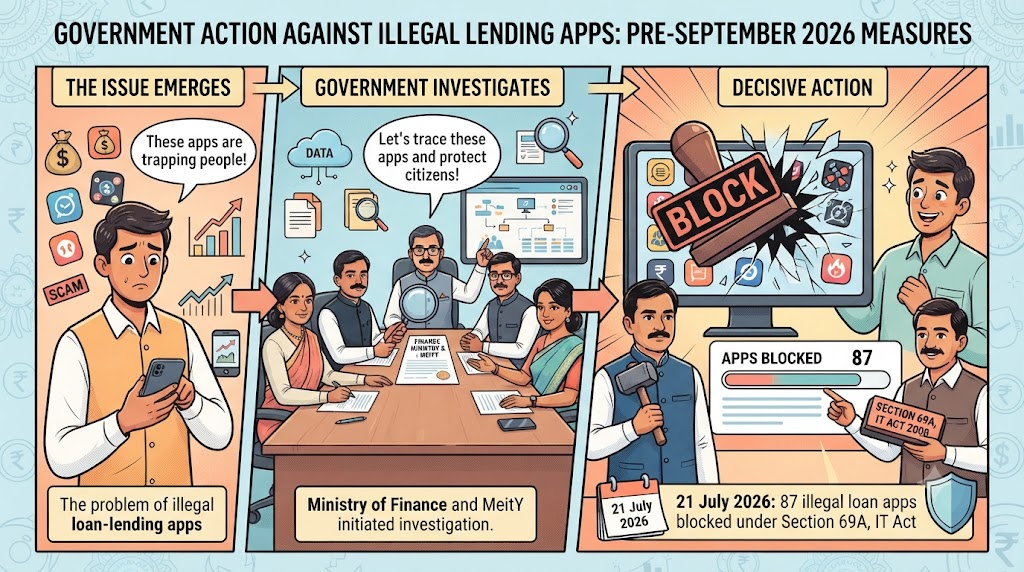
The latest report came after government action was already under way. On 21 July 2026, the Ministry of Finance said through the Press Information Bureau that MeitY had blocked 87 illegal loan-lending applications under Section 69A of the Information Technology Act, 2000 after due process. The same government update said authorities were engaging with regulators, internet intermediaries and the Indian Cyber Crime Coordination Centre against fake and illegal loan apps.
That action shows 2 things. Authorities were already treating illegal digital lending as an active problem, yet blocking apps did not remove the risk completely. New names can appear. The Ministry of Home Affairs had also warned much earlier that illegal lending apps could target vulnerable and low-income people, collect contacts, location details, photographs and videos, then misuse that information for blackmail or harassment. Its advisory was dated 28 September 2022.
The September 2026 case therefore adds another form of pressure to an older problem. The borrower may no longer begin with a fake promise alone. The scheme can begin with genuine money reaching a genuine bank account.
Mohit Chawla’s earlier warning remains relevant because it focuses on what borrowers may discover too late. The loan amount may be small, but the app may already hold valuable personal information. Once recovery calls start, the user faces financial pressure and a privacy threat at the same time.
The latest investigation also contacted people linked to some of the apps. Callers claimed connections with Pakistan, Bangladesh and a “cyber city” in Thailand. Those locations should not be presented as established facts. The New Indian Express reported that some of the location claims could not be independently verified. A foreign telephone code or a caller stating where they work does not establish where the people controlling an app are physically based.
That distinction is important for readers. Dramatic overseas claims can distract from the evidence already in the borrower’s hands: an unsolicited bank credit, the app used, the transaction ID, messages demanding money, and any personal information the app requested.
The newer feature is the genuine bank credit being used as a decoy. Earlier warnings often centred on fake offers, hidden charges, abusive recovery, and misuse of contacts. Here, money reaching the account can itself become a trust signal. People have learned to distrust suspicious links. Fewer expect an unwanted bank credit to begin the pressure.
There is also a useful borrower takeaway that goes beyond repeating a government advisory. A genuine transaction and a genuine lender are 2 different things. A bank can confirm that funds arrived. The credit alert alone cannot tell the borrower that every permission, repayment demand, or deadline pushed through an unknown app is legitimate.
This is where a few minutes of checking can save far more than the original loan amount. A worker who receives money without approving a loan should avoid spending it, keep the transaction traceable, and contact the bank. If threats begin, the person should move the issue to official cybercrime channels rather than trying to settle every new amount demanded on WhatsApp.
The latest case carries a straightforward warning for Indian borrowers, especially workers living on daily or irregular income. A bank credit proves that money arrived. It does not prove that the app behind it deserves trust.
The reported ₹2,400 transfer followed by a ₹9,500 payment shows how quickly that gap can become expensive. Government blocking action and police warnings show the pattern has been visible for years, but using an actual bank transfer as the opening move creates another risk. When money appears without a properly approved loan, saving evidence, contacting the bank, and reporting the incident early can stop a short cash shortage from turning into repeated payments, threats, and misuse of personal data.
The person should preserve the bank entry and screenshots, contact the bank, avoid hurried extra payments, and report suspected fraud through official cybercrime channels.
Yes. Police warnings have described misuse of contacts, personal photographs, and other phone data. Evidence should be saved before permissions are withdrawn or the app is removed.
A March 2026 Reddit discussion raised almost the same problem after ₹2,000 was allegedly credited without consent and ₹4,000 was demanded. The safer response is to document the credit, contact the bank, call 1930, and file a cybercrime complaint instead of relying on the app’s recovery caller.
An unsolicited transfer should not be handled on guesswork. The recipient should keep the money traceable, inform the bank and report the app. Any genuine liability depends on the actual agreement and facts, not an amount dictated during threatening calls.
Urgent borrowers often prioritise speed over checks. Small amounts may look harmless, helping an app obtain identity documents, bank details, and phone permissions before aggressive recovery begins.









.png&w=3840&q=75)


