
By continuing, you agree to LoansJagat's Credit Report Terms of Use, Terms and Conditions, Privacy Policy, and authorize contact via Call, SMS, Email, or WhatsApp
Disclaimer: The information published on LoansJagat is intended for general informational and educational purposes only and should not be considered financial, legal, or investment advice. Interest rates, loan terms, statistics, and other data may change over time and may vary by lender or source. Please verify the latest information and consult a qualified financial advisor or the respective Bank/NBFC before making any financial decisions.
Subscribe Now
About the author

Arshathul Afia
Arshathul Afia is a journalism graduate and fintech content writer with 4+ years of experience in digital publishing and research-led writing. She has written 200+ articles covering personal finance, lending, banking, digital payments, credit, insurance, and major financial developments in India. At LoansJagat, she focuses on simplifying complex fintech news, RBI updates, loan-related changes, policy developments, and industry trends for everyday readers. Her journalism background helps her approach stories with research, context, and clarity, while her SEO experience ensures content remains discoverable and relevant. She aims to make financial news easier to understand, practical, and useful for readers across India.
Related News
Simplify All Your Loans Into One Affordable EMI

Customers Served

Debt Consolidated

1200+ Reviews

Locations in India
Club all Loans & Credit Card Bills into Single EMI

Quick Apply Loan
Consolidate your debts into one easy EMI.

Takes less than 2 minutes. No paperwork.

10 Lakhs+
Trusted Customers

2000 Cr+
Loans Disbursed

4.7/5
Google Reviews

50+
Banks & NBFCs Offers
Other services mentioned in this article
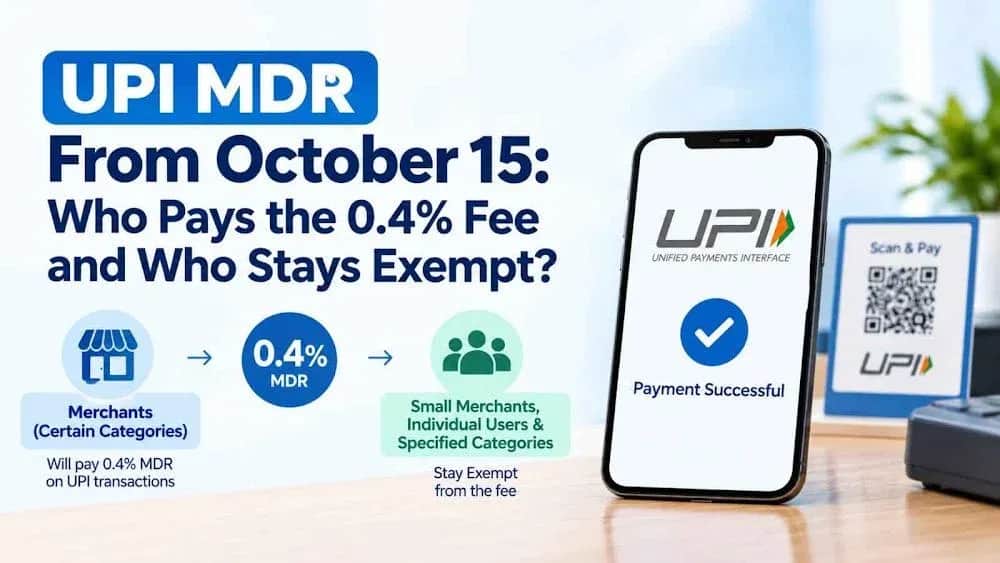
Selected merchants will pay UPI processing fees from 15 October 2026, while customers remain exempt and most everyday merchant transactions continue without any MDR charge.
Key Highlights
15 October 2026 is the scheduled start date for India’s revised UPI merchant fees. The Department of Financial Services’ FAQs dated 15 September 2026 confirm the date. Eligible businesses will pay the Merchant Discount Rate, or MDR, when accepting specified payments. Customers will continue paying through UPI without transaction charges.
Covered merchants face an additional processing expense. Traders opposing the fee have raised concerns about the expense businesses will bear immediately. The government, meanwhile, says the receipts will fund payment infrastructure over time. Personal transfers remain exempt, as do low-value merchant payments and receipts covered by the small-vendor exemptions.
Customers sending money to family or paying a shop will remain exempt from UPI transaction charges. Approximately 96% of person-to-merchant transactions will see no change, the Finance Ministry stated on 15 September 2026 in Release ID 2310586. The ministry counted transactions for this estimate. It did not say that 96% of customers or businesses qualify for exemption.
For qualifying small vendors, the Person-to-Person-Merchant, or P2PM, classification preserves the exemption. Receiving more than ₹2,000 in a payment does not, by itself, make an exempt vendor liable for MDR. The September FAQs say merchant categorisation determines the treatment. Existing QR codes can continue operating without replacement.
In the ministry’s view, subsidies would not be enough to finance UPI’s further growth. Cybersecurity and fraud prevention require ongoing spending, along with the infrastructure that processes payments. It proposed collecting a fee on selected merchant transactions while keeping UPI free for customers.
Economic commentator A K Bhattacharya supported selective charges in his analysis published on 3 October 2026, but questioned whether the government had adequately consulted merchant associations. He also recorded opposition from the Swadeshi Jagaran Manch. His assessment captures the dispute: the government wants payment revenue, while affected traders face a new expense for accepting UPI.
The Finance Ministry’s 15 September 2026 statement sets different rates for standard commercial payments and specified sectors. The following table summarises that official structure.
Merchants cannot pass MDR directly to customers. UPI applications are also prohibited from imposing platform fees or hidden charges. The ministry says MDR goes to payment-system participants and is not a tax collected by the government.
Our reading of the rules is that the ₹2,000 threshold cannot be assessed in isolation. Merchant classification comes first. A blanket decision to reject larger UPI payments would overlook the exemptions, while applying 0.4% to every business receipt would overlook the special rates.
Zero MDR for person-to-merchant UPI payments took effect in January 2020, following a notification dated 30 December 2019. The Finance Ministry confirmed this history in its statement of 18 April 2025, Release ID 2122747.
The government’s August 2026 statement a possible threshold-based MDR on selected merchant transactions. September’s documents then supplied the rates, exemptions and scheduled commencement. Both announcements retained the commitment to free UPI payments for consumers.
The October 15 framework places MDR on eligible merchant receipts. Customers remain exempt. A business’s account classification determines its eligibility for exemption. Where MDR applies, the payment category and transaction amount determine whether the business pays the standard or a special rate.
The Department of Financial Services’ September FAQs give 15 October 2026 as the commencement date.
The notified MDR applies to eligible merchants. The customer owes no MDR, and the merchant is not allowed to recover it by adding the fee to the customer’s bill.
Yes. Person-to-person transfers remain free, irrespective of the amount transferred within permitted transaction limits.
No. Eligible P2PM vendors remain exempt, while specified merchant categories have separate rates.
No. ₹300 is the maximum standard merchant-side MDR for eligible payments of ₹75,000 and above.









.png&w=3840&q=75)


