
By continuing, you agree to LoansJagat's Credit Report Terms of Use, Terms and Conditions, Privacy Policy, and authorize contact via Call, SMS, Email, or WhatsApp
Disclaimer: The information published on LoansJagat is intended for general informational and educational purposes only and should not be considered financial, legal, or investment advice. Interest rates, loan terms, statistics, and other data may change over time and may vary by lender or source. Please verify the latest information and consult a qualified financial advisor or the respective Bank/NBFC before making any financial decisions.
Subscribe Now
About the author

Arshathul Afia
Arshathul Afia is a journalism graduate and fintech content writer with 4+ years of experience in digital publishing and research-led writing. She has written 200+ articles covering personal finance, lending, banking, digital payments, credit, insurance, and major financial developments in India. At LoansJagat, she focuses on simplifying complex fintech news, RBI updates, loan-related changes, policy developments, and industry trends for everyday readers. Her journalism background helps her approach stories with research, context, and clarity, while her SEO experience ensures content remains discoverable and relevant. She aims to make financial news easier to understand, practical, and useful for readers across India.
Related Blog Post
Simplify All Your Loans Into One Affordable EMI

Customers Served

Debt Consolidated

1200+ Reviews

Locations in India
Club all Loans & Credit Card Bills into Single EMI

Quick Apply Loan
Consolidate your debts into one easy EMI.

Takes less than 2 minutes. No paperwork.

10 Lakhs+
Trusted Customers

2000 Cr+
Loans Disbursed

4.7/5
Google Reviews

50+
Banks & NBFCs Offers
Other services mentioned in this article
From 15 October 2026, selected merchant UPI payments will carry MDR, though customer-to-customer transfers and most everyday purchases will remain free for individual users.
Key Highlights
A customer scanning a UPI QR code will not pay anything extra after 15 October 2026. The change happens at the merchant’s end. Selected shop payments above ₹2,000 will carry 0.4% MDR, but the deduction cannot cross ₹300 once the bill reaches ₹75,000. The Finance Ministry released these final terms on 15 September 2026.
Personal UPI transfers will remain free, irrespective of the amount. Payments to merchants up to ₹2,000 will also carry zero MDR. An official government update dated 16 September 2026 said around 96% of person-to-merchant transactions would remain unaffected by the new charge.
Small vendors receive additional protection. Merchants accepting up to ₹1 lakh per month through UPI QR codes under the Person-to-Person-Merchant category will retain zero MDR. One payment above ₹2,000 will not automatically trigger the fee for an eligible vendor. The merchant’s account classification and monthly UPI receipts will decide its treatment.
Banks have been advised to stop sellers from adding MDR separately to customer bills. UPI applications cannot introduce platform fees or hidden payment charges under the new framework. Individual users will also face no monthly quota on free transactions.
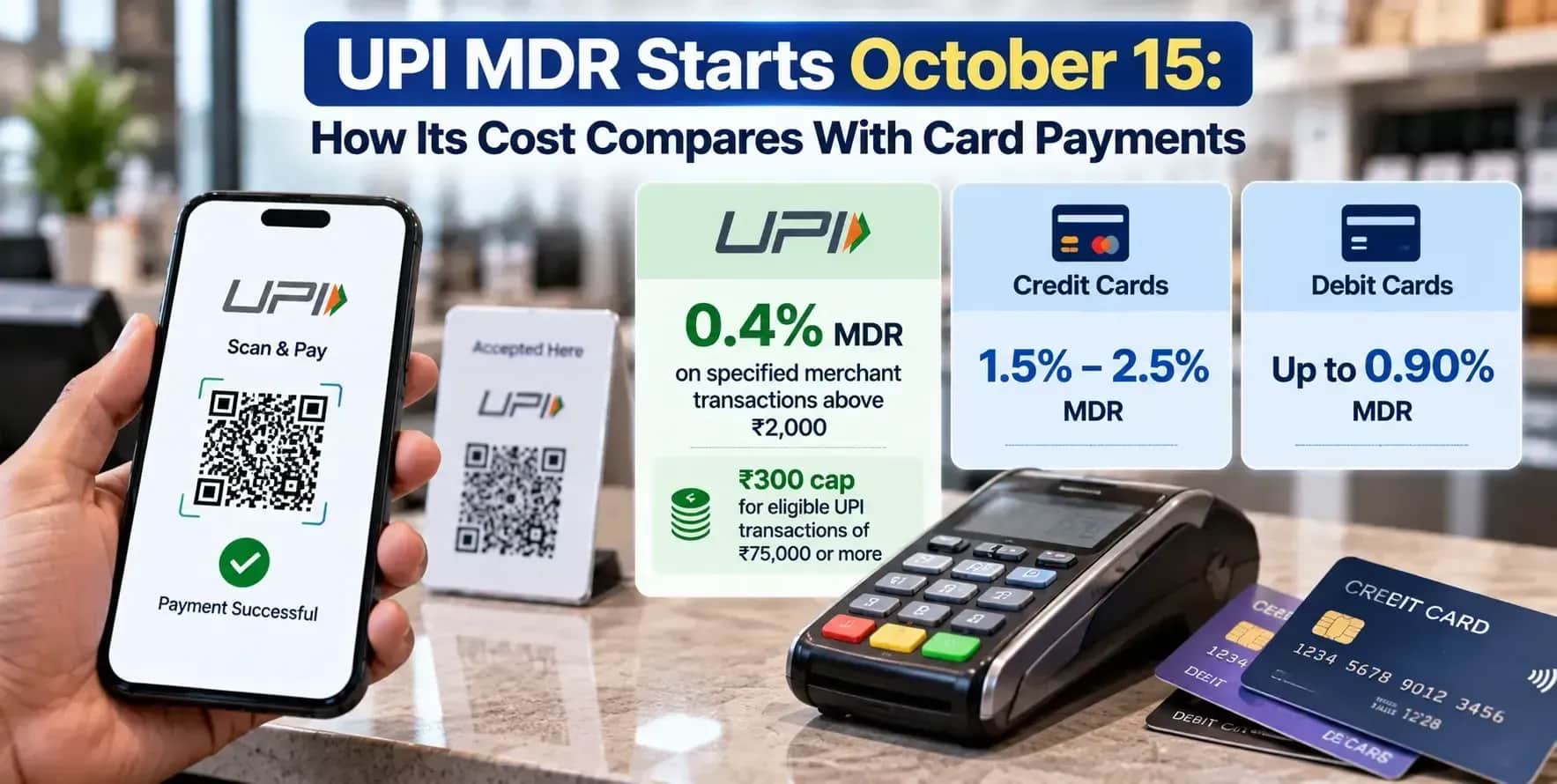
The Merchant Discount Rate on Select UPI P2M Transactions FAQ, dated 15 September 2026, compares UPI with standard card acceptance rates. It places conventional credit-card MDR between 1.5% and 2.5%. Debit-card MDR can reach 0.9%, while regular bank-account-funded UPI will charge 0.4% above ₹2,000.
NPCI says this difference will keep UPI cheaper for commercial businesses that already accept cards. Merchants should still examine the rates written into their payment agreements. Card costs can change by network, business category and the terms offered by the acquiring bank.
The table below compares the merchant-side MDR. It excludes GST charged on the processing fee.
Illustration: On an eligible ₹10,000 purchase, UPI MDR would be ₹40. A debit-card payment at 0.9% would cost the merchant ₹90. The credit-card cost would fall between ₹150 and ₹250 under the range quoted in the official FAQ.
RuPay debit is a separate exception. The Finance Ministry’s Notification S.O. 5067(E), dated 14 September 2026, retained no-charge protection for RuPay-powered debit-card transactions without giving a monetary ceiling. RuPay debit can therefore cost a merchant less than UPI on a payment above ₹2,000.
Railway, telecom, insurance, fuel and agricultural-input payments above ₹2,000 will carry a flat ₹5 MDR. The flat rate protects businesses in categories where a percentage charge could rise sharply on a large payment.
Capital-market payments involving mutual funds, securities, stockbrokers and dealers will attract 0.02% MDR, capped at ₹300. UPI AutoPay and automated recurring instructions will not carry the prescribed MDR. Credit cards linked to UPI and pre-approved credit lines will continue under their separate credit-product rules.
GST applies to the MDR amount rather than the full purchase value. NPCI said on 22 September 2026 that eligible GST-registered merchants could claim input tax credit for GST paid on MDR. Businesses unable to claim that credit may bear the tax component.
A LoansJagat update, last revised on 11 September 2025, recorded the Finance Ministry’s position that individual UPI users would not face transaction charges. That position has not changed. The 2026 framework places the fee within the merchant payment system.
On 8 August 2026, the Finance Ministry issued an official policy statement. It said the amendment to the Payment and Settlement Systems Act, 2007, would enable a threshold-based MDR on a limited group of merchant transactions. The government issued Notification S.O. 5067(E) on 14 September. NPCI released the rate structure on 15 September, exactly 1 month before implementation.
NPCI Managing Director and CEO Dilip Asbe said in an interview published on 22 September 2026 that the percentage-based charge shields smaller purchases while higher-value commercial transactions contribute towards system costs. Special flat rates protect selected sectors with narrow margins.
Retailers Association of India chief executive Kumar Rajagopalan took a different view. He warned that sellers may consider cash for festival purchases above ₹2,000. Clothing Manufacturers Association of India president Santosh Katariya also referred to pressure on demand and margins. Zerodha chief executive Nithin Kamath questioned the 0.02% capital-market fee when a customer transfers money but completes no trade.
LoansJagat’s assessment is that the direct cost for a household remains ₹0 under the notified rules. Any consumer impact would come from a merchant changing payment preferences or product pricing, not from a fee deducted by a UPI application. Comparing final settlement receipts will help merchants identify the actual cost instead of rejecting all high-value UPI payments.
UPI will remain free for customers and cheaper than conventional cards carrying standard MDR. Most daily merchant payments will also stay outside the charge.
The comparison has one qualification. RuPay debit cards retain zero MDR, while selected bank-account UPI payments above ₹2,000 will carry 0.4% from 15 October 2026. Merchants will need to compare actual settlement costs before choosing between UPI and cards.
No. Customers will not pay the notified MDR. The charge applies to eligible merchants receiving selected UPI payments above ₹2,000.
No. P2P transfers remain free, qualifying small merchants retain zero MDR, and several payment categories have separate rates or exemptions.
The official framework says merchants cannot pass the MDR directly to customers. Banks have been advised to monitor this condition.
The standard 0.4% calculation produces ₹400, but the notified ₹300 cap applies from ₹75,000 onwards. The merchant would therefore pay ₹300 before GST.
No. RuPay credit cards linked to UPI and pre-approved credit lines follow their respective credit-product and merchant-pricing rules.








.png&w=3840&q=75)


