
By continuing, you agree to LoansJagat's Credit Report Terms of Use, Terms and Conditions, Privacy Policy, and authorize contact via Call, SMS, Email, or WhatsApp
Disclaimer: The information published on LoansJagat is intended for general informational and educational purposes only and should not be considered financial, legal, or investment advice. Interest rates, loan terms, statistics, and other data may change over time and may vary by lender or source. Please verify the latest information and consult a qualified financial advisor or the respective Bank/NBFC before making any financial decisions.
Subscribe Now
About the author

Arshathul Afia
Arshathul Afia is a journalism graduate and fintech content writer with 4+ years of experience in digital publishing and research-led writing. She has written 200+ articles covering personal finance, lending, banking, digital payments, credit, insurance, and major financial developments in India. At LoansJagat, she focuses on simplifying complex fintech news, RBI updates, loan-related changes, policy developments, and industry trends for everyday readers. Her journalism background helps her approach stories with research, context, and clarity, while her SEO experience ensures content remains discoverable and relevant. She aims to make financial news easier to understand, practical, and useful for readers across India.
Related News
Simplify All Your Loans Into One Affordable EMI

Customers Served

Debt Consolidated

1200+ Reviews

Locations in India
Club all Loans & Credit Card Bills into Single EMI

Quick Apply Loan
Consolidate your debts into one easy EMI.

Takes less than 2 minutes. No paperwork.

10 Lakhs+
Trusted Customers

2000 Cr+
Loans Disbursed

4.7/5
Google Reviews

50+
Banks & NBFCs Offers
Other services mentioned in this article
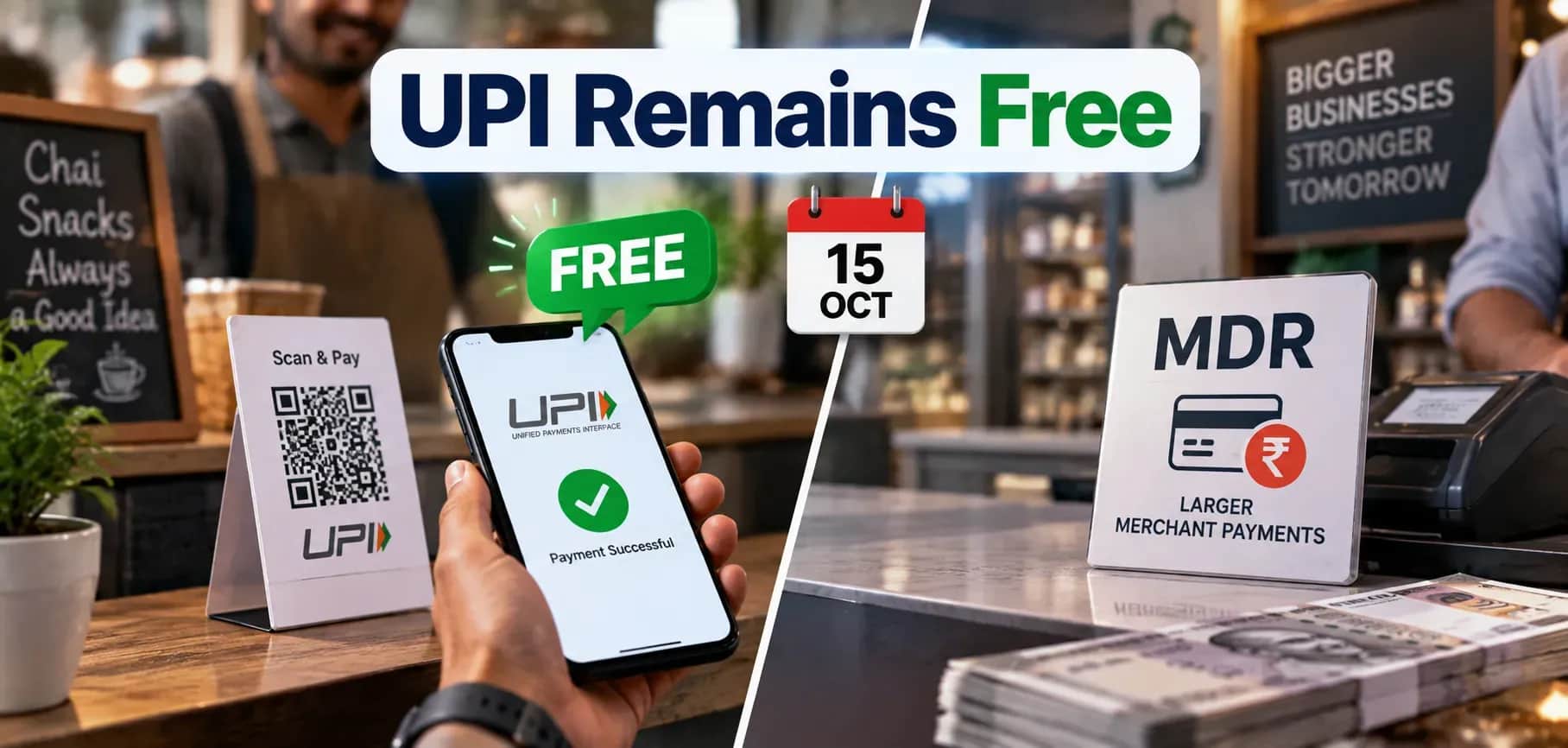
From October 15, selected UPI merchant payments above ₹2,000 will attract MDR, while customers will continue paying no transaction fee when using UPI across India.
India’s UPI rules will change on October 15, 2026, but QR payments will not become a paid service for consumers. The Ministry of Finance said on September 15 that eligible person-to-merchant, or P2M, transactions above ₹2,000 will attract a 0.4% Merchant Discount Rate. The merchant bears that charge. Customers continue paying only the purchase amount, P2P transfers stay free, and eligible small merchants remain protected under the zero-MDR framework.
The short-term impact will fall mainly on larger merchants handling qualifying UPI payments above the threshold. Some retailers may have to absorb a new acceptance cost during the festive shopping season, when bills can easily cross ₹2,000. Over time, the government expects merchant-side revenue to help fund payment infrastructure, fraud controls and UPI operations. The Press Information Bureau’s September 15 release says banks have also been advised to stop merchants from passing MDR directly to customers.
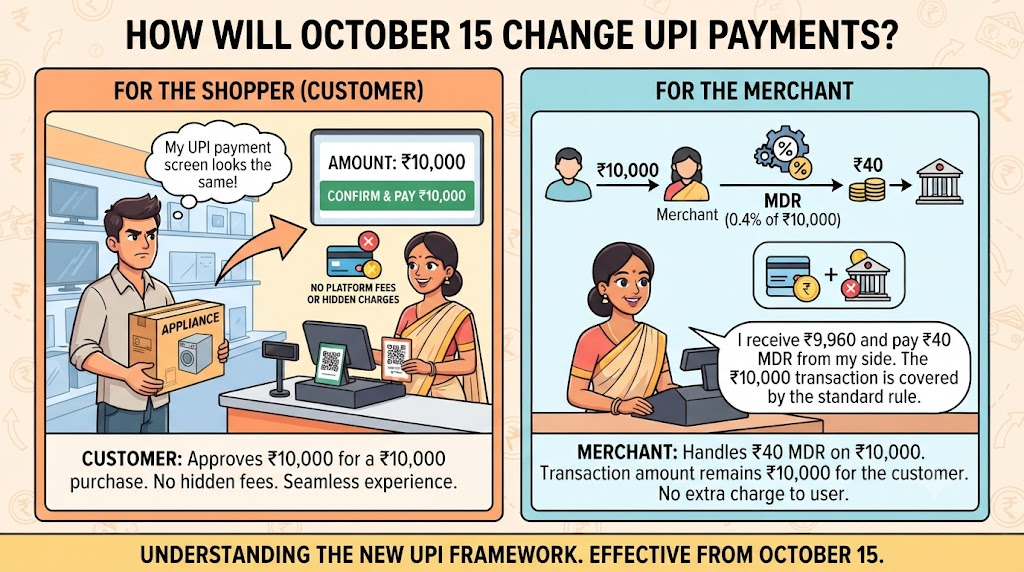
For a shopper, very little changes at the payment screen. If a customer buys a ₹10,000 appliance from a merchant covered by the standard rule, the customer still approves ₹10,000. A 0.4% MDR works out to ₹40, but that is handled on the merchant side. UPI apps are not allowed to add a platform fee or hidden charge to the user under this framework.
P2M payments up to ₹2,000 remain at zero MDR, while P2P payments between individuals stay free regardless of the amount. Qualifying street vendors, neighbourhood stores and other small merchants receiving up to ₹1 lakh a month through UPI QR under P2PM also retain zero MDR. The ₹2,000 threshold, therefore, is not a blanket trigger on every QR payment in India.
The Department of Financial Services MDR FAQs were published on September 15, 2026. The main payment categories are below.
The headline figure of 0.4% does not apply to every business. Essential and thin-margin categories receive a flat ₹5 rate on applicable payments above ₹2,000, while capital-market payments carry 0.02% MDR subject to the cap. The policy uses different rates rather than treating a railway booking, stockbroker payment and retail purchase alike.
The biggest consumer concern is whether merchants can simply add 0.4% to a bill and call it a UPI fee. The official framework says MDR is a merchant-payment charge, not a customer charge. Banks have been advised to ensure that merchants do not pass MDR directly to buyers, while UPI application providers cannot impose platform fees or hidden transaction charges.
Merchant classification also counts. A small shop covered by P2PM protection does not automatically move into the 0.4% bracket because 1 customer buys goods worth more than ₹2,000. Government data released on September 15 says around 96% of P2M transactions are expected to remain unaffected because they are below the threshold or fall within small-merchant protection.
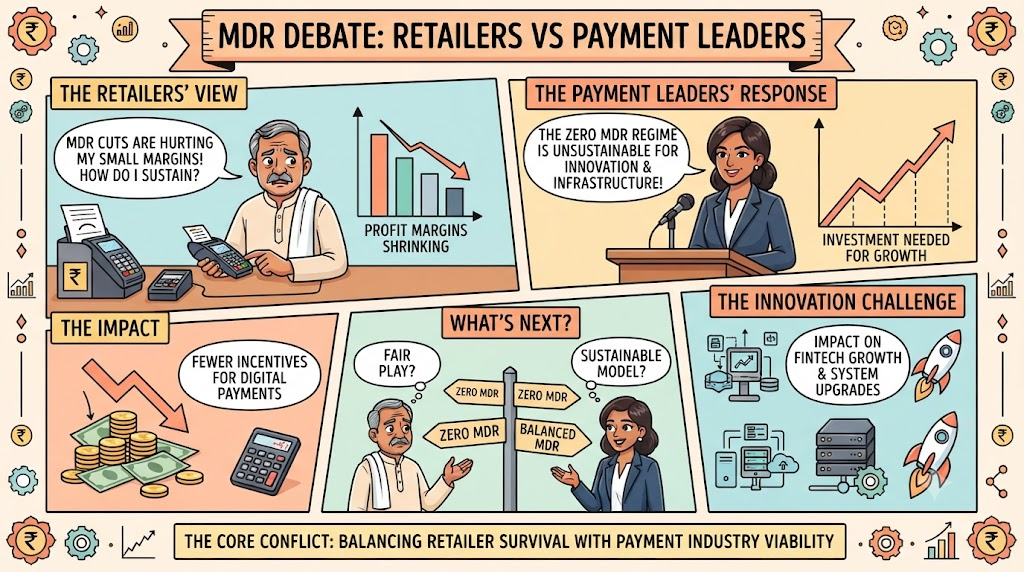
Retailers have raised sharper objections. Retailers Association of India CEO Kumar Rajagopalan told Reuters that an added payment cost could encourage some merchants to prefer cash, particularly when margins are narrow, and purchase values rise during the festive season. Clothing Manufacturers Association of India President Santosh Katariya also pointed to pressure on consumer-facing businesses already watching demand and operating costs.
Payment-industry representatives see a funding gap. Payments Council of India Chairman Vishwas Patel told Business Standard that MDR revenue can support technology, cybersecurity and expansion of the payment network. For buyers, the practical step is to check the final amount before approving payment and question any fee described as compulsory UPI MDR. Merchants should confirm their classification with the acquiring bank or payment provider, especially if they may qualify for P2PM protection.
The older policy came into force in 2020. The Income Tax Department’s Circular No. 16/2020, F.No.370142/35/2019-TPL-Pt, dated August 30, 2020, recorded the prohibition on banks and payment-system providers charging payers or beneficiaries for prescribed electronic modes. It also directed banks to refund charges collected on such transactions after January 1, 2020.
By 2026, the policy debate had shifted towards funding large commercial UPI payments without charging ordinary users. Parliament changed the legal framework through the Taxation and Other Laws Amendment Bill, 2026. A LoansJagat analysis published on August 17 tracked the transition when a 0.3% to 0.5% merchant rate was being discussed but had not been formally notified. The final 0.4% rate landed inside that range.
LoansJagat’s earlier reading also gives useful context for borrowers and everyday users because it separated a possible merchant-side fee from a customer UPI charge before the final rates arrived. That distinction remains important now. A payment above ₹2,000 may trigger MDR for an eligible merchant, but the customer’s own UPI transfer does not become chargeable simply because the bill is larger.
The Centre issued the next notification on September 14, retaining zero MDR for UPI transactions up to ₹2,000. Detailed rates followed on September 15 after UPI Steering Committee deliberations, with implementation fixed for October 15. Articles published in early August described a proposal. The September documents converted it into an operating framework with rates, exemptions and customer protections.
For customers, the direct cost remains ₹0. The indirect effect is harder to predict. A merchant processing many high-value UPI transactions may absorb MDR, adjust discounts, promote another payment mode, or spread higher operating costs across general pricing. Those choices would not turn MDR into an official consumer UPI charge, but they could alter how some businesses price or promote payments.
For the payments industry, the October change creates revenue tied to larger commercial usage. The government says MDR is shared across payment ecosystem participants and is neither a tax nor money collected by the government or NPCI. It also provides for a small-merchant fund financed with an amount equivalent to 5% of total MDR collections to support UPI acceptance among smaller businesses.
UPI remains free for users after October 15, 2026. The new 0.4% MDR applies to selected P2M payments above ₹2,000 and is paid within the merchant-payment system, subject to exemptions and a ₹300 cap. P2P transfers remain free, low-value merchant payments retain zero MDR, and qualifying small merchants continue to receive protection.
The real test will come at shop counters and online checkouts. Retail groups fear another cost on businesses, while payment-industry representatives argue that merchant revenue can help fund UPI’s next phase. For customers, the rule is straightforward: a QR payment should not carry a separate compulsory MDR charge simply because the bill crosses ₹2,000.
No. The 0.4% MDR applies to eligible merchant transactions, not to customers making ordinary UPI payments.
No. P2P UPI transfers remain free regardless of amount, subject to normal bank and transaction limits.
Will Shops Start Asking Customers To Pay Cash For Bills Above ₹2,000?
Some merchants may prefer cash, but the official rule does not require customers to pay MDR on UPI purchases.
The framework says MDR is a merchant charge, and banks have been advised to stop direct pass-through to customers.
No. Eligible small merchants covered under P2PM rules can continue receiving UPI payments with zero MDR.









.png&w=3840&q=75)


