
By continuing, you agree to LoansJagat's Credit Report Terms of Use, Terms and Conditions, Privacy Policy, and authorize contact via Call, SMS, Email, or WhatsApp
Disclaimer: The information published on LoansJagat is intended for general informational and educational purposes only and should not be considered financial, legal, or investment advice. Interest rates, loan terms, statistics, and other data may change over time and may vary by lender or source. Please verify the latest information and consult a qualified financial advisor or the respective Bank/NBFC before making any financial decisions.
Subscribe Now
About the author

Arshathul Afia
Arshathul Afia is a journalism graduate and fintech content writer with 4+ years of experience in digital publishing and research-led writing. She has written 200+ articles covering personal finance, lending, banking, digital payments, credit, insurance, and major financial developments in India. At LoansJagat, she focuses on simplifying complex fintech news, RBI updates, loan-related changes, policy developments, and industry trends for everyday readers. Her journalism background helps her approach stories with research, context, and clarity, while her SEO experience ensures content remains discoverable and relevant. She aims to make financial news easier to understand, practical, and useful for readers across India.
Related News
Simplify All Your Loans Into One Affordable EMI

Customers Served

Debt Consolidated

1200+ Reviews

Locations in India
Club all Loans & Credit Card Bills into Single EMI

Quick Apply Loan
Consolidate your debts into one easy EMI.

Takes less than 2 minutes. No paperwork.

10 Lakhs+
Trusted Customers

2000 Cr+
Loans Disbursed

4.7/5
Google Reviews

50+
Banks & NBFCs Offers
Other services mentioned in this article
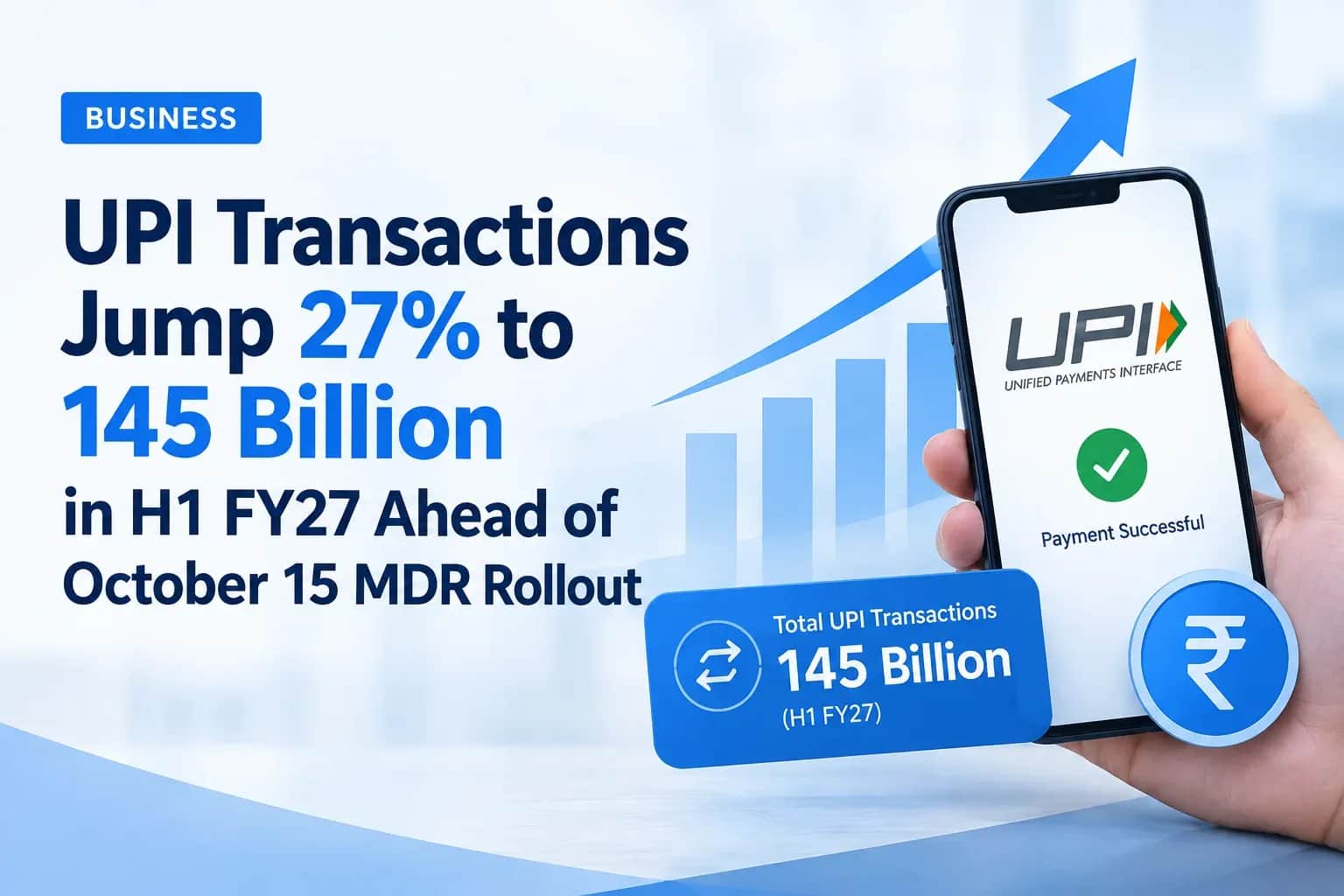
UPI transactions rose 27% in April–September 2026, ahead of new merchant fees starting 15 October, while consumers remain protected from direct charges under the framework.
Key Highlights
PTI’s report of 2 October 2026 puts India’s Unified Payments Interface transaction count for April–September 2026 at around 145 billion. The NPCI data cited in that report records 114 billion transactions for the corresponding period a year earlier. The increase comes before new charges on specified merchant payments.
Person-to-person transfers remain free, with approximately 96% of merchant transactions also unaffected. The Ministry of Finance set out these protections in its 15 September 2026 announcement, Release ID 2310586. It placed responsibility on banks to stop merchants from passing MDR to customers. Payment apps cannot recover charges through platform fees or hidden charges either.
For P2PM vendors, zero MDR continues on UPI QR receipts of up to ₹1 lakh a month. For other eligible merchant payments, the standard MDR is 0.4% when the amount exceeds ₹2,000. At ₹75,000, the fee reaches ₹300; that is also the maximum for payments above ₹75,000.
Maintaining UPI as volumes grow requires continued spending on infrastructure, cybersecurity and customer service. These expenses are among the stated uses of MDR revenue in the “Merchant Discount Rate (MDR) on Select UPI (P2M) Transactions” FAQs, issued by the Department of Financial Services on 15 September 2026.
Merchants need not replace their QR codes for the transition. The document also allows time to prepare before implementation. It also distinguishes exempt P2PM vendors from regular merchants: receiving an individual payment above ₹2,000 does not remove a qualifying small vendor’s exemption.
UPI transaction value reached ₹177 lakh crore in H1 FY27, up 20% from ₹148 lakh crore a year earlier. September’s monthly totals fell, but daily transactions increased. NPCI figures cited in the 2 October 2026 report show why both measures need attention.
September’s shorter calendar helps explain the monthly decline. Our reading of the published figures is that daily volume offers the more useful comparison here: using the rounded averages, daily transactions increased by approximately 1.4%. These figures precede implementation and do not measure how merchants will respond after MDR starts.
After meeting Finance Minister Nirmala Sitharaman on 30 September 2026, the All India Mobile Retailers Association and All India Consumer Products Distributors Federation withdrew their protest call. They had scheduled the protest for 2 October 2026.
The delegation requested deferment until after the festive season and a committee to examine merchant concerns. In its statement, the delegation said it hoped the government would consider and address the concerns it had submitted. The withdrawal followed discussions; it did not announce a cancellation of MDR.
UPI’s half-year growth brings the merchant-fee rollout into focus. Under the published rules, merchants bear processing costs on specified payments; consumers continue using UPI free of charge. Our assessment separates the period covered by the figures from the period covered by the new fees. The figures show growth before implementation. The framework sets out who pays processing costs afterwards.
April–September 2026 accounted for around 145 billion UPI transactions. Against the previous year’s 114 billion for the same period, that represents a 27% increase.
According to one of the official sources, the new UPI MDR starts on 15th October 2026.
No. Under the framework, eligible merchants bear MDR. Merchants cannot pass it to customers.
No. Person-to-person UPI transfers remain free for the sender and recipient.
September had 30 days compared with August’s 31. Average daily transactions increased from 791 million to 802 million despite the lower monthly total.









.png&w=3840&q=75)


