
By continuing, you agree to LoansJagat's Credit Report Terms of Use, Terms and Conditions, Privacy Policy, and authorize contact via Call, SMS, Email, or WhatsApp
Disclaimer: The information published on LoansJagat is intended for general informational and educational purposes only and should not be considered financial, legal, or investment advice. Interest rates, loan terms, statistics, and other data may change over time and may vary by lender or source. Please verify the latest information and consult a qualified financial advisor or the respective Bank/NBFC before making any financial decisions.
Subscribe Now
About the author

Arshathul Afia
Arshathul Afia is a journalism graduate and fintech content writer with 4+ years of experience in digital publishing and research-led writing. She has written 200+ articles covering personal finance, lending, banking, digital payments, credit, insurance, and major financial developments in India. At LoansJagat, she focuses on simplifying complex fintech news, RBI updates, loan-related changes, policy developments, and industry trends for everyday readers. Her journalism background helps her approach stories with research, context, and clarity, while her SEO experience ensures content remains discoverable and relevant. She aims to make financial news easier to understand, practical, and useful for readers across India.
Related News
Simplify All Your Loans Into One Affordable EMI

Customers Served

Debt Consolidated

1200+ Reviews

Locations in India
Club all Loans & Credit Card Bills into Single EMI

Quick Apply Loan
Consolidate your debts into one easy EMI.

Takes less than 2 minutes. No paperwork.

10 Lakhs+
Trusted Customers

2000 Cr+
Loans Disbursed

4.7/5
Google Reviews

50+
Banks & NBFCs Offers
India’s 2026 UPI law change opens the door to merchant MDR on selected payments, while consumers and small merchants remain protected from new direct charges.
India’s UPI fee policy has entered a new phase. Parliament passed the Taxation and Other Laws (Amendment) Bill, 2026 in August, changing the legal position that had kept MDR barred on prescribed UPI merchant payments. Finance Minister Nirmala Sitharaman said the amendment does not impose a UPI tax on users, while the government does not intend to levy MDR on small merchants, according to the Akashvani News report dated 11 August 2026.
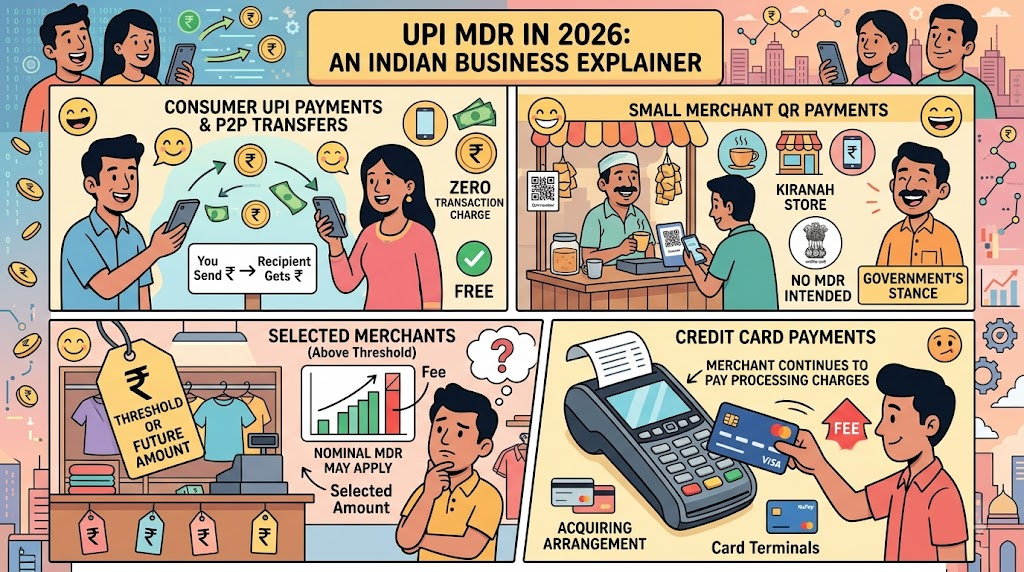
Consumer UPI payment → No transaction charge
Person-to-person transfer → Free
Small merchant QR payment → Government says no MDR is intended
Selected merchant payment above a future threshold → Nominal MDR may apply
Credit card payment → Merchant continues to pay processing charges under its acquiring arrangement
For most households, the immediate payment experience should remain unchanged. A person paying a kirana store, pharmacy, taxi driver or neighbourhood service provider through a bank-linked UPI app is not being asked to pay a new transaction fee. The government has also said person-to-person UPI transfers will continue without charges.
That protection is important because UPI grew by making low-value digital acceptance easy for small sellers. Keeping routine QR payments free can protect that habit while larger commercial transactions are treated separately. There is still a possible indirect effect. If a large retailer eventually pays MDR on qualifying UPI sales, it may reduce cashback or payment-linked discounts. Customers could then feel a cost at checkout even though the government has not imposed a UPI user fee.
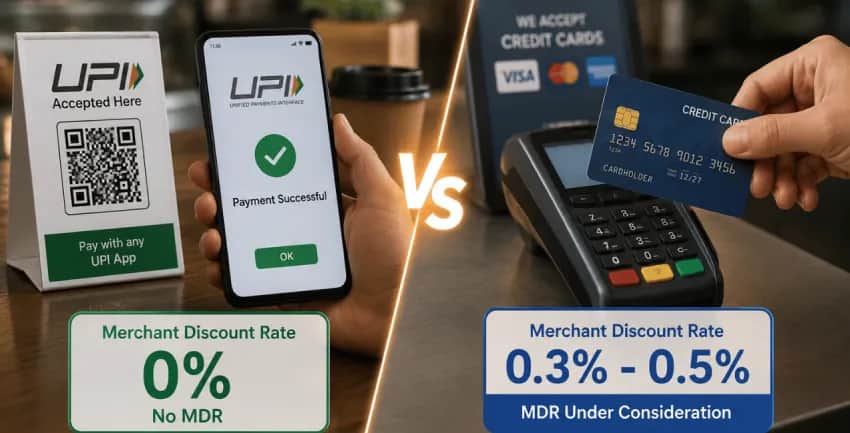
Credit cards and UPI follow different commercial models. When a merchant accepts a credit card, the payment moves through banks, processors, and card networks under an acquiring arrangement. The merchant generally pays a processing fee for that acceptance service. The commercial rate can vary by merchant, network, sector, and agreement.
UPI was treated differently by policy. From January 2020, MDR on prescribed UPI P2M transactions was set at 0% to encourage merchants to accept digital payments without losing part of each sale. Processing still had costs. Banks, payment service providers, and technology companies continued to spend on fraud controls, routing, dispute handling, servers, and security. Government incentives supported parts of this ecosystem instead of a standard merchant MDR.
The current position can be read quickly below.
The table shows why “UPI is free” needs precise wording. Consumers are protected from transaction charges, while standard UPI merchant MDR has also been 0% under the policy. Credit cards did not receive the same broad zero-MDR treatment. The 2026 amendment creates space for a limited UPI merchant fee without making every QR payment chargeable.
The current debate follows 6 years of zero-MDR policy. From January 2020, the government kept MDR at 0% on prescribed UPI merchant payments. This reduced the direct acceptance cost for shops and helped QR payments spread across organised retail and small local businesses.
The government later supported low-value UPI acceptance through incentives. A Press Information Bureau release dated 24 March 2025 said the Union Cabinet approved a ₹1,500 crore scheme for FY2024-25. Eligible UPI payments of up to ₹2,000 received by small merchants carried a 0.15% incentive for participating payment entities, while the merchant still faced 0% MDR.
By 2026, UPI had reached a very different scale. The Ministry of Finance said on 8 August 2026 that UPI processed 2,366 crore transactions worth ₹29.9 lakh crore in July 2026. The government linked the legal change to stronger fraud prevention, cybersecurity and payment infrastructure. It also said subsidies alone cannot fund the next phase of growth.
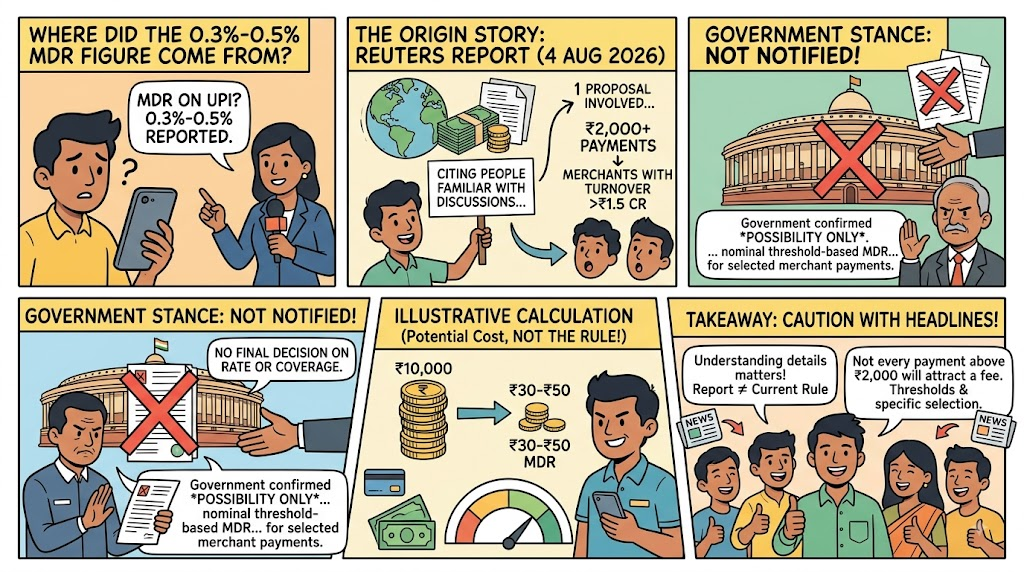
The headline range has not been notified by the government. Reuters reported on 4 August 2026, citing people familiar with the discussions, that 1 proposal involved a 0.3%-0.5% MDR on UPI payments above ₹2,000 for merchants with annual turnover above ₹1.5 crore. Reuters also reported that no final decision had been taken on the rate or coverage.
That distinction is crucial for anyone reading headlines about “UPI charges”. The government has confirmed only the possibility of a nominal, threshold-based MDR for selected merchant payments. It has not said every payment above ₹2,000 will attract a fee. As an illustration, a 0.3%-0.5% charge on a qualifying ₹10,000 payment would equal ₹30-₹50 for the merchant. That calculation explains the possible cost but does not describe the current rule.
The government’s position focuses on keeping everyday UPI free. Sitharaman told Parliament that consumers will not be charged and small merchants are not intended to be covered. The Ministry of Finance said on 8 August 2026 that any future MDR would cover only a limited set of merchant transactions, above a threshold, at a nominal rate lower than card MDR. It also said the UPI and Services Steering Committee headed by NPCI would decide the MDR, if any.
Payment companies have argued that rising transaction volumes require a revenue route for technology and infrastructure. A LoansJagat analysis published on 17 July 2026 also points towards a graded approach. Restricting any merchant fee to larger businesses and higher-value payments could bring revenue into the payments ecosystem without disturbing small-ticket QR payments used by households every day.
There is a practical reason for that approach. A blanket MDR could make a tea stall and a large online retailer pay under the same fee structure even though their transaction sizes, margins and payment volumes are very different. A turnover test combined with a transaction-value threshold could separate those merchant groups more effectively.
Any final notification should therefore specify the merchant-turnover cut-off, transaction threshold, MDR rate, exemptions and start date. It should also separate merchant MDR from consumer charges so businesses cannot present the fee as a compulsory UPI surcharge for customers. That wording will be especially important at online checkout pages and large retail counters.
UPI’s original policy priority was adoption. Making MDR 0% lowered one barrier for merchants, particularly businesses deciding whether a QR payment was worth accepting for a small purchase. Government incentives then helped payment participants handle low-value transactions without charging merchants directly.
The policy challenge in 2026 is different. UPI is already used at scale, while banks and payment companies continue spending on transaction capacity, fraud detection, cybersecurity and support systems. The Ministry of Finance’s 8 August statement said the payment ecosystem needs a self-sustaining revenue model and greater private-sector participation for further expansion.
This does not automatically mean MDR must apply widely. The stronger policy option is to preserve the part of UPI that made it popular while creating a separate commercial model for selected large merchants. If that line is maintained, a neighbourhood seller should not face the same payment cost as a large company processing thousands of high-value transactions.
The 2026 change does not end free UPI for Indian consumers. It gives the government and the NPCI-led committee room to consider MDR for selected merchant payments after years of a 0% merchant-fee policy. Small merchants and person-to-person transfers remain outside the proposed paid category under the latest government position.
Credit cards continue with merchant processing charges because card acceptance follows a fee-funded commercial model. UPI reached the same checkout counter through a different policy route, with 0% MDR helping merchant adoption. The next major development will be the final merchant-fee decision, if one is issued.
Until that happens, the 0.3%-0.5% MDR range should be described only as a reported proposal. It is not a new UPI rate already in force, and ordinary consumers have not been told to pay a new transaction fee.
No. A selective merchant MDR is possible, but the final rate, threshold, and implementation date have not been notified.
No. The government says consumers and person-to-person UPI transfers will continue without transaction charges.
The government says small merchants are not intended to be covered under the proposed merchant-fee structure.
No. Reuters reported the range on 4 August 2026 as a proposal still under discussion.
Card acceptance uses a commercial processing chain, with merchants paying fees under their acquiring agreements.









.png&w=3840&q=75)


