
By continuing, you agree to LoansJagat's Credit Report Terms of Use, Terms and Conditions, Privacy Policy, and authorize contact via Call, SMS, Email, or WhatsApp
Disclaimer: The information published on LoansJagat is intended for general informational and educational purposes only and should not be considered financial, legal, or investment advice. Interest rates, loan terms, statistics, and other data may change over time and may vary by lender or source. Please verify the latest information and consult a qualified financial advisor or the respective Bank/NBFC before making any financial decisions.
Subscribe Now
About the author

Arshathul Afia
Arshathul Afia is a journalism graduate and fintech content writer with 4+ years of experience in digital publishing and research-led writing. She has written 200+ articles covering personal finance, lending, banking, digital payments, credit, insurance, and major financial developments in India. At LoansJagat, she focuses on simplifying complex fintech news, RBI updates, loan-related changes, policy developments, and industry trends for everyday readers. Her journalism background helps her approach stories with research, context, and clarity, while her SEO experience ensures content remains discoverable and relevant. She aims to make financial news easier to understand, practical, and useful for readers across India.
Related News
Simplify All Your Loans Into One Affordable EMI

Customers Served

Debt Consolidated

1200+ Reviews

Locations in India
Club all Loans & Credit Card Bills into Single EMI

Quick Apply Loan
Consolidate your debts into one easy EMI.

Takes less than 2 minutes. No paperwork.

10 Lakhs+
Trusted Customers

2000 Cr+
Loans Disbursed

4.7/5
Google Reviews

50+
Banks & NBFCs Offers
The rate of used-car financing is higher than new-car financing in India. The primary reason is lower costs, easier payments, and formal credit, which draws buyers across India into the credit market.
India’s used-car finance market has moved into a faster growth lane than new-car lending. Business Standard reported on August 19, 2026, citing CRIF High Mark’s August 2026 Wheels & Ambition report, that used-car financing grew at a 26.2% 5-year CAGR between June 2021 and June 2026. Auto loans grew at 17.6% over the same period. The shift involves banks, NBFCs, organised used-car sellers and borrowers across India. Lower vehicle prices, smaller loan amounts and easier access to monthly repayment plans are driving it.
For households, the short-term gain is access. A buyer who cannot comfortably fund a new vehicle may still be able to finance a 3-year-old or 4-year-old car with a smaller principal amount. The longer-term risk comes from treating a low EMI as the full cost of ownership. Interest, insurance, repairs and existing debt can push the monthly burden higher. CRIF found that used-car borrowers carrying 2 or more active loans rose from 4.8% in June 2021 to 6.7% in June 2026.
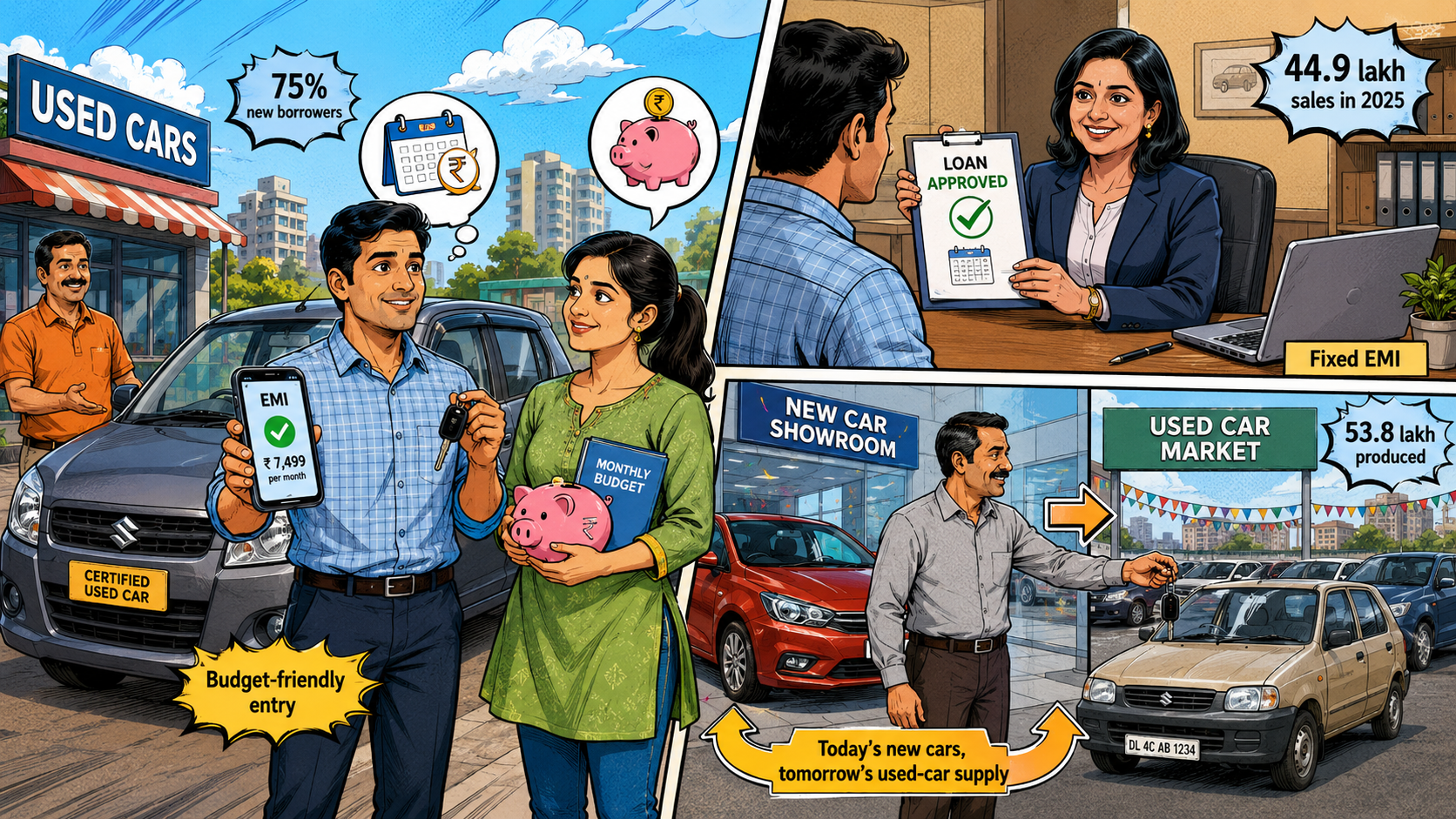
First-time owners and households with fixed monthly budgets stand to benefit most. CRIF reported that around 75% of used-car loan originations in Q1 FY27 came from new-to-product borrowers. Formal finance gives these buyers a fixed repayment schedule and lets them preserve part of their savings rather than paying the entire vehicle price upfront.
There is also a large supply base feeding the second-hand market. According to an Unstarred Question No. 1737 answer given on February 10, 2026, by the Ministry of Heavy Industries, passenger vehicle sales and production during the initial part of the year 2025, specifically January to December, stood at 44.9 lakh and 53.8 lakh, respectively. The Ministry of Heavy Industries stated the data was obtained from an industry association called SIAM. The vehicles sold today will turn into resale stock at a later point when the owner decides to upgrade.
The comparison below captures the shift without reducing the story to 1 growth figure. Used-car finance is expanding quickly, while new-car borrowing is moving towards larger tickets.
CRIF High Mark’s August 2026 data provides the figures in the table. The numbers explain why EMI has become a stronger sales tool. The financed amount for a used car is usually lower, even though a pre-owned vehicle can carry a higher interest rate. For someone choosing between a higher-priced new SUV and a younger used model, the smaller principal can keep the monthly payment within budget.
Government registration systems are also making vehicle transfers more formal. The VAHAN portal under Parivahan of the Ministry of Road Transport and Highways manages registrations and service requests for transfer of ownership. Digitized documents do not eliminate the need for mechanical inspection, but they make it easier to validate documents for used car sales.
CRISIL Ratings gave a direct explanation on August 4, 2026. Anuj Sethi, Senior Director at CRISIL Ratings, said used-car volumes were expected to grow 7-9% in FY27, led by first-time buyers who account for nearly 2/3 of transactions. CRISIL expects organised used-car volumes to cross 7 million vehicles this fiscal. Its analysis also found used hatchbacks and sedans about 25% cheaper than comparable new vehicles over 5 years, while used utility vehicles offered savings of around 20%.
The solution for buyers is to compare total repayment, not the EMI shown on a dealer screen. Extending the tenure can lower the monthly instalment while keeping interest running for longer. A January 2, 2026 LoansJagat guide on used-car loan interest rates advises borrowers to compare lender offers and inspect insurance, the registration certificate, service records and the vehicle’s condition. The practical test is simple: car price, loan cost and likely maintenance should be checked together before signing.
For borrowers, the current finance boom creates a less obvious trade-off. Because the vehicle being purchased is used, the lender perceives greater risk and will charge a higher interest rate to offset the cost of potentially having to resell the vehicle. While the purchase price may be lower and the monthly payment may be affordable, a higher interest rate will increase the cost of credit unless your credit places you in a particularly strong position. A larger down payment will lower the amount you have to finance, but keep in mind emergency savings.
The finance surge began in August 2026. CRISIL Ratings anticipated the situation as early as July 11, 2025, when they reported that used-car sales were likely to reach 6 million units in the fiscal. CRISIL predicted used-car sales would grow at 10%, compared to new-car sales, which were predicted to grow at the time by only 5%. CRISIL attributed the positive change to the digital adoption of customers coupled with the partnerships of lenders with online platforms, which improved the availability of credit.
By January 14, 2026, lenders were showing stronger interest in pre-owned vehicles. ICRA’s thematic report, Lenders Shift Focus to Pre-Owned Vehicles, projected pre-owned vehicle finance AUM to grow at a 16-18% CAGR during FY26-FY27, compared with 14-16% for new vehicles. ICRA also projected pre-owned vehicles could account for more than 41% of NBFC vehicle-finance AUM by March 2027, against 34% in March 2020.
Organised platforms have changed how these transactions happen. Inspection, refurbishment, finance, insurance, and delivery can now be offered in 1 place. CRISIL’s August 4, 2026 release estimated organised companies account for around 26% of used-car sales, up from 20-21% in FY22. The informal market remains larger, but younger cars and easier financing are pulling more transactions towards organised sellers.
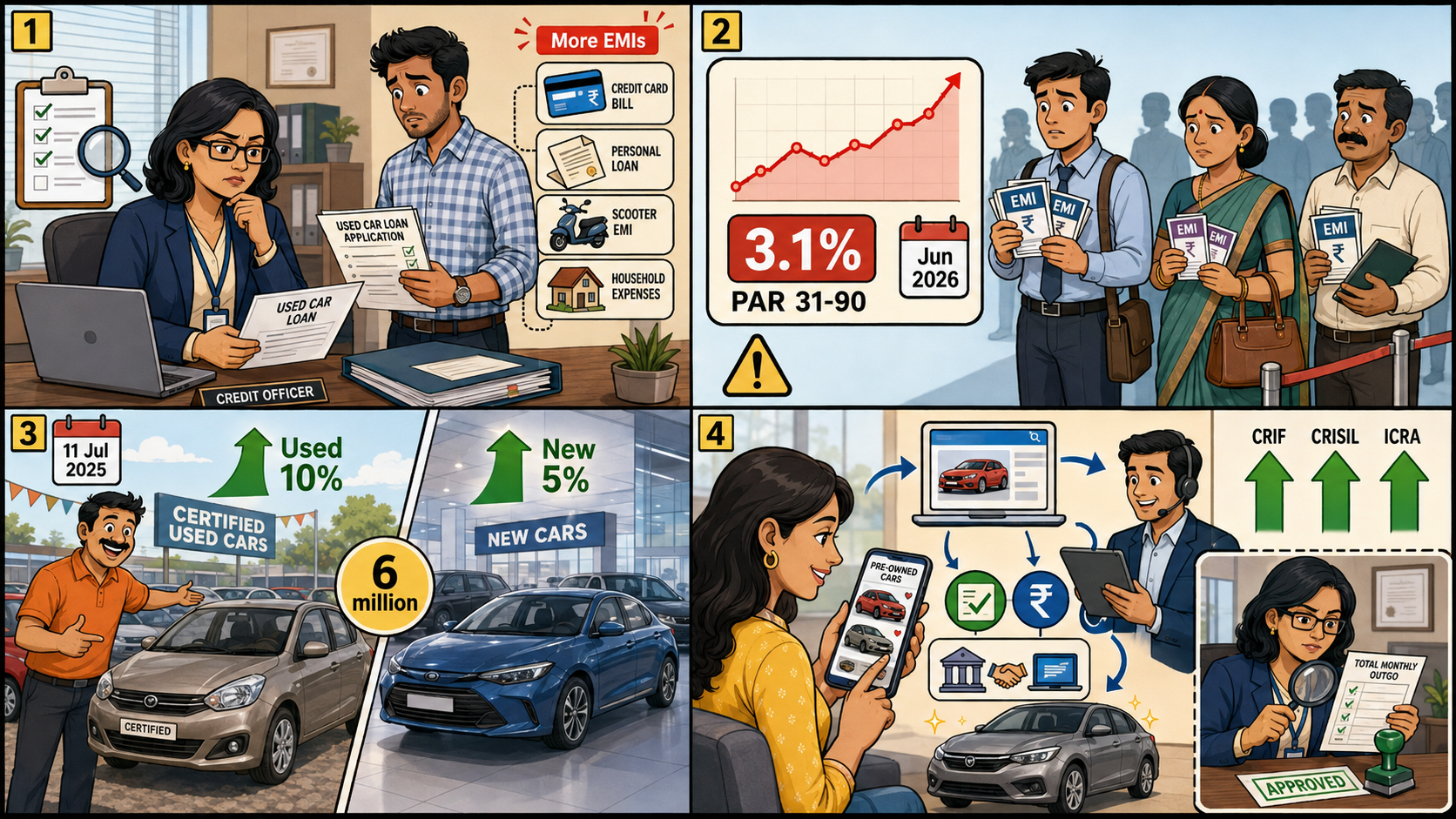
Lenders are watching repayment quality as new customers enter formal used-car credit. CRIF’s August 2026 report placed early-stage delinquency, measured as PAR 31-90 days, at 3.1% in June 2026. The increase in customers holding several active loans is another warning. Approving a car EMI requires checking the borrower’s existing monthly obligations, not only the resale value of the vehicle.
The finance surge began in August 2026. CRISIL Ratings anticipated the situation as early as July 11, 2025, when they reported that used-car sales were likely to reach 6 million units in the fiscal. CRISIL predicted used-car sales would grow at 10%, compared to new-car sales, which were predicted to grow at the time by only 5%. CRISIL attributed the positive change to the digital adoption of customers coupled with the partnerships of lenders with online platforms, which improved the availability of credit.
CRIF’s borrower growth, CRISIL’s volume forecast and ICRA’s lender projections point in the same direction. More people are financing pre-owned cars, and lenders are allocating more credit to them. The next test is whether loan checks keep pace, particularly when a borrower already has several EMIs.
Used-car financing is growing faster than new-car lending because it gives buyers a cheaper entry point into car ownership while lenders gain access to a rapidly formalising segment. The 26.2% 5-year growth rate is striking, but the arrival of first-time borrowers may prove more important over time.
There is a warning behind the growth. An affordable EMI does not make every loan affordable. Buyers still need room for insurance, fuel, repairs and existing debt. If lenders keep approvals tied to repayment capacity and borrowers compare the full ownership cost rather than the monthly figure alone, used-car finance can expand without turning smaller EMIs into heavier household debt.
Price reductions of cars mean smaller loan amounts are required. Also, purchasers have easier access to organized formal loans due to digitization of the process by organized car sellers.
The answer can be either. A lower selling price of a used car may lower the principal amount and equate to a lower monthly equated instalment (EMI). However, the used-car loan interest rate may be high.
One should check the interest rate, the payment tenure, the total interest, the down payment amount, insurance, the vehicle registration certificate (RC), the service and vehicle condition history, and the expected cost of repair.
A smaller used-car loan is less risky than a bigger new-car EMI. The used-car EMI leaves enough room in the budget to sustain savings.
A smart buyer considering a used-car purchase may save more money by buying used, even with the inspection fee. The buyer should consider the cost of maintaining a used car.









.png&w=3840&q=75)


