By continuing, you agree to LoansJagat's Credit Report Terms of Use, Terms and Conditions, Privacy Policy, and authorize contact via Call, SMS, Email, or WhatsApp
Disclaimer: The information published on LoansJagat is intended for general informational and educational purposes only and should not be considered financial, legal, or investment advice. Interest rates, loan terms, statistics, and other data may change over time and may vary by lender or source. Please verify the latest information and consult a qualified financial advisor or the respective Bank/NBFC before making any financial decisions.
Subscribe Now
About the author

Arshathul Afia is a journalism graduate and fintech content writer with 4+ years of experience in digital publishing and research-led writing. She has written 200+ articles covering personal finance, lending, banking, digital payments, credit, insurance, and major financial developments in India. At LoansJagat, she focuses on simplifying complex fintech news, RBI updates, loan-related changes, policy developments, and industry trends for everyday readers. Her journalism background helps her approach stories with research, context, and clarity, while her SEO experience ensures content remains discoverable and relevant. She aims to make financial news easier to understand, practical, and useful for readers across India.
Related News
Simplify All Your Loans Into One Affordable EMI

Customers Served

Debt Consolidated

1200+ Reviews

Locations in India
Club all Loans & Credit Card Bills into Single EMI

Quick Apply Loan
Consolidate your debts into one easy EMI.

Takes less than 2 minutes. No paperwork.

10 Lakhs+
Trusted Customers

2000 Cr+
Loans Disbursed

4.7/5
Google Reviews

50+
Banks & NBFCs Offers
Other services mentioned in this article
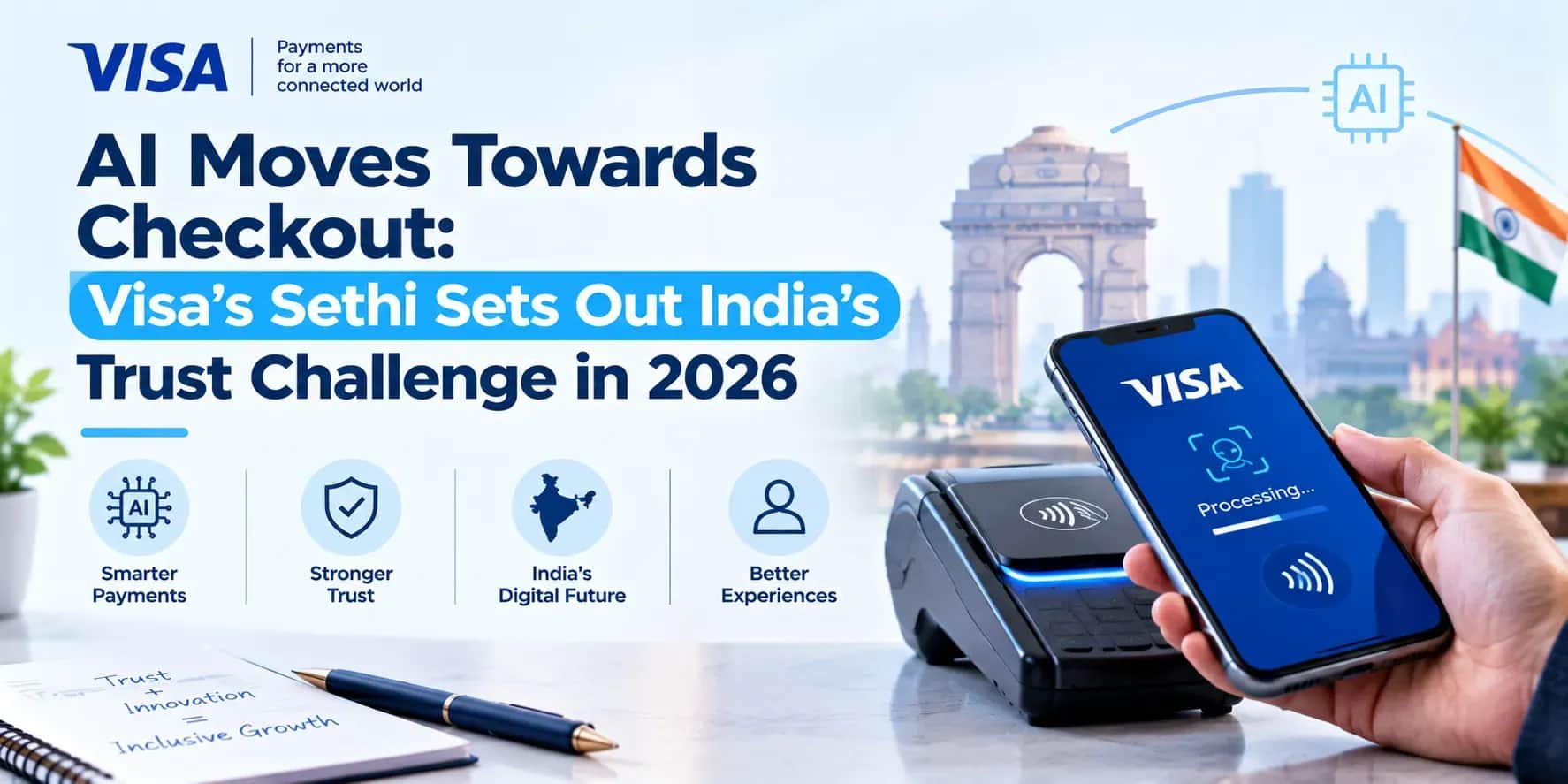
Visa’s Suresh Sethi says India’s AI shopping ambitions depend on trusted agents, consumer permission and secure payments, as technology moves closer to completing purchases online.
Key Takeaways
At Global Fintech Fest 2026 in Mumbai, Visa's Suresh Sethi addressed India's challenge with AI checkout. His interview was published in The Economic Times on 15 September, and updated on 14 October 2026. The message: People may wish to select and purchase products via AI agents, but they need to be able to rely on the software that guides them on those purchases.
That can be less time spent comparing products, and completing orders, for Indian households. Conversational tools might also help people who struggle with complicated shopping applications. The risk arrives when a recommendation becomes a purchase. An agent that misunderstands instructions could order the wrong item or spend beyond the intended budget. Sethi described Visa’s direction for commerce, rather than announcing universal access across Indian stores.
Visa’s Intelligent Commerce documentation describes AI helping consumers discover products, make decisions and complete transactions with permission. A family might request a helper to make a comparison between replacement appliances within a range. That is an example of what the proposed experience would look like, but doesn't mean it will be available at all retailers. Visa lists some of the controls businesses can take to prevent fraud, including spending limits, approval processes, and authentication.
Merchants face another task. Their websites must distinguish approved shopping agents from harmful bots. A customer could otherwise authorise an assistant that a retailer blocks before checkout. Conversely, accepting software without checking its identity could expose the store to misuse. Visa’s approach seeks to make legitimate agents recognisable while preserving controls over payment access.
“For any DPI, trust is something you cannot bolt on,” Sethi told The Economic Times. He discussed agent identification, tokenisation, authentication and faster cybersecurity responses. His concern reaches beyond whether money arrives: consumers also need the agent to follow their instructions. That distinction separates a successful payment from a successful purchase.
Cloudflare chief strategy officer Stephanie Cohen said that “securing the future of commerce is a shared responsibility” in Visa’s 14 October 2025 announcement. Cloudflare helped develop the Trusted Agent Protocol, which uses agent-specific cryptographic signatures to communicate information to merchants. Such checks support recognition.
Visa’s October 2025 protocol addressed communication between agents and merchants using existing web infrastructure. Its Intelligent Commerce programme covers payment credentials, controls and authentication. Visa’s product documentation says deployment continues and warns that final features may differ from those described.
DD News reported on 24 June 2026 that McKinsey expected AI tools to move further into completing purchases. The report also identified consumer trust as a barrier. That earlier coverage provides context for Sethi’s argument; it does not demonstrate that Indian consumers have already delegated everyday spending to AI.
The Ministry of Finance’s release “UPI completes 10 glorious years, Emerges as World’s Largest Real-Time Payments Platform, Anchoring India’s Digital Economy” appeared on 30 April 2026, under PIB Release ID 2257087. Its figures describe existing UPI activity, not AI shopping adoption.
20 July 2026, Minister of State for Finance Pankaj Chaudhary made all these points in his reply to the Lok Sabha. Their current safeguards demonstrate the need for additional checks and balances around access and identity for new interfaces.
We examined agents entering payment operations on 5 September 2026. For borrowers, the implication is permission design: allowing software to buy an item should not become an assumption that the customer also wants finance.
A shopper comparing appliances needs to see the total price separately from any instalment offer. An assistant that prioritises a smaller monthly payment could overlook the buyer’s preference to avoid borrowing. This is analysis of the proposed buying journey, not evidence that Visa agents currently select loans. The spending instruction should specify whether credit is acceptable before any financing decision. The customer needs a chance to refuse financing before approving any payment.
Sethi’s argument puts consumer permission alongside merchant verification. India’s payment scale provides a starting point, but successful AI checkout will depend on accurate orders, bounded authority and usable records when purchases go wrong.
Agentic commerce lets AI assistants help consumers find products, compare options and complete purchases with permission. Visa describes several levels of involvement, depending on deployment.
Sethi described Visa’s direction for trusted AI commerce during Global Fintech Fest 2026.
His interview did not establish universal availability across merchants or payment applications.
Visa's protocol makes it possible for merchants to identify approved agents and differentiate them from malicious bots. It offers information sharing, but not a suitable purchase.
Trust depends on the service, spending permissions and available controls, rather than the AI label alone. Visa identifies authentication, approval workflows and limits as safeguards.
Sethi’s remarks do not establish automatic EMI selection as a feature. Permission to purchase should specify whether financing is acceptable before an assistant considers borrowing.