
Disclaimer: The information published on LoansJagat is intended for general informational and educational purposes only and should not be considered financial, legal, or investment advice. Interest rates, loan terms, statistics, and other data may change over time and may vary by lender or source. Please verify the latest information and consult a qualified financial advisor or the respective Bank/NBFC before making any financial decisions.
Subscribe Now
About the author

Arshathul Afia is a journalism graduate and fintech content writer with 4+ years of experience in digital publishing and research-led writing. She has written 200+ articles covering personal finance, lending, banking, digital payments, credit, insurance, and major financial developments in India. At LoansJagat, she focuses on simplifying complex fintech news, RBI updates, loan-related changes, policy developments, and industry trends for everyday readers. Her journalism background helps her approach stories with research, context, and clarity, while her SEO experience ensures content remains discoverable and relevant. She aims to make financial news easier to understand, practical, and useful for readers across India.
Related News
Simplify All Your Loans Into One Affordable EMI

Customers Served

Debt Consolidated

1200+ Reviews

Locations in India
Club all Loans & Credit Card Bills into Single EMI

Quick Apply Loan
Consolidate your debts into one easy EMI.

Takes less than 2 minutes. No paperwork.

10 Lakhs+
Trusted Customers

2000 Cr+
Loans Disbursed

4.7/5
Google Reviews

50+
Banks & NBFCs Offers
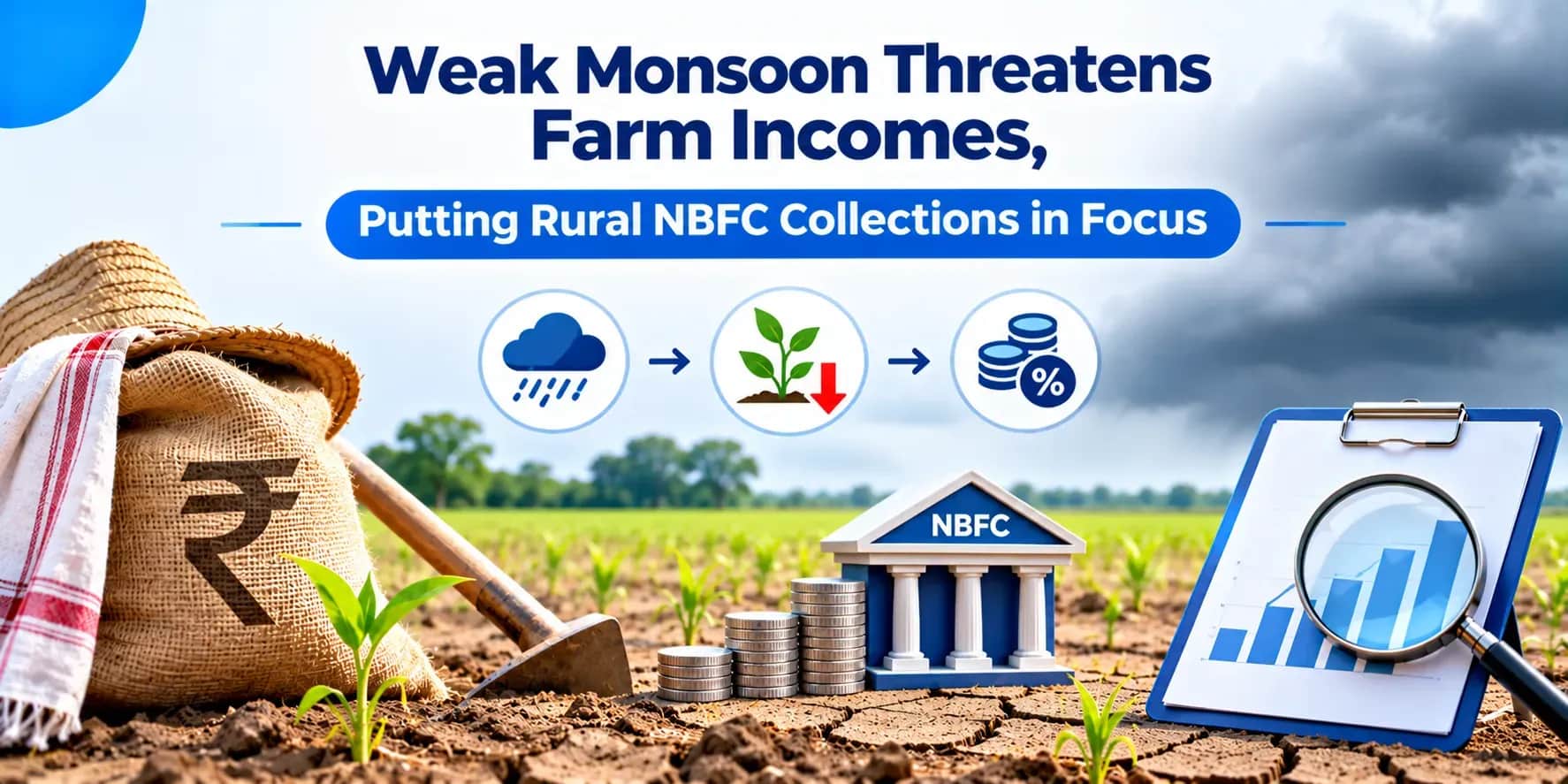
Rural NBFCs face repayment risks as drought conditions threaten farm incomes in affected states, while rising food costs put urban borrowers' loan repayments and household budgets under pressure.
Key Highlights
Drought conditions in six Indian states have raised concerns about farm incomes and the ability of rural borrowers to repay their loans. In its assessment, reported on 30 October 2026, Nomura warns of collection pressure for non-banking financial companies that lend to rural households or finance vehicles and consumption. Urban borrowers face another risk identified by the brokerage: food inflation reducing their ability to repay.
For lenders, the immediate concern is collections; sustained pressure would feed into credit costs and lending growth under Nomura's downside scenario. Salaried households face a different route of exposure through food expenditure. IMD's season-end report, released on 30 September 2026, recorded deficient rainfall, giving the lending warning an agricultural backdrop.
Crop earnings and farm work pay for household expenses as well as loan instalments. Nomura's concern is the combination of weak rainfall and depleted reservoirs, with rabi sowing also starting slowly. Its warning reaches beyond landowners because, as the brokerage notes, rural employment extends beyond farming.
Loan portfolios determine how directly lenders face that pressure. Urban-focused lenders with substantial mortgage and business-loan portfolios are less exposed in Nomura's assessment than rural and vehicle-focused NBFCs that also finance consumption. Its assessment concerns potential deterioration in repayment performance. Nomura is looking to November and December 2026 for a fuller picture of rural incomes and food inflation.
Nomura identifies food inflation as a threat to urban customers because essential expenditure reduces disposable income. For salaried households, that puts the household budget at the heart of this story. Income from employment and income from farming differ, but both have to cover living expenses alongside debt repayments.
The borrower analysis is therefore about cash available each month. A household's existing EMI commitments compete with essential expenditure within the same income. Nomura's warning draws attention to that relationship: repayment pressure can develop through higher living costs as well as weaker earnings. That distinction keeps the salaried-employee angle tied to the lending concern, without treating farm-income losses as salary losses.
The national rainfall total came to 87% of the long-period average in IMD's Salient Features of the 2026 Southwest Monsoon Season, released on 30 September 2026. A later forecast, the November outlook issued on 31 October 2026, projected below-normal rain across the country and IMD's specified South Peninsular region.
September's figure records rainfall already received. The November figure, however, describes expected rainfall. For the lending assessment, the distinction is between rainfall already measured and a shortage forecast for the coming month.
Crisil Ratings' 22 June 2026 release, Guardrails Bolster Microfinance Securitised Pool Performance, linked improved collections in selected pools to stronger underwriting and borrower selection. Associate Director Payal Anand indicated that rising loan disbursements would require continued monitoring of portfolio performance. The agency also warned that El Niño could affect rural incomes, posing additional risks.
For crop planning, Chouhan's instruction on 28 September 2026 was to start with the water available. Where irrigation was limited, pulses and oilseeds were Chouhan’s priority because they require less water. He asked for suitable seeds to reach farmers on time, with procurement arrangements included in production planning. Germination and productivity would suffer if sowing was delayed, he warned.
Weak rainfall has brought farm earnings and rural loan collections into sharper focus. Nomura's assessment separates lenders by their exposure, while Crisil's research points to better borrower checks as a support for selected portfolios. For salaried households, the related concern is food expenditure reducing the income available for repayments.
Crop activity and farm earnings are vulnerable when rainfall falls short. Nomura identifies pressure on rural incomes as a risk to borrowers' repayment capacity, particularly where lenders finance rural consumption, vehicles and microfinance borrowers.
In this story, Nomura's concern is household spending. Higher food expenditure leaves less disposable income for repayments. For salaried borrowers, that links the rural weather warning to the amount available for EMIs after essential purchases.
In Nomura's October 2026 outlook, urban-focused NBFCs with substantial mortgage and business lending are preferred. The greater exposure lies with rural, vehicle and consumption-focused portfolios.
Southwest monsoon rainfall finished at 87% of the long-period average in IMD's assessment dated 30 September 2026. Its outlook of 31 October 2026 then forecast below-normal rainfall for November, keeping agricultural water availability a concern.
Crisil's 22 June 2026 study linked better performance in selected securitised pools to lending safeguards, stronger underwriting and tighter borrower selection. Its findings concern those pools, while the agency continues to flag rural-income risks.
Start your journey today
Apply Now*T&C apply











