
By continuing, you agree to LoansJagat's Credit Report Terms of Use, Terms and Conditions, Privacy Policy, and authorize contact via Call, SMS, Email, or WhatsApp
Disclaimer: The information published on LoansJagat is intended for general informational and educational purposes only and should not be considered financial, legal, or investment advice. Interest rates, loan terms, statistics, and other data may change over time and may vary by lender or source. Please verify the latest information and consult a qualified financial advisor or the respective Bank/NBFC before making any financial decisions.
Subscribe Now
About the author

LoansJagat Team
‘Simplify Finance for Everyone.’ This is the common goal of our team, as we try to explain any topic with relatable examples. From personal to business finance, managing EMIs to becoming debt-free, we do extensive research on each and every parameter, so you don’t have to. Scroll up and have a look at what 15+ years of experience in the BFSI sector looks like.
Related Blog Post
Simplify All Your Loans Into One Affordable EMI

Customers Served

Debt Consolidated

1200+ Reviews

Locations in India
Club all Loans & Credit Card Bills into Single EMI

Quick Apply Loan
Consolidate your debts into one easy EMI.

Takes less than 2 minutes. No paperwork.

10 Lakhs+
Trusted Customers

2000 Cr+
Loans Disbursed

4.7/5
Google Reviews

50+
Banks & NBFCs Offers
Other services mentioned in this article
Global banks are resisting India’s offshore rupee data push because it could expose client details, clash with foreign laws, and raise compliance pressure in major trading hubs.
The latest friction between India and foreign lenders is over offshore rupee trade reporting. Bloomberg reported on 11 March 2026 that global banks had pushed back against a proposal seeking more disclosure on offshore rupee-linked foreign exchange transactions, especially where related parties are involved.
Their objection is not only about more paperwork. Banks are worried about client confidentiality, overlap with overseas regulations, and the wider signal that India wants tighter visibility over trades booked outside its jurisdiction. That is why the pushback has been sharp.
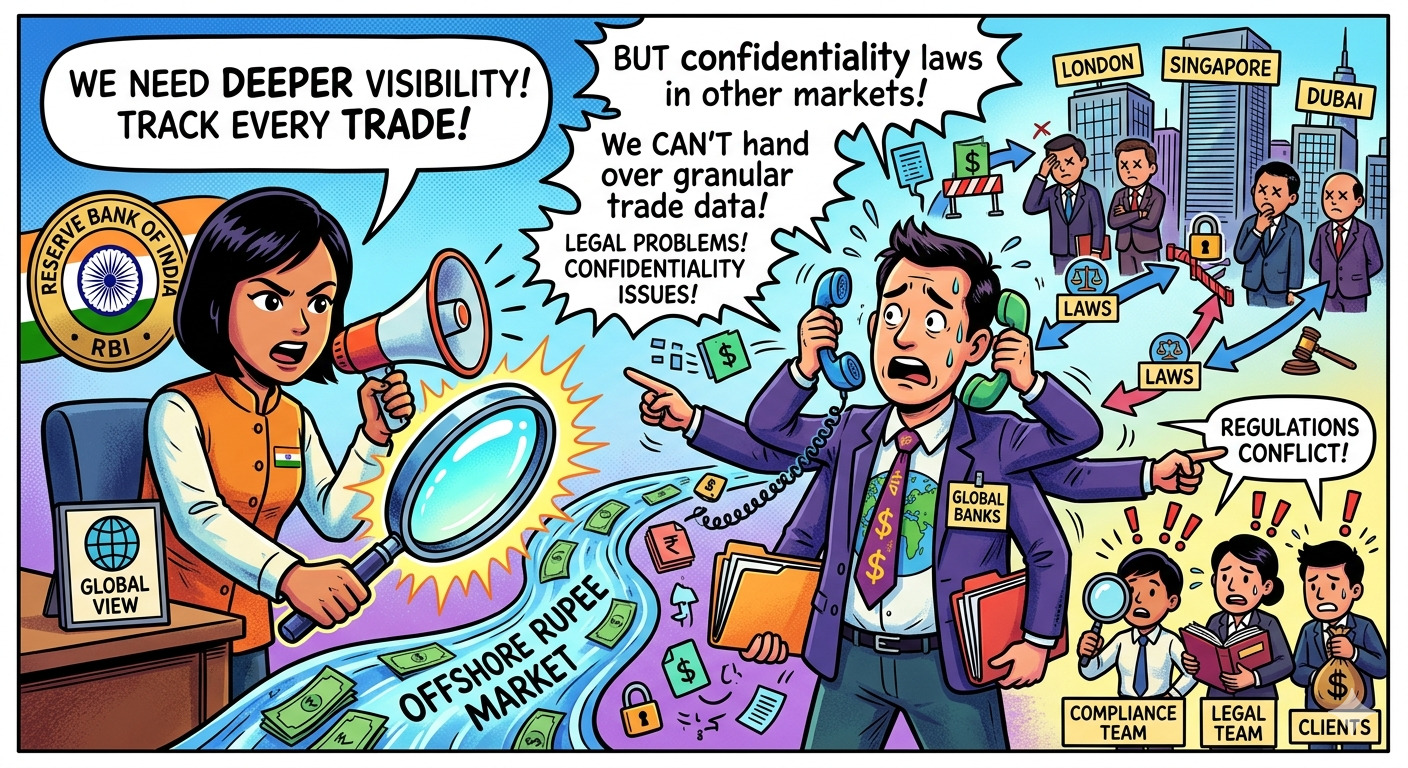
The core issue is simple. India wants deeper visibility into offshore rupee activity, while global banks do not want to hand over granular trade data that may be governed by laws in Singapore, London or Dubai. According to Bloomberg, 11 March 2026, foreign lenders said the proposal could create confidentiality and legal problems.
Read More - World Falling Into Another Banking Crisis
For these banks, the concern is that one regulator’s reporting demand can run into another market’s privacy or conduct framework. Once that starts, compliance teams, legal teams and clients all get dragged in.
The pushback is stronger because offshore rupee trading is now huge, and banks do not want fresh reporting obligations in a market that is already heavily watched.
This is why banks are wary. A bigger market means more clients, more counterparties and more legal exposure. LoansJagat, 23 September 2025 also cited the $161 billion and 140% jump while explaining how offshore rupee activity had accelerated.
This friction has been building for some time. Reuters reported on 12 October 2022 that banks were informally asked not to build fresh positions in the offshore non-deliverable forwards market.
At that stage, the 1-month USD/INR NDF rate was 7 paisa above the onshore rate, while the 3-month rate was around 25 paisa higher. Reuters later reported on 13 December 2022 that those restrictions were lifted after conditions stabilised.
Another reason banks are uneasy is the growing scale of offshore influence on rupee pricing.
*T&C Apply
That background explains why foreign banks are cautious. They see tighter data requests as part of a broader effort to track and shape offshore rupee activity.
Also Read - Axis Bank’s $500 Million Global Bet
What Stakeholders Are Saying?

Bloomberg said global banks fear the proposal could breach client confidentiality and conflict with overseas rules. Reuters, in earlier reports, quoted bankers and traders saying heavy curbs on offshore trading can distort pricing and push volatility elsewhere.
Global banks are resisting because the proposal brings legal risk, disclosure pressure, and extra compliance costs. For them, this is not a routine reporting change but a cross-border regulatory test.
.









.png&w=3840&q=75)



