
By continuing, you agree to LoansJagat's Credit Report Terms of Use, Terms and Conditions, Privacy Policy, and authorize contact via Call, SMS, Email, or WhatsApp
Disclaimer: The information published on LoansJagat is intended for general informational and educational purposes only and should not be considered financial, legal, or investment advice. Interest rates, loan terms, statistics, and other data may change over time and may vary by lender or source. Please verify the latest information and consult a qualified financial advisor or the respective Bank/NBFC before making any financial decisions.
Subscribe Now
About the author

Arshathul Afia
Arshathul Afia is a journalism graduate and fintech content writer with 4+ years of experience in digital publishing and research-led writing. She has written 200+ articles covering personal finance, lending, banking, digital payments, credit, insurance, and major financial developments in India. At LoansJagat, she focuses on simplifying complex fintech news, RBI updates, loan-related changes, policy developments, and industry trends for everyday readers. Her journalism background helps her approach stories with research, context, and clarity, while her SEO experience ensures content remains discoverable and relevant. She aims to make financial news easier to understand, practical, and useful for readers across India.
Related Blog Post
Simplify All Your Loans Into One Affordable EMI

Customers Served

Debt Consolidated

1200+ Reviews

Locations in India
Club all Loans & Credit Card Bills into Single EMI

Quick Apply Loan
Consolidate your debts into one easy EMI.

Takes less than 2 minutes. No paperwork.

10 Lakhs+
Trusted Customers

2000 Cr+
Loans Disbursed

4.7/5
Google Reviews

50+
Banks & NBFCs Offers
Other services mentioned in this article
The July 31 ITR deadline is fixed and eligible taxpayers have only a few hours left to submit their ITR. After midnight, late fees, interest, and restrictions will begin.
As of 5:03 pm IST Friday, the Central Board of Direct Taxes had not issued an extension for the July 31, 2026, income tax return deadline. The income tax department stated the deadline remained applicable for the eligible persons and HUFs filing ITR-1 and ITR-2 for income of FY 2025-26. This primarily included salaried persons, pensioners and persons reporting income from house property, capital gains, and interest income. The department also extended filing support and assistance by lines till 11:59 pm.
The short-term cost of missing midnight can include a late fee and interest where tax remains unpaid. The longer effect may be tougher for someone carrying eligible business or capital losses, since delayed filing can block their carry-forward. Refund claims remain possible through a valid belated return, but processing may begin later. A late acknowledgement can also slow a home loan, visa or other application that asks for recent income records.
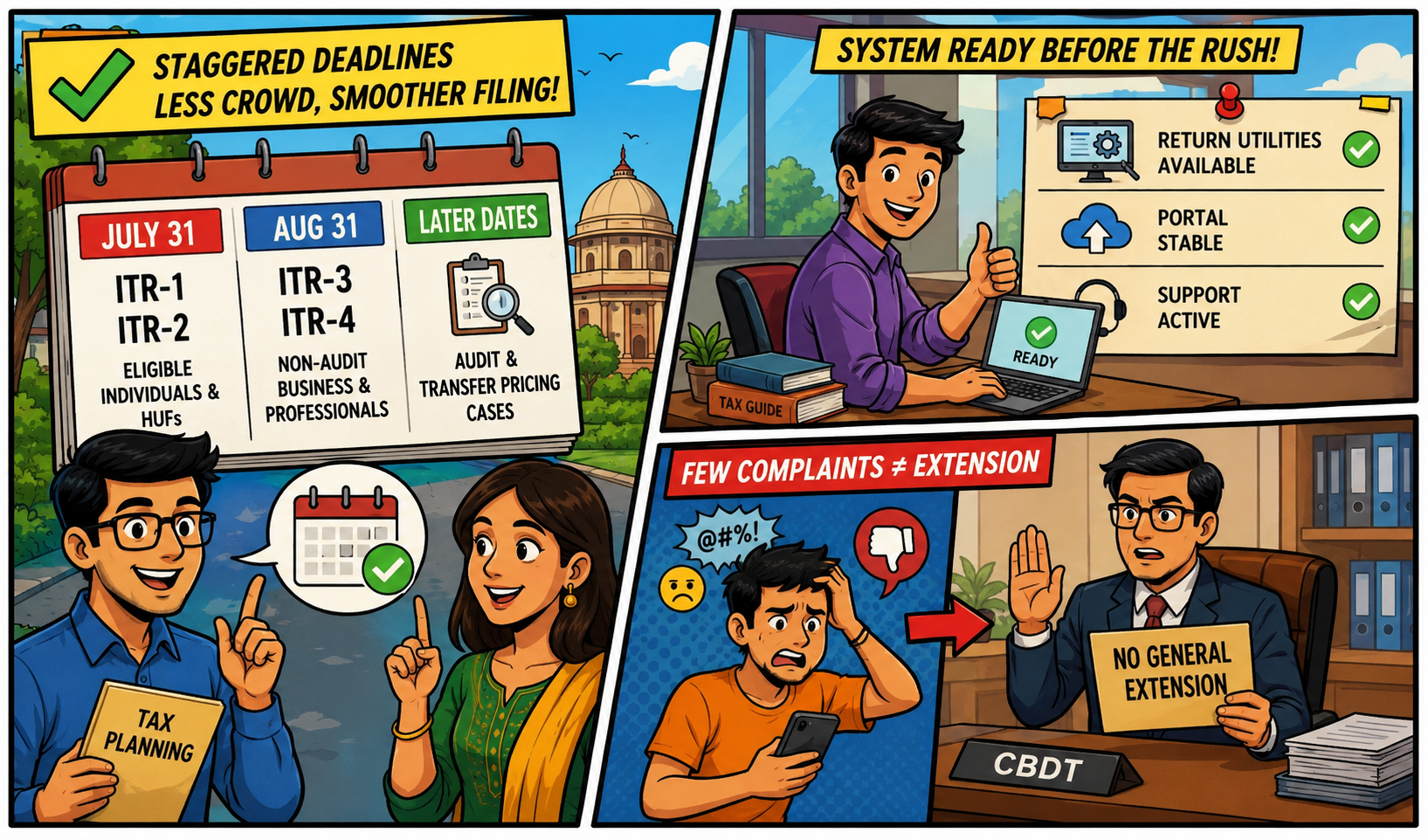
The 2026 calendar has split return filing across different dates. Eligible ITR-1 and ITR-2 taxpayers face July 31, while many non-audit business and professional filers using ITR-3 or ITR-4 have until August 31. Audit and transfer-pricing cases follow later dates. That spread reduces the crowding that once built up around a single July evening.
Return utilities were also available before the last week, and the portal had not suffered a nationwide breakdown. Technical complaints did appear on social media and professional groups asked for more time. Still, an error faced by some users is different from a system-wide failure. CBDT had not treated those complaints as grounds for a general extension by Friday evening.
A belated return remains available until December 31, 2026. It comes with conditions. Section 234F permits a fee of ₹1,000 where total income does not exceed ₹5 lakh and ₹5,000 in other cases. Interest may also be charged when tax was due but remained unpaid after July 31. The amount will vary from one return to another.
The less visible cost is often more serious. A taxpayer who sold shares or mutual funds at a loss may lose the chance to carry an eligible capital loss into a later year. The same problem can arise with certain business losses. Someone expecting a refund will still be able to claim it through a valid late return, though the file enters the system later and the money may take longer to reach the bank account.
There is one helpful option for people who have reliable documents but are stuck over a small omission. They can file the original return before midnight and correct an eligible error later through a revised return. That does not support rough estimates. Salary, TDS, rent, bank interest, dividends and investment sales should still be checked against Form 16, Form 26AS, AIS and personal records.
Tax professionals quoted by ET Wealth Online on July 31 did not speak in one voice. Sandeep Bhalla, partner at Dhruva Advisors, referred to requests from professional bodies and intermittent technical complaints. Abhishek Soni, chief executive and co-founder of Tax2win, placed the chance of relief lower because the portal had largely worked. Sanjoli Maheshwarri, executive director at Nangia & Co LLP, also advised taxpayers against waiting for a late announcement.
Their advice lands in the same place. Eligible taxpayers should file on the basis that July 31 is final unless CBDT publishes a written order. A WhatsApp forward, an old circular or a screenshot without a government URL does not change the due date. Final-hour filers should save payment references, download the acknowledgement and complete e-verification within the allowed period.
The LoansJagat review of common filing errors also points to a basic problem seen near the deadline. Taxpayers often accept pre-filled figures without checking bank interest, property income, capital gains or TDS entries. For borrowers, an inaccurate or delayed return can create extra questions during home loan and business loan checks. Filing quickly helps only when the numbers can be defended.
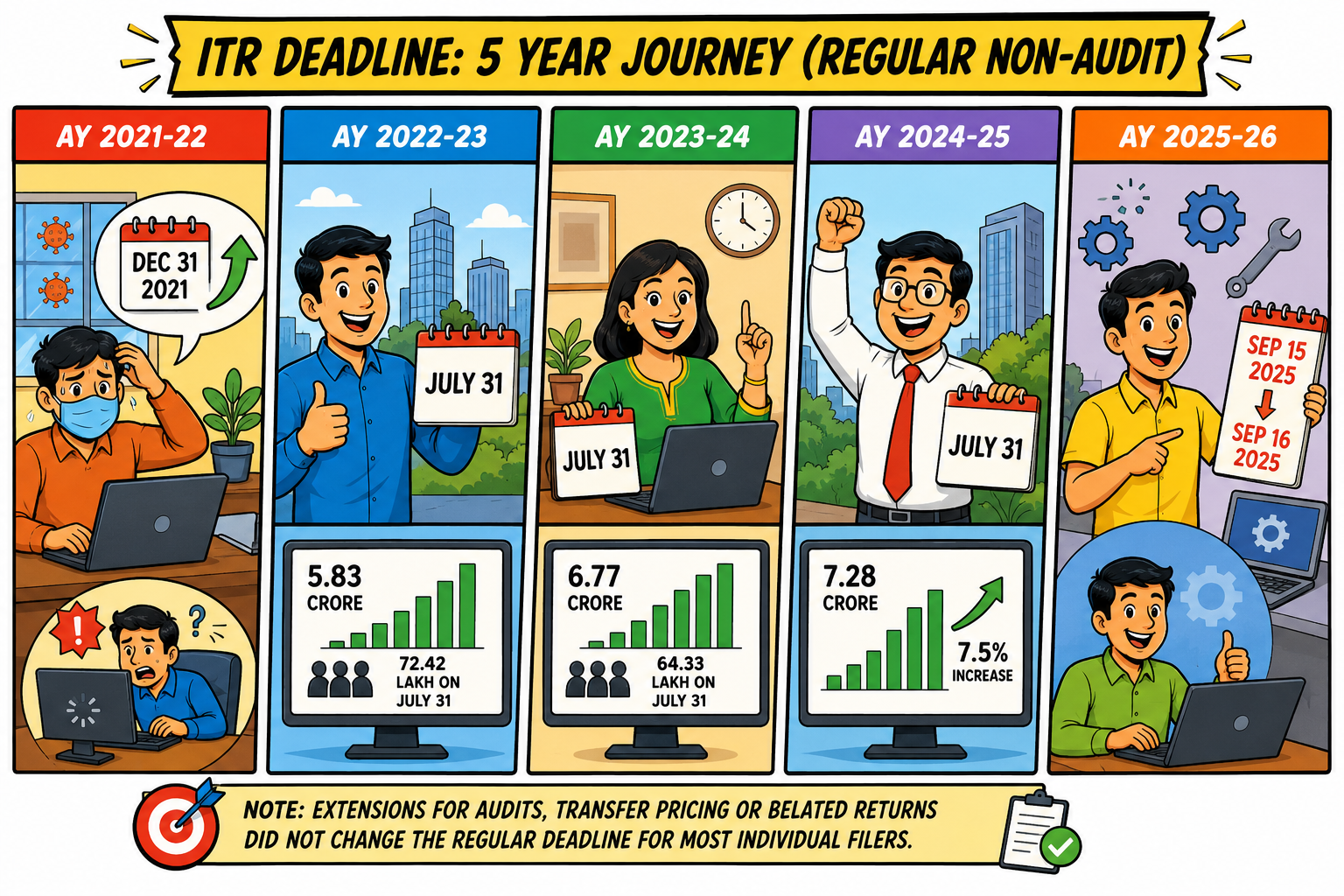
Deadline history is often quoted without naming the taxpayer group. That creates confusion. An extension for tax audits, transfer-pricing cases or belated returns did not automatically give salaried employees more time. The table tracks the regular non-audit date relevant to most individual filers.
The pattern is uneven, which is why we cannot forecast this year based on last year. Relief during the pandemic came in 2021. In 2025, the CBDT announced a change on May 27 about the notified forms that required system development and testing, so the deadline was changed to an earlier date. Relief was again provided. There was no such early order for AY 2026-27.
The 3 seasons between those extensions closed on July 31 for ordinary non-audit filers. Filing volumes rose, yet the department kept the date. That record does not prove CBDT can never act late. It does show that an extension is an exception requiring a formal order, not an annual feature.
The first check should be the return form. ITR-1 does not fit every salaried person, particularly where capital gains, foreign assets or other specified income is involved. The next check is income matching. Form 16 should be compared with Form 26AS and AIS, while savings interest, fixed-deposit interest, dividends, rent and investment sales need a separate look.
After any self-assessment tax is paid, the challan details should appear correctly in the return. The taxpayer should then submit and download the acknowledgement and verify the filing. When a payment or portal page fails, screenshots and transaction references should be saved. Repeated payments made in panic can create a second problem.
The ITR deadline of July 31, 2026, remained unchanged, and CBDT had not announced a formal extension. The official portal showed the same deadline for applicable ITR-1 and ITR-2. The cost of waiting for a rumor in the evening is real.
Taxpayers who miss the midnight deadline have a belated return option up to December 31, 2026. This option will likely incur a fee up to ₹5,000, interest on unpaid taxes, slower refunds and a limitation on some loss carry forwards. The best option is to file with due diligence verification and retain all documents.
No word from CBDT yet. As of now, no extension has been announced, so July 31 stays the last date.
Mostly individuals and HUFs who need to file ITR-1 or ITR-2. Think salaried folks, pensioners, and people with fairly straightforward income.
You're looking at up to ₹5,000. If your total income is under ₹5 lakh, though, the fee is capped at ₹1,000.
Yes, don't panic. You can file a belated return for AY 2026-27 anytime up to December 31, 2026.
Possibly, yes. Your return simply joins the queue a bit later for processing. But don't worry, a genuine refund claim isn't going anywhere, it'll still come through, just maybe not as quickly.
Yes. Uploading the return alone does not complete the filing process.









.png&w=3840&q=75)


