By continuing, you agree to LoansJagat's Credit Report Terms of Use, Terms and Conditions, Privacy Policy, and authorize contact via Call, SMS, Email, or WhatsApp
Disclaimer: The information published on LoansJagat is intended for general informational and educational purposes only and should not be considered financial, legal, or investment advice. Interest rates, loan terms, statistics, and other data may change over time and may vary by lender or source. Please verify the latest information and consult a qualified financial advisor or the respective Bank/NBFC before making any financial decisions.
Subscribe Now
About the author

Arshathul Afia is a journalism graduate and fintech content writer with 4+ years of experience in digital publishing and research-led writing. She has written 200+ articles covering personal finance, lending, banking, digital payments, credit, insurance, and major financial developments in India. At LoansJagat, she focuses on simplifying complex fintech news, RBI updates, loan-related changes, policy developments, and industry trends for everyday readers. Her journalism background helps her approach stories with research, context, and clarity, while her SEO experience ensures content remains discoverable and relevant. She aims to make financial news easier to understand, practical, and useful for readers across India.
Related News
Simplify All Your Loans Into One Affordable EMI

Customers Served

Debt Consolidated

1200+ Reviews

Locations in India
Club all Loans & Credit Card Bills into Single EMI

Quick Apply Loan
Consolidate your debts into one easy EMI.

Takes less than 2 minutes. No paperwork.

10 Lakhs+
Trusted Customers

2000 Cr+
Loans Disbursed

4.7/5
Google Reviews

50+
Banks & NBFCs Offers
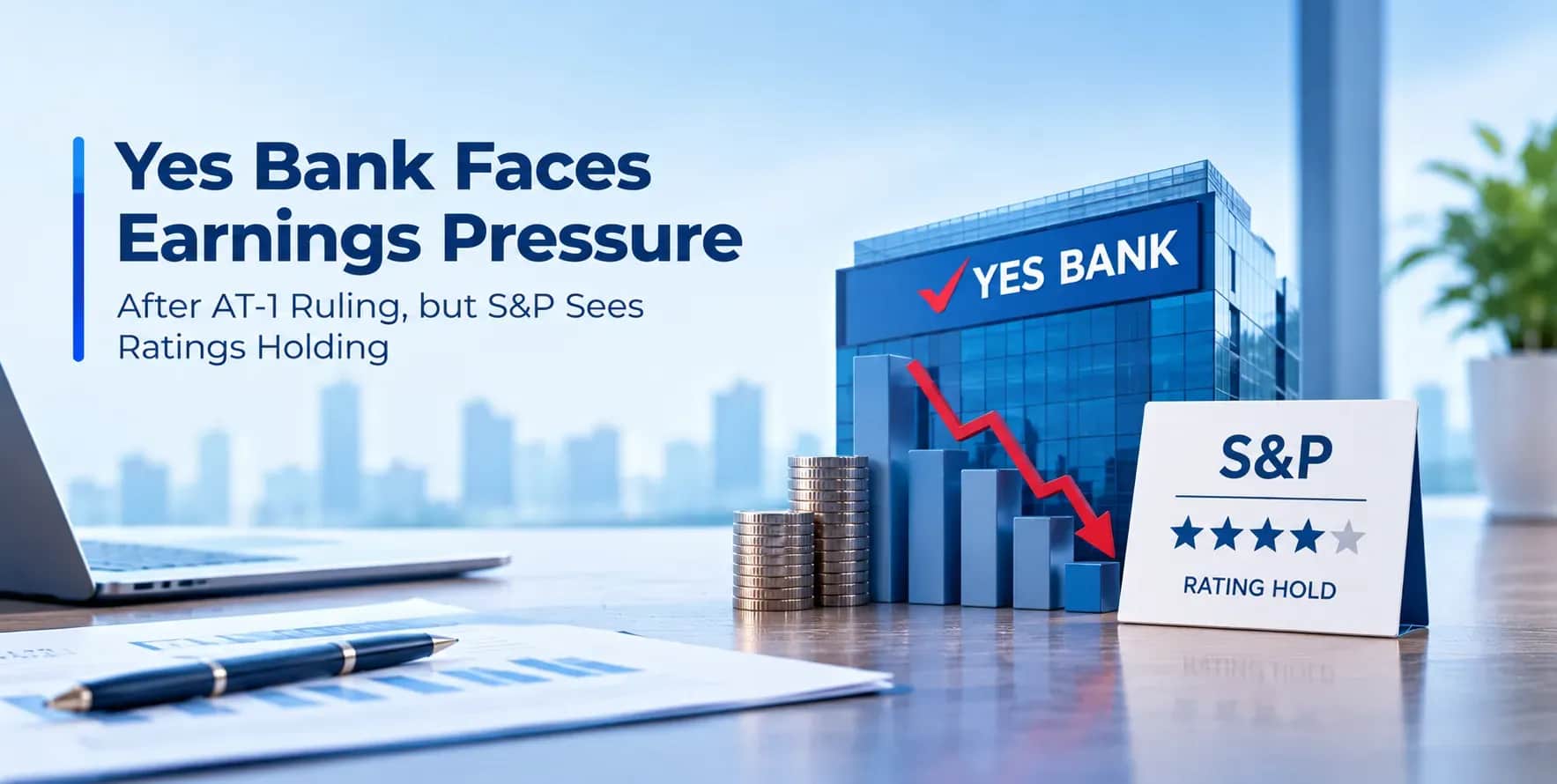
S&P expects Yes Bank’s ratings to withstand the AT-1 ruling, although restoring the bonds would put pressure on earnings and reduce the lender’s common equity.
Key Highlights
The judgment upheld the cancellation of a write-off carried out during Yes Bank’s March 2020 reconstruction. Bondholders retained their legal victory, while the lender faces an accounting adjustment and continuing servicing costs. Yes Bank said it was reviewing the judgment and its implications.
For AT-1 bondholders, the decision preserves their successful challenge to the write-off. Annual coupon payments remain governed by the instruments’ Information Memoranda. The dispute involved household savings as well as institutional investments: SEBI’s 7 September 2022 adjudication order recorded complaints from customers who said the bonds had been presented as comparable to fixed deposits.
For borrowers, our reading is narrower. The Yes Bank verdict addresses the lender’s obligations to bondholders; it should not be treated as an instruction to change loan repayments. A bond coupon is payable by the issuer to investors. A borrower’s EMI is payable under a separate loan agreement. Keeping those obligations apart prevents the earnings headline from being mistaken for a change in personal or home loan terms.
“We do not anticipate any meaningful impact on our total adjusted capital,” S&P said in its 15 October 2026 assessment. Reinstating the AT-1 instruments would restore a category of capital even as common equity falls. That offset underpins the agency’s view that Yes Bank can absorb the ruling.
The cost of servicing the bonds remains. Their coupons of 9% and 9.5% would put pressure on earnings, according to S&P. The agency’s assessment separates the bank’s capital position from its profitability: restored capital recognition does not cancel interest obligations. S&P said it would continue monitoring developments.
S&P’s assessment, reported on 16 October 2026, sets out the following capital measures. The projected figures are the agency’s estimates, rather than results reported by Yes Bank after the judgment.
S&P expects Yes Bank to remain adequately capitalised after the adjustment. Its risk-adjusted capital ratio and the regulatory CET1 ratio are different measures and should not be presented as interchangeable.
The final reconstruction scheme notified on 13 March 2020 omitted a write-down provision included in the draft. The administrator nevertheless ordered the bonds written down on 14 March 2020. His authority to take that action became central to the court challenge.
The Bombay High Court set aside the write-off on 20 January 2023. The Supreme Court’s 15 October 2026 judgment, 2026 INSC 1132, dismissed the appeals and left that decision undisturbed. The ruling concerns the authority and procedure used for this particular write-off.
Yes Bank said it was examining the judgment and would make further disclosures as required.
Before the verdict, finance chief Niranjan Banodkar had defended the bank’s actions as consistent with contractual obligations and permitted procedures. During the 18 April 2026 earnings call, he said the lender would await the court’s decision and update stakeholders on its impact. That position appears in the bank’s published transcript.
S&P expects Yes Bank to absorb the capital consequences of the AT-1 ruling, while the restored bonds bring servicing costs back into focus. The agency’s position supports the bank’s credit profile without suggesting that the earnings impact disappears.
The Supreme Court upheld the cancellation of Yes Bank’s AT-1 write-off on 15 October 2026. S&P expects the ruling to weigh on earnings without affecting its ratings.
Yes Bank wrote down the AT-1 bonds during its March 2020 reconstruction. The courts subsequently rejected the administrator’s authority to carry out that action under the final scheme.
S&P expects restored AT-1 capital to largely offset the common-equity reduction. Coupon payments would still reduce earnings.
The judgment concerns AT-1 bond obligations. Borrowers’ repayments remain governed by their loan agreements.
On 20 January 2023, the Bombay High Court set aside the write-off. Its decision remained stayed during the Supreme Court proceedings.