By continuing, you agree to LoansJagat's Credit Report Terms of Use, Terms and Conditions, Privacy Policy, and authorize contact via Call, SMS, Email, or WhatsApp
Disclaimer: The information published on LoansJagat is intended for general informational and educational purposes only and should not be considered financial, legal, or investment advice. Interest rates, loan terms, statistics, and other data may change over time and may vary by lender or source. Please verify the latest information and consult a qualified financial advisor or the respective Bank/NBFC before making any financial decisions.
Subscribe Now
About the author

Arshathul Afia is a journalism graduate and fintech content writer with 4+ years of experience in digital publishing and research-led writing. She has written 200+ articles covering personal finance, lending, banking, digital payments, credit, insurance, and major financial developments in India. At LoansJagat, she focuses on simplifying complex fintech news, RBI updates, loan-related changes, policy developments, and industry trends for everyday readers. Her journalism background helps her approach stories with research, context, and clarity, while her SEO experience ensures content remains discoverable and relevant. She aims to make financial news easier to understand, practical, and useful for readers across India.
Related News
Simplify All Your Loans Into One Affordable EMI

Customers Served

Debt Consolidated

1200+ Reviews

Locations in India
Club all Loans & Credit Card Bills into Single EMI

Quick Apply Loan
Consolidate your debts into one easy EMI.

Takes less than 2 minutes. No paperwork.

10 Lakhs+
Trusted Customers

2000 Cr+
Loans Disbursed

4.7/5
Google Reviews

50+
Banks & NBFCs Offers
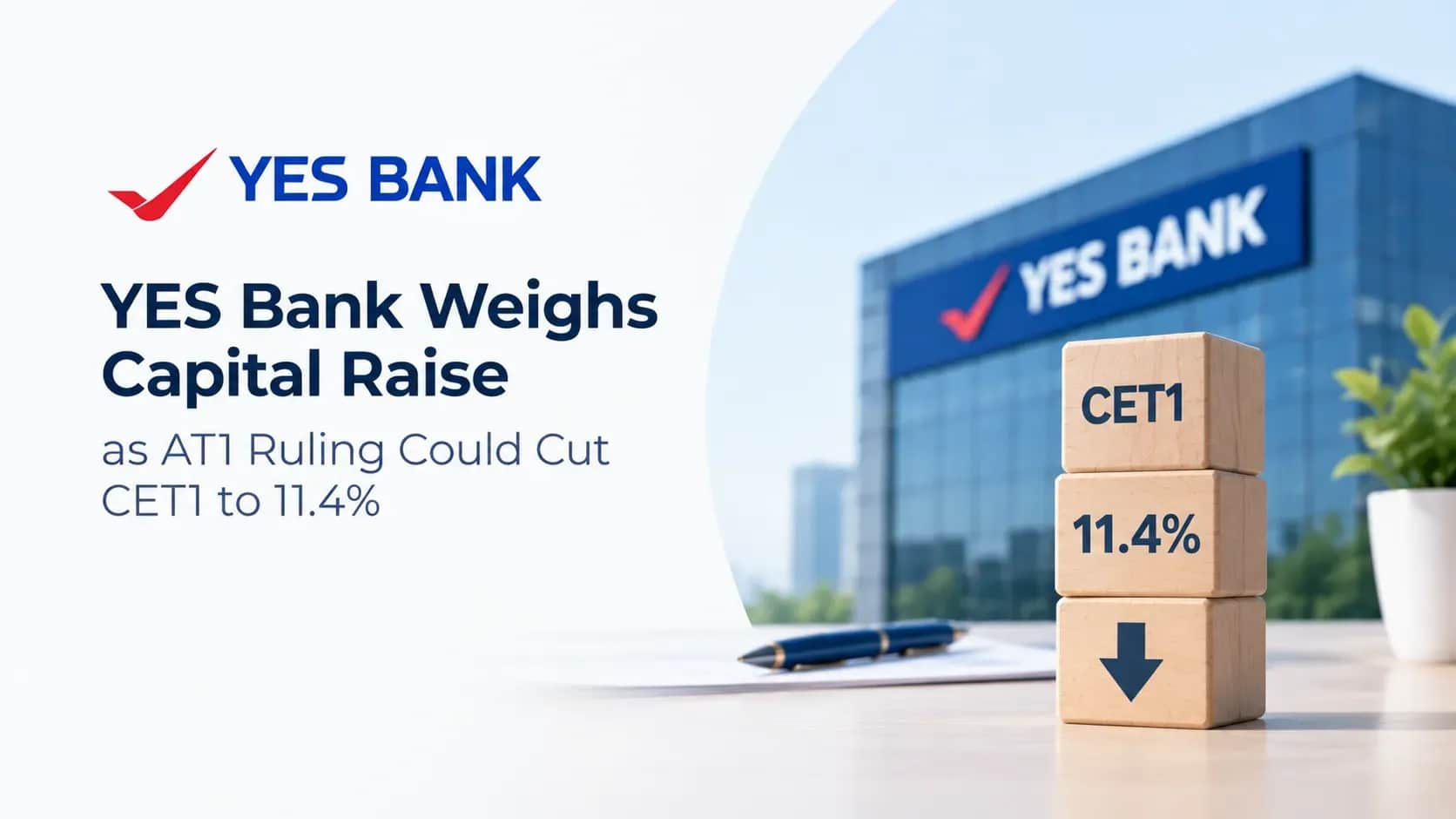
YES Bank is weighing fresh capital after the Supreme Court’s AT1 bond ruling, which could lower its CET1 ratio to 11.4%, affecting future lending capacity.
Key Highlights
YES Bank is assessing its capital position after the Supreme Court overturned the write-down of ₹8,415 crore in Additional Tier 1 (AT1) bonds. During an earnings discussion on 19 October 2026, the Mumbai-based lender indicated that fresh capital remained an option. Chief Financial Officer Niranjan Banodkar said the bank had sufficient room to continue growing despite the expected reduction in its core equity ratio.
The judgment creates an accounting challenge for YES Bank. Restoring the bonds would reduce its core capital buffer, leaving less room to absorb losses while expanding lending. The lender has maintained that its existing financial position supports business growth, although management considers the indicative 11.4% CET1 ratio below its preferred operating level.
The bank had written down its AT1 bonds during the March 2020 reconstruction. The Supreme Court’s decision means those liabilities must be considered again. This changes the composition of YES Bank’s capital because the bonds would be reinstated instead of remaining written down.
Its financial disclosures dated 17 October 2026 provide an indicative calculation of the impact.
The revised figures are unaudited, pro forma estimates. The bank has not recognised the judgment’s financial impact in its reported September-quarter results.
Management has also explained that restoring the principal would involve adjustments between reserves and liabilities. The reinstatement itself does not require immediate repayment of the principal amount.
Savings account holders, fixed deposit customers and existing borrowers are not directly affected by the bond judgment. The dispute concerns AT1 securities, which carry different risks from ordinary bank deposits.
The longer-term concern involves lending capacity. A smaller CET1 buffer leaves the bank with less capital available to support additional risk-weighted assets. From the assessment, the 11.4% estimate signals pressure on the bank’s financial flexibility, not an announced reduction in customer lending. The distinction is important because a bank’s capital adequacy ratio measures its ability to absorb losses, rather than determining individual loan approvals.
During the 19 October 2026 earnings discussion, CFO Niranjan Banodkar described the indicative 11.4% CET1 ratio as “not ideal”. He said YES Bank would examine capital actions, including fundraising, while considering the amount required and the interests of existing shareholders. Managing Director and CEO Vinay M Tonse indicated that the bank’s comfortable CET1 operating range was 13.5% to 14%.
An assessment released by CRISIL Ratings on 16 October 2026 on 16 October 2026 offered another perspective. The agency expected YES Bank to absorb the financial impact without an immediate change to its credit ratings, although future earnings could face pressure. Management is considering capital-management options alongside possible fundraising, rather than treating a new share issue as the only available response.
The dispute dates to YES Bank’s reconstruction in March 2020. The Central Government notified the final reconstruction scheme on 13 March 2020. The following day, the bank’s Administrator wrote down AT1 bonds worth ₹8,415 crore.
Bondholders challenged the action. On 20 January 2023, the Bombay High Court set aside the write-down. The Supreme Court upheld that decision on 15 October 2026 in YES Bank Limited & Anr. v. Axis Trustee Services Limited & Ors., reported as 2026 INSC 1132.
The dispute centred on whether the Administrator had the legal authority to write down the bonds after the Central Government notified the final reconstruction scheme. The Court examined the Administrator’s powers under the applicable legal framework and the terms of the approved scheme.
The judgment also directed that annual coupon payments must follow the relevant Information Memoranda. YES Bank is examining the implementation of the ruling and the treatment of those payments.
YES Bank’s capital planning has come under renewed attention following the Supreme Court’s 15 October 2026 AT1 judgment.
The potential fall in CET1 from 13.7% to 11.4% is significant for the lender’s future capital planning. However, management has maintained that the bank can continue growing without an immediate fundraise.
The final financial impact depends on the accounting treatment of the reinstated bonds and the implementation of the court’s directions. Any capital-raising decision will be assessed separately by the bank.
YES Bank is considering additional capital because reinstating ₹8,415 crore in AT1 bonds could reduce its CET1 ratio to 11.4%. Management has not identified an immediate fundraising requirement.
The bank’s indicative CET1 ratio of 11.4% remains above the applicable minimum capital requirement. Its management has said this level still provides room for business growth.
The Supreme Court judgment concerns AT1 bonds, not ordinary deposits. It does not direct YES Bank to reduce customer deposit balances or change existing deposit terms.
The judgment sets aside the earlier write-down, but it does not establish an immediate lump-sum repayment schedule. YES Bank is assessing the legal and accounting treatment of the reinstated bonds.
Dilution depends on how fresh capital is raised. YES Bank has not finalised a share issue. Management has said shareholder interests will be considered when assessing capital options.