By continuing, you agree to LoansJagat's Credit Report Terms of Use, Terms and Conditions, Privacy Policy, and authorize contact via Call, SMS, Email, or WhatsApp
Disclaimer: The information published on LoansJagat is intended for general informational and educational purposes only and should not be considered financial, legal, or investment advice. Interest rates, loan terms, statistics, and other data may change over time and may vary by lender or source. Please verify the latest information and consult a qualified financial advisor or the respective Bank/NBFC before making any financial decisions.
Subscribe Now
About the author

Vidhi Chauhan is a copywriter and content writer with extensive experience creating high-quality, SEO-driven content across multiple industries, with a strong focus on fintech. She has written extensively on GST, banking, personal loans, business loans, credit cards, income tax, insurance, and other financial topics, helping Indian readers understand complex concepts through clear, accurate, and engaging content.
Related Blog Post
Simplify All Your Loans Into One Affordable EMI

Customers Served

Debt Consolidated

1200+ Reviews

Locations in India
Club all Loans & Credit Card Bills into Single EMI

Quick Apply Loan
Consolidate your debts into one easy EMI.

Takes less than 2 minutes. No paperwork.

10 Lakhs+
Trusted Customers

2000 Cr+
Loans Disbursed

4.7/5
Google Reviews

50+
Banks & NBFCs Offers
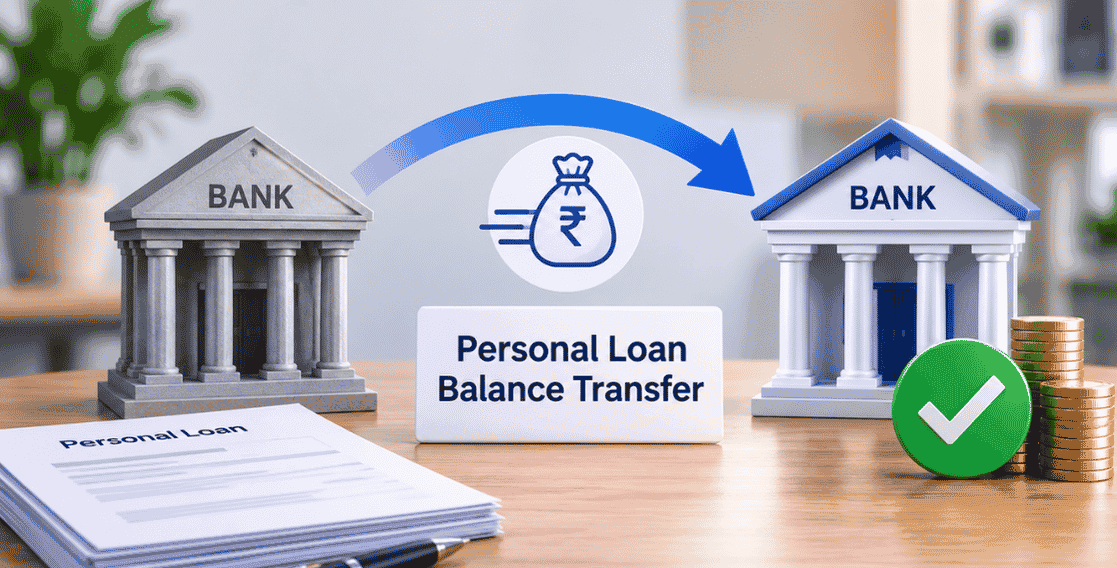
The transfer of balance for a personal loan involves transferring the outstanding amount of a loan taken from a particular lender to another lender who provides better terms and conditions. This is generally chosen by individuals to avail a low rate of interest, lower their EMI amounts, increase repayment tenure or get some additional facilities like top-up loans.
In contrast to availing a new personal loan for meeting the need of money, balance transfer deals with lowering the cost of an existing loan for you. A lower interest rate and modified terms and conditions can help you manage your finances effectively.
Nevertheless, it is always important to analyse processing fees, foreclosure fees and eligibility criteria before considering a personal loan balance transfer. In this article, we will discuss the process of personal loan balance transfer, its advantages, eligibility criteria, documentation required and the whole procedure.
Definition of Personal Loan Balance Transfer
Personal Loan Balance Transfer refers to a method by which the borrower transfers the outstanding balance of his/her personal loan from one lender to another. Borrowers choose this method if there are other lenders who are offering a better interest rate, better terms and conditions, better loan amount or other benefits.
Purpose of Personal Loan Balance Transfer
The main purpose of using the Personal Loan Balance Transfer facility is to ensure that the cost of borrowing is reduced and the process of repayment is made easier.
Meaning and purpose
The purpose of using a Personal Loan Balance Transfer facility is to enable borrowers to:
For example, if you have taken a personal loan at a 15% interest rate per annum and some other lender is offering you 11%, then this transfer of loan balance can help you reduce costs significantly.
Although both options involve borrowing money, they serve entirely different purposes.
A personal loan balance transfer can lower costs without increasing overall debt.
How is the Balance Transfer Process Carried Out?
The procedure for the transfer of a personal loan balance is not very difficult. Most lenders have made the process quite simple and easy for the borrower.
1. Analysis of the amount due on the loan
The lender makes an analysis of the amount left to pay on the existing loan. The following aspects are also considered by the lender:
This helps the lender know whether the transfer would be profitable for them.
2. Analysis of the borrower's eligibility
Next, the lender analyses the eligibility of the borrower. The various aspects that are considered include:
According to a recent notification from the Reserve Bank of India (RBI), new rules have been set which shall come into force from 1 January 2026 onwards. These new regulations state that banks and non-banking financial institutions (NBFCs) cannot levy foreclosure and prepayment penalties in case of eligible floating rate personal loans taken by individuals for their personal use. These new regulations shall come into effect even if the loan repayment is made through money borrowed from some other source.
A personal loan balance transfer can help borrowers reduce their borrowing costs and improve their repayment experience by moving an existing loan to a new lender that offers better terms. The table below highlights the key benefits of a personal loan balance transfer.
*T&C Apply
Flexible repayment tenure
Before applying for a balance transfer, it is important to compare interest rates, processing charges, foreclosure fees, repayment terms, and eligibility requirements to ensure that the transfer provides genuine financial benefits.
Before considering any personal loan balance transfer, one has to be eligible according to the bank’s/financial institution’s norms and should produce the required documents. Though different institutions have different criteria for the same process, banks/NBFCs mostly have the same criteria.
For making a balance transfer, the borrower will be required to provide the following documents:
Complete and correct documentation will make the verification process faster and increase the chances of getting better terms on the loan.
Procedure for Personal Loan Balance Transfer Application
Always calculate the total savings compared to the processing fees and other costs before transferring the loan.
Personal loan balance transfer could prove a smart option for cutting down your cost of borrowing, lowering EMIs, and getting better terms of repayment. Before taking any final decision, however, it will be prudent to take into account a number of factors such as interest rates, processing fees, and eligibility criteria.
There is no particular restriction when it comes to the number of times a person may transfer their personal loan balance. Lenders may look into certain aspects like repayment history, remaining loan amount, income level, and creditworthiness while deciding on a new transfer.
It is always advisable to transfer your loan in its early days when the EMIs are mostly covered by interest charges. The balance transfer will help you save money at that time.
The personal loan balance transfer process may initially affect your credit score due to a credit check by the lender and creation of a new loan account. However, timely payments will help you get back on track in improving your credit score.
Yes, most banks and other lending institutions allow self-employed individuals and entrepreneurs to obtain a balance transfer facility based on their stable business, earnings, tax returns and payment records.
Yes, it may be possible to negotiate interest rates in certain cases, especially when a borrower has a good credit record and a reliable repayment record. Previous associations with banks may also increase the chances of success.
In such a case, the borrower may continue paying off the loan as per the agreement. It is always prudent to know the reasons why the application was rejected and try to sort out these reasons.
For the majority of lenders, full loan transfer is always preferable over transferring just a part of the loan. This is done in order to avoid complicating the whole process of loan management.
Most lenders have introduced the option of a completely online loan balance transfer process which involves document submission, validation, sanction, and fund transfer. But in some cases, the lender may require physical validation of documents.
The borrower needs to calculate all the costs incurred in the process of balance transfer. These costs include processing fee, stamp duty charge, legal charges, and closure penalty of the loan.
Not always. The borrower can keep the same repayment tenure or alter it into a longer or shorter one, depending on his/her requirement and the lender’s terms.