Disclaimer: The information published on LoansJagat is intended for general informational and educational purposes only and should not be considered financial, legal, or investment advice. Interest rates, loan terms, statistics, and other data may change over time and may vary by lender or source. Please verify the latest information and consult a qualified financial advisor or the respective Bank/NBFC before making any financial decisions.
Subscribe Now
About the author

Arshathul Afia is a journalism graduate and fintech content writer with 4+ years of experience in digital publishing and research-led writing. She has written 200+ articles covering personal finance, lending, banking, digital payments, credit, insurance, and major financial developments in India. At LoansJagat, she focuses on simplifying complex fintech news, RBI updates, loan-related changes, policy developments, and industry trends for everyday readers. Her journalism background helps her approach stories with research, context, and clarity, while her SEO experience ensures content remains discoverable and relevant. She aims to make financial news easier to understand, practical, and useful for readers across India.
Related News
Simplify All Your Loans Into One Affordable EMI

Customers Served

Debt Consolidated

1200+ Reviews

Locations in India
Club all Loans & Credit Card Bills into Single EMI

Quick Apply Loan
Consolidate your debts into one easy EMI.

Takes less than 2 minutes. No paperwork.

10 Lakhs+
Trusted Customers

2000 Cr+
Loans Disbursed

4.7/5
Google Reviews

50+
Banks & NBFCs Offers
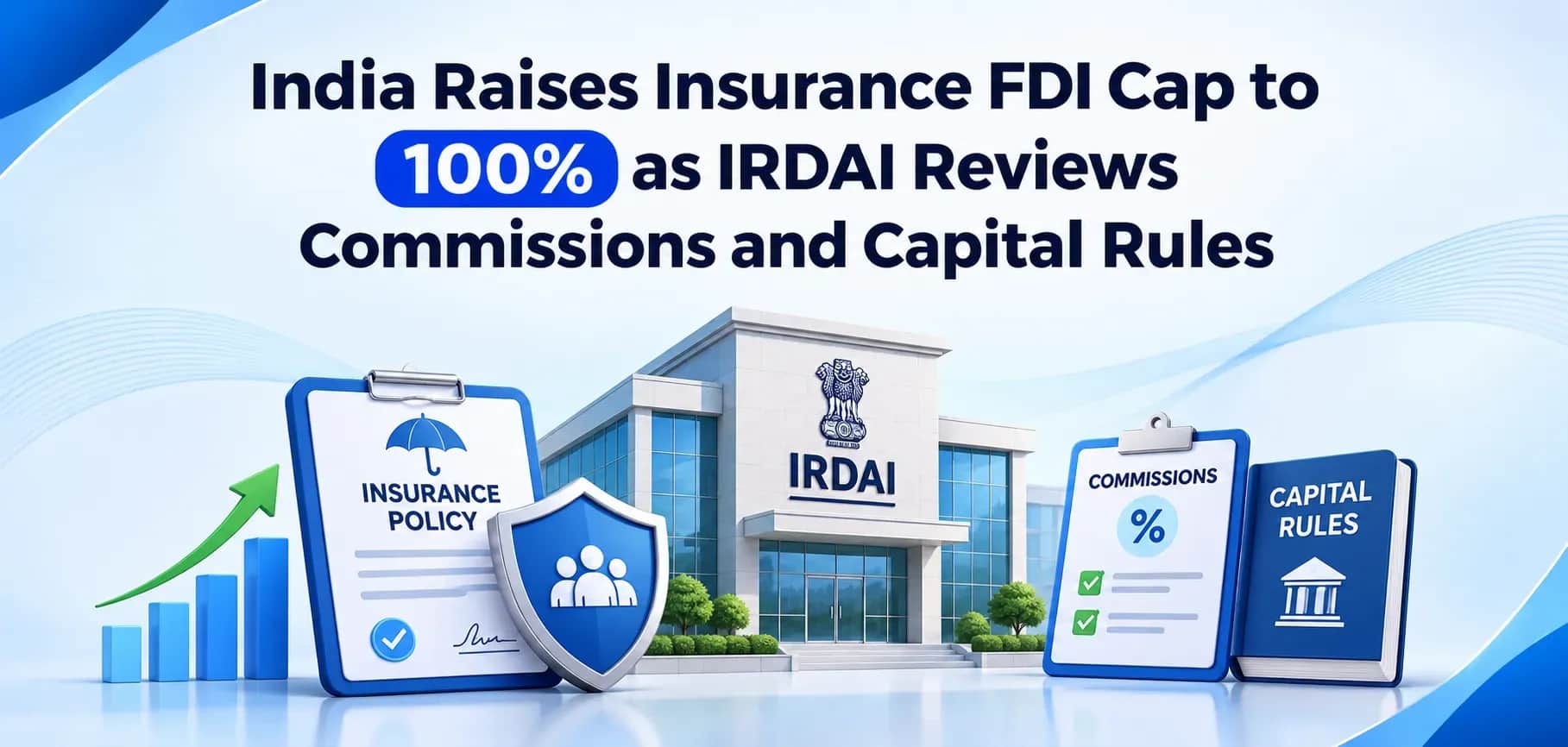
India raised the foreign investment cap for insurers to 100% in 2026, as IRDAI proposed tighter commission rules and began drafting risk-based capital requirements.
Key Highlights
The foreign investment provisions of the Sabka Bima Sabki Raksha (Amendment of Insurance Laws) Act, 2025 took effect on 5 February 2026. Foreign investors can now hold up to 100% of an Indian insurer’s equity, subject to applicable rules. The law also lowered the minimum net-owned funds for foreign reinsurance branches from ₹5,000 crore to ₹1,000 crore.
By 17 November, the Insurance Regulatory and Development Authority of India (IRDAI) was reviewing proposals on distribution costs and commissions. Separate panels were developing a framework to link insurers’ capital requirements to the risks they take.
The higher foreign ownership ceiling was intended to attract long-term capital, bring in technology and extend insurance coverage. In February, IRDAI also clarified exposure limits for investments in alternative investment funds (AIFs) and when an insurer could use an excuse right to sit out an underlying investment.
At its 137th meeting in July, the regulator approved amendments to rules on investment, capital structure, share transfers and amalgamations. The changes give insurers more room to raise capital and restructure, with stronger actuarial and financial oversight.
IRDAI’s 30 March amendment required insurers to prepare financial statements under the applicable Indian Accounting Standards (Ind AS) from 1 April 2026. The standards make reporting on insurance contracts, assets and liabilities more comparable. IRDAI set up a Joint Expert Group in April to deal with implementation questions and issued further clarifications during the year.
April’s revised Information and Cyber Security Guidelines strengthened board oversight, the role of chief information security officers and incident response planning across insurers and intermediaries. The Information Security Risk Management Committee must meet at least quarterly, up from twice a year.
July regulations put the Policyholders’ Education and Protection Fund into operation. The fund supports insurance literacy, grievance redressal and better technology for policyholder services. It can also help trace unclaimed insurance money and get it to the people entitled to it.
Intermediaries moved to continuous registration, with annual fees and ongoing compliance in place of periodic renewals. July’s amendments also tightened disclosure, governance and reporting requirements. Each proposal, policy and certificate must identify the authorised salesperson. That gives insurers a record to check if a customer disputes a sale.
The feedback deadline for distribution reforms was 31 October 2026. Separately, IRDAI gave two working groups one month from 10 November to prepare draft regulations on insurers’ risk-based capital requirements.
The distribution proposals would tighten scrutiny of payments to banks, corporate agents and brokers and curb compulsory bundling of insurance with loans. IRDAI wants distributors to focus more on advice, affordability and whether customers keep their policies.
The capital proposal would replace the current factor-based solvency regime with requirements that reflect the risks individual insurers take, including underwriting and investment risks. The final method and start date are still pending.
Following a Supreme Court direction, IRDAI issued a four-layer policy format for private cars and two-wheelers. It covers third-party liability, legal liability to occupants, personal accident and own damage. Third-party cover is mandatory. The personal accident section distinguishes mandatory cover for the owner-insured from optional cover for other occupants. Legal liability to occupants and own damage are optional.
Insurers must use standard wording, record customers’ cover selections on an option form and issue a Customer Information Sheet at the point of sale. The policy schedule will show the cover and premium for each section. Insurers must also integrate the format with Bima Sugam by 15 December 2026.
India opened insurance ownership to more foreign capital in 2026 and changed how insurers report their finances. The December motor insurance rules give vehicle owners a way to see their options and what each cover costs. Two decisions remain open. IRDAI has to settle the limits that would govern distributor payments, and its working groups have to turn the risk-based capital approach into draft rules. Those decisions will shape what insurers spend on sales and how much capital they hold.
The law permitting up to 100% foreign investment in Indian insurers took effect on 5 February 2026, raising the previous cap of 74% on ownership.
No. IRDAI proposed limits based on the product and sales channel in its September consultation. The limits were still under review on 17 November 2026.
IRDAI wants capital requirements to reflect the risks each insurer takes. Its working groups are drafting a framework using statements prepared under Indian Accounting Standards.
Foreign direct investment is investment by a person or company based abroad in a domestic business, typically to establish a lasting interest in that business.
Third-party cover pays for covered liabilities to others. Own-damage cover can pay for repairs to your car after a covered accident, subject to policy terms.
Start your journey today
Apply Now*T&C apply