
By continuing, you agree to LoansJagat's Credit Report Terms of Use, Terms and Conditions, Privacy Policy, and authorize contact via Call, SMS, Email, or WhatsApp
Disclaimer: The information published on LoansJagat is intended for general informational and educational purposes only and should not be considered financial, legal, or investment advice. Interest rates, loan terms, statistics, and other data may change over time and may vary by lender or source. Please verify the latest information and consult a qualified financial advisor or the respective Bank/NBFC before making any financial decisions.
Subscribe Now
About the author

Arshathul Afia
Arshathul Afia is a journalism graduate and fintech content writer with 4+ years of experience in digital publishing and research-led writing. She has written 200+ articles covering personal finance, lending, banking, digital payments, credit, insurance, and major financial developments in India. At LoansJagat, she focuses on simplifying complex fintech news, RBI updates, loan-related changes, policy developments, and industry trends for everyday readers. Her journalism background helps her approach stories with research, context, and clarity, while her SEO experience ensures content remains discoverable and relevant. She aims to make financial news easier to understand, practical, and useful for readers across India.
Related News
Simplify All Your Loans Into One Affordable EMI

Customers Served

Debt Consolidated

1200+ Reviews

Locations in India
Club all Loans & Credit Card Bills into Single EMI

Quick Apply Loan
Consolidate your debts into one easy EMI.

Takes less than 2 minutes. No paperwork.

10 Lakhs+
Trusted Customers

2000 Cr+
Loans Disbursed

4.7/5
Google Reviews

50+
Banks & NBFCs Offers
Other services mentioned in this article
At ₹15 lakh, salary can face a higher tax bill than rent or professional receipts because each income type reaches taxable income through separate rules.
If a salaried individual is earning ₹15 lakh in India in FY 2025-26, then the amount of tax he/she might be required to pay under the new tax regime is approximately ₹97,500. This is for AY 2026-27 only. The taxable salary post standard deduction is ₹14.25 lakh after ₹75,000. This is still higher than the ₹12 lakh cap on section 87A rebate.
Relief is available below this level. A gross salary of ₹12.75 lakh can become tax-free in a normal case because the ₹75,000 deduction reduces taxable income to ₹12 lakh. The pressure starts once salary moves beyond that range.
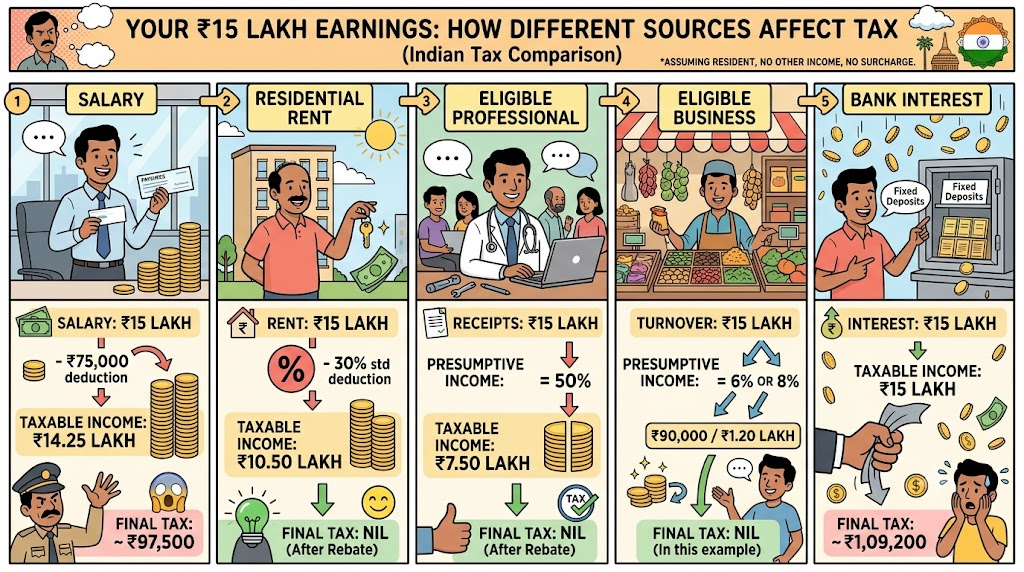
Salary is taxed close to the amount paid by the employer. The new regime gives the employee a fixed deduction of ₹75,000. Daily travel, office meals, work clothes, home internet and electricity used for office work usually do not reduce taxable salary.
The tax then builds across the slabs. Income up to ₹4 lakh attracts no tax. The next ₹4 lakh is taxed at 5%. Another ₹4 lakh is taxed at 10%. The remaining ₹2.25 lakh falls in the 15% slab.
Tax before cess comes to ₹93,750. The 4% cess adds ₹3,750. Final liability reaches ₹97,500.
Rent follows a different calculation. A landlord can claim a 30% standard deduction from net annual value. Eligible professionals may use Section 44ADA, under which 50% of gross receipts is treated as presumptive income. Eligible small businesses may use Section 44AD, where income is generally taken at 8% of turnover or 6% for qualifying digital receipts.
The table below compares gross inflows. It does not place salary, rent, professional billing and business turnover on the same economic footing.
The figures need some care. A landlord may pay society charges, municipal tax, repairs and loan interest. A consultant can spend on software, travel, equipment and staff. A shop reporting ₹15 lakh turnover may use most of that money to buy stock.
Salary does not carry those business costs. Still, employees also cannot claim several expenses linked with keeping a job. That is where the frustration comes from.
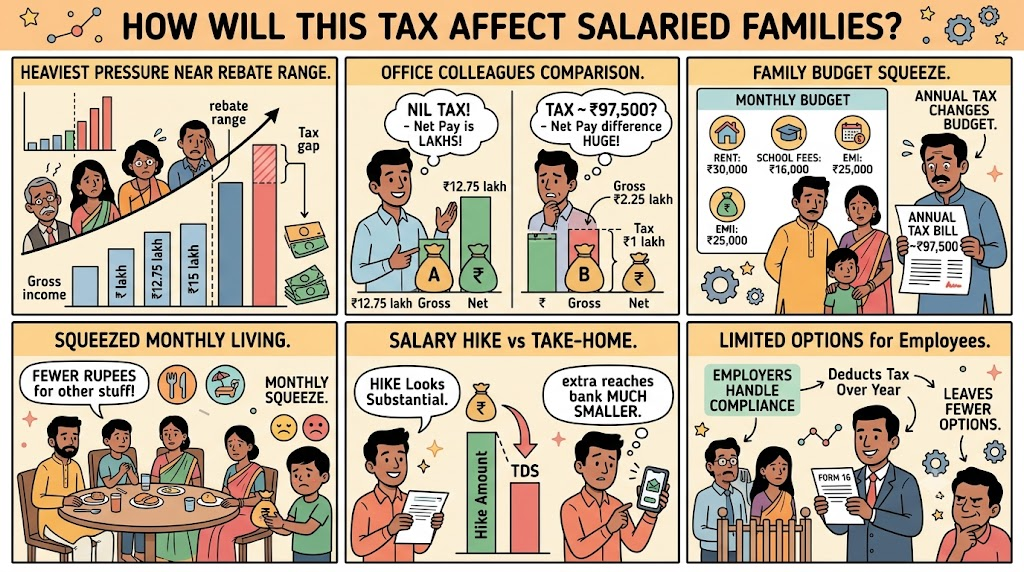
The heaviest pressure falls on people just above the rebate range. Take 2 employees in the same office. One earns ₹12.75 lakh and may pay nil tax on normal income. The other earns ₹15 lakh and may pay about ₹97,500. Their gross salary difference is ₹2.25 lakh. The tax difference is close to ₹1 lakh.
For a family paying ₹30,000 rent, ₹16,000 school fees and a ₹25,000 EMI, that annual tax bill changes the monthly budget. A salary hike may look substantial on paper, but the extra amount reaching the bank can be far smaller after TDS. Employees also have limited room to change the outcome. The employer reports salary through Form 16 and deducts tax during the year. This keeps compliance simple. It also leaves fewer options.
The new regime still helps people who do not have large deductions. Filing needs fewer documents. Employees are also less likely to buy poor insurance or investment products in March only to save tax. Those with genuine deductions should calculate both regimes. A person claiming HRA, home-loan interest and NPS may get a different result from a colleague drawing the same salary without those claims.
Tax advisers usually point out 1 problem in this comparison. ₹15 lakh turnover is not ₹15 lakh profit. A neighbourhood shop may record ₹15 lakh in sales and spend ₹11 lakh or ₹12 lakh on stock, rent, transport and wages. A consultant billing ₹15 lakh may pay for subscriptions, travel, equipment and delayed client payments. Presumptive taxation gives such taxpayers a fixed income figure instead of asking them to show every expense.
The employee’s position is more direct. Salary reaches the bank after TDS. There may be provident fund, insurance and paid leave, but taxable income stays close to gross salary.
The useful step is to compare both tax regimes before filing. The LoansJagat tax analysis also shows that HRA, NPS, home-loan interest and other valid claims can change the result for salaried taxpayers.
A ₹15 lakh employee should check Form 16, review TDS entries and verify employer NPS contributions. HRA claims should match rent records where documents are required. Home-loan interest should agree with the lender certificate.
Salary restructuring also needs proper records. Reimbursements must follow company policy and actual spending. Artificial claims can invite questions during assessment.
Future relief could come through a higher standard deduction. Another route may be a limited claim for compulsory work expenses that employers do not reimburse. Such relief would need a cap and documentary proof.
The present calculation followed 2 major policy changes. The standard deduction in the new regime was increased from ₹50,000 to ₹75,000 in July 2024 in the Union Budget. This resulted in another ₹25,000 deducted from the taxable income for salaried employees.
There was a significant change on 1 February 2025. Finance Minister Nirmala Sitharaman announced that the section 87A rebate has been revised and increases the rebate. The Press Information Bureau said normal taxable income up to ₹12 lakh could attract nil tax under the new regime.
For salaried taxpayers, the ₹75,000 deduction raised the effective tax-free salary level to ₹12.75 lakh. The announcement gave strong relief to employees inside that range. Someone earning ₹12.75 lakh could see tax fall to nil in a normal case. A person earning ₹15 lakh remained above the rebate line.
That is why the gap now looks sharper. A moderate salary increase can move taxable income beyond ₹12 lakh. Once that happens, the employee loses the full rebate, subject to marginal relief near the cut-off.
The government described the 2025 changes as support for household spending, savings and investment. Employees within the rebate range gained the most because more salary stayed in their bank accounts.
Tax professionals welcomed the simpler slabs but continued to seek regular revision of the standard deduction. Employment costs have risen across large cities. Daily travel, rent near office districts and home-office costs take a sizeable share of salary.
Business owners and professionals present another side. Their gross receipts can look high even when final profit is modest. Unpaid invoices, irregular assignments and operating costs can reduce actual earnings sharply.
Both groups carry different costs. Even so, the fixed ₹75,000 salary deduction remains a frequent point of debate because it does not rise automatically with wages or urban living expenses.
About ₹97,500 (about one-fifth of ₹15 lakh) may be paid by a ₹15 lakh paid employee for AY 2026-27 under the new regime. If the gross rent received by the landlord is ₹15 lakh, his taxable income will be ₹10.50 lakh (after tax deduction of 30% of gross rent), and he will get a rebate from the landlord.
A person who is eligible as a professional under clause 44ADA can take presumptive income of ₹7.50 lakh. In the above example, the tax may be reduced to zero thanks to the rebate.
It cannot be said that everyone earning a salary pays more than everyone who is a professional, as ₹15 lakh of bank interest can generate a bigger tax liability. Business turnover also cannot be considered as personal profit. The better news is that salary is exempted of automatic deductions before tax slabs are applied. It is a difference that is visible to employees above the rebate limit, in each of their payslips.
Why is the income tax of a salary of ₹15 lakhs almost ₹97,500?
The standard deduction of ₹75,000 from the total income is ₹14.25 lakh. It still has room above the rebate cap of ₹12 lakh.
How much is the total income of ₹ 1500000 taxable?
No, under the new regime, a standard deduction of ₹75,000 is available for salaried individuals in AY 27-28.
How to make an income of ₹15 lakh rent-free?
Yes, for the example shown here. This exemption of 30% applies to house property income after applying it to the taxable income, which is ₹10.50 lakh.
Can ₹15 lakh rental income become tax-free?
Yes, in the example used here. The 30% deduction reduces taxable house-property income to ₹10.50 lakh before rebate.
Does every professional qualify for Section 44ADA?
No. Only specified professionals who meet the legal conditions and receipt limits can use the scheme.
Should every employee earning ₹15 lakh choose the old regime?
No. HRA, NPS, home-loan interest, insurance and other valid deductions decide which regime gives the lower tax.










.png&w=3840&q=75)


