
By continuing, you agree to LoansJagat's Credit Report Terms of Use, Terms and Conditions, Privacy Policy, and authorize contact via Call, SMS, Email, or WhatsApp
Disclaimer: The information published on LoansJagat is intended for general informational and educational purposes only and should not be considered financial, legal, or investment advice. Interest rates, loan terms, statistics, and other data may change over time and may vary by lender or source. Please verify the latest information and consult a qualified financial advisor or the respective Bank/NBFC before making any financial decisions.
Subscribe Now
About the author

Arshathul Afia
Arshathul Afia is a journalism graduate and fintech content writer with 4+ years of experience in digital publishing and research-led writing. She has written 200+ articles covering personal finance, lending, banking, digital payments, credit, insurance, and major financial developments in India. At LoansJagat, she focuses on simplifying complex fintech news, RBI updates, loan-related changes, policy developments, and industry trends for everyday readers. Her journalism background helps her approach stories with research, context, and clarity, while her SEO experience ensures content remains discoverable and relevant. She aims to make financial news easier to understand, practical, and useful for readers across India.
Related Blog Post
Simplify All Your Loans Into One Affordable EMI

Customers Served

Debt Consolidated

1200+ Reviews

Locations in India
Club all Loans & Credit Card Bills into Single EMI

Quick Apply Loan
Consolidate your debts into one easy EMI.

Takes less than 2 minutes. No paperwork.

10 Lakhs+
Trusted Customers

2000 Cr+
Loans Disbursed

4.7/5
Google Reviews

50+
Banks & NBFCs Offers
Razorpay and Cashfree now use AI behind the payment screen, but neither company is ready to let software move a customer’s money alone just yet.
AI has begun doing actual payment work in India. Razorpay now uses Vulcan to study routes and spot suspicious transactions. Cashfree’s Relay steps in after a payment fails and can help merchants follow up with buyers. PhonePe and Zoho have released tools for business users too. Moneycontrol reported these moves on September 5, 2026. Razorpay launched Vulcan on August 18, while Cashfree announced Relay on August 25. The changes reach beyond these companies. A shopper’s checkout, a small seller’s back office or a bank connection may all be touched by the software.
For merchants, the immediate appeal is fairly ordinary. Fewer failed checkouts would protect sales, and automated follow-ups could spare staff from chasing every unfinished order. Wider use may come later, if the tools prove dependable. There is a harder side to it. A genuine payment may be stopped as fraud. A badly timed call may drive a buyer away. If permissions are loose, an agent could take a step the merchant never meant to approve.
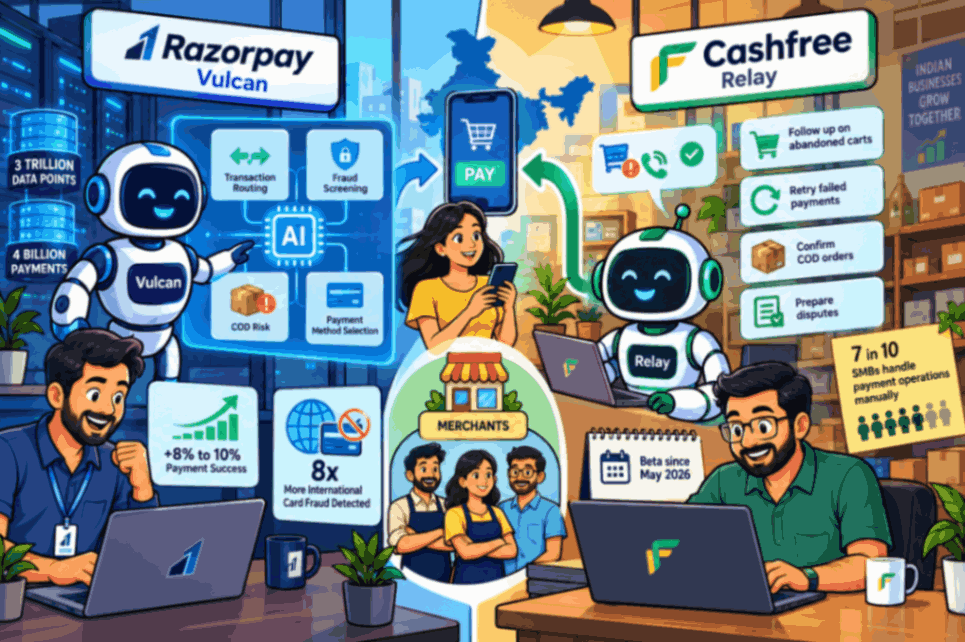
Razorpay’s Vulcan is a transformer-based foundation model built for payments. The company says it examines transaction signals together, then applies them to routing, fraud screening, cash-on-delivery risk and payment-method selection. Earlier systems often used separate models for each job.
Razorpay said on August 18, 2026, that Vulcan had been trained on nearly 3 trillion data points across 4 billion payments. Its internal study of 1.5 million shoppers and more than 51,000 businesses recorded an 8% to 10% rise in payment success. The company also reported 8 times more international card fraud detected and stopped. Merchants still need their own transaction results before treating those gains as typical.
Cashfree’s Relay works closer to a merchant’s daily workload. Its agents follow up on abandoned carts, retry failed payments, confirm cash-on-delivery orders and prepare disputes. Cashfree said on August 25, 2026, that 7 in 10 small and medium businesses handled payment operations manually. Relay has been in beta since May 2026.
For a shopper, the technology may appear through small changes. The checkout may show a preferred UPI application, select a healthier route or send a fresh link after an unsuccessful attempt. The work happens behind the screen while the buyer sees a shorter payment path.
Small sellers could gain more. A home business in Kochi may not have staff to call every buyer who leaves a cart. An agent can identify the failed step, prepare a message and record the outcome. Human approval can remain mandatory before customer contact or any movement of money.
India’s transaction volume raises the stakes. The Press Information Bureau said on August 24, 2026 that UPI processed 24,162 crore transactions worth around ₹314 lakh crore in FY 2025-26. It also said 86% of merchant payments were below ₹500. A faulty AI rule could therefore inconvenience many users quickly.
The products do different jobs. Razorpay focuses on transaction decisions, Cashfree acts on merchant operations, while PhonePe and Zoho help businesses build or control payment functions.
PhonePe announced its integration agent on May 6, 2026 and SmartPages on June 10. The company said SmartPages could create a payment page in under 10 minutes, including through Indian-language prompts. Zoho’s May 28 connector allowed authorised tools to create links, inspect payments and refunds, and prepare payouts.
The groundwork became public in October 2025, when Razorpay, NPCI and OpenAI announced an agent-led payment pilot. BigBasket joined as an early merchant, with Axis Bank and Airtel Payments Bank in the flow. Customers could search and buy within an AI conversation.
The pilot did not give software unlimited spending power. It used UPI Circle and Reserve Pay, required customer confirmation, and allowed the permission to be revoked. As of September 5, 2026, AI could prepare a transaction, but no nationwide facility for unrestricted agent-led UPI payments had been publicly launched.
The pilot also preceded UPI’s 10th anniversary. Official data released on August 24, 2026 recorded 2,366 crore July transactions worth ₹29.88 lakh crore, with 741 banks live. That scale favours systems trained around Indian payment patterns rather than general-purpose language tools.
Harshil Mathur, Razorpay’s co-founder and chief executive, told Moneycontrol that AI represented a fundamental shift, but payment companies had to proceed cautiously. He also pointed to GPU and cloud costs. A model must lift completed payments, reduce fraud losses or cut staff work enough to justify that bill.
Cashfree co-founder Reeju Datta said AI was resolving close to 60% of support tickets, with a target of 85%. Moneycontrol published his statement on September 5, 2026. Merchants quoted in the report wanted better conversion, lower cost or saved time. A polished demo would not justify adoption.
LoansJagat’s editorial view is that merchant-facing agents may show measurable gains before autonomous consumer payments do. Recovered carts, successful retries and staff hours can be counted. Trust is harder to repair after an unwanted debit. Its report on shared fraud warnings explains how a Digital Payments Intelligence Platform could help institutions spot suspicious transfers earlier.
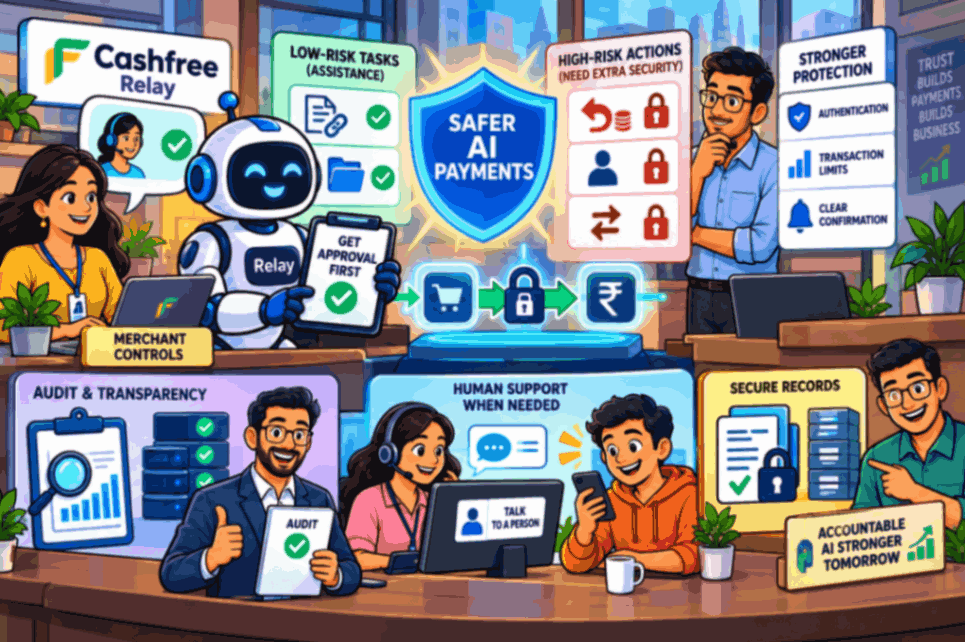
Payment companies can separate low-risk assistance from actions involving funds. An agent may draft a link or collect dispute documents. Refund approval, beneficiary changes and transfers need stronger authentication, transaction limits and visible confirmation. Greater financial impact requires greater human control.
Cashfree says Relay asks for approval before customer contact and before a payment moves. Merchants can set quiet hours, contact limits and opt-outs, while unusual actions go to internal review. Relay also creates a record that cannot be edited or deleted. Independent audits and published error rates would provide stronger evidence.
Users need a fast route to a person when automation gets a decision wrong. A customer whose genuine payment is blocked should not have to argue with another bot. Revocable permissions and separate task caps can limit the damage.
AI has moved from answering payment questions to performing parts of the job. Razorpay applies a shared model to routing and fraud decisions. Cashfree automates merchant follow-ups, while PhonePe and Zoho shorten integration and payment-management work. These products arrived between May and August 2026.
Adoption will depend on results and restraint. Shoppers may face fewer failures, while merchants could save staff time and recover lost sales. Yet payment agents need narrow permissions, permanent records and fast human review. Customer confirmation should remain wherever money can move.
An AI payment agent examines transaction information and performs an assigned task, such as selecting a route, sending a retry link or preparing a refund review. Unlike a basic chatbot, it can take operational steps. Money movement should still require authentication, limited permissions and approval.
The October 2025 Razorpay, NPCI and OpenAI pilot required customer confirmation and allowed users to revoke permission. As of September 5, 2026, India had not publicly launched unrestricted AI-led UPI payments nationwide. Any delegated model would need spending caps, identity checks and liability rules.
It may reduce failures by choosing a better route before an attempt. Razorpay reported an 8% to 10% improvement in its August 18 internal study. Results vary by merchant, bank and payment method, so each business should compare its own completion rate before and after activation.
Cashfree Relay can prepare follow-ups for abandoned carts or failed payments, but Cashfree says the merchant approves contact first. Businesses may set quiet hours, attempt caps and opt-outs. Buyers should receive an easy way to refuse further automated calls or messages.
Merchants should check approval settings, payment limits, contact rules, data access, audit records and human escalation. They should measure completed payments, recovered orders, incorrect fraud blocks and complaints. Company claims may guide a trial, but the merchant’s own results should decide continued use.








.png&w=3840&q=75)


