
By continuing, you agree to LoansJagat's Credit Report Terms of Use, Terms and Conditions, Privacy Policy, and authorize contact via Call, SMS, Email, or WhatsApp
Disclaimer: The information published on LoansJagat is intended for general informational and educational purposes only and should not be considered financial, legal, or investment advice. Interest rates, loan terms, statistics, and other data may change over time and may vary by lender or source. Please verify the latest information and consult a qualified financial advisor or the respective Bank/NBFC before making any financial decisions.
Subscribe Now
About the author

Arshathul Afia
Arshathul Afia is a journalism graduate and fintech content writer with 4+ years of experience in digital publishing and research-led writing. She has written 200+ articles covering personal finance, lending, banking, digital payments, credit, insurance, and major financial developments in India. At LoansJagat, she focuses on simplifying complex fintech news, RBI updates, loan-related changes, policy developments, and industry trends for everyday readers. Her journalism background helps her approach stories with research, context, and clarity, while her SEO experience ensures content remains discoverable and relevant. She aims to make financial news easier to understand, practical, and useful for readers across India.
Related News
Simplify All Your Loans Into One Affordable EMI

Customers Served

Debt Consolidated

1200+ Reviews

Locations in India
Club all Loans & Credit Card Bills into Single EMI

Quick Apply Loan
Consolidate your debts into one easy EMI.

Takes less than 2 minutes. No paperwork.

10 Lakhs+
Trusted Customers

2000 Cr+
Loans Disbursed

4.7/5
Google Reviews

50+
Banks & NBFCs Offers
Other services mentioned in this article
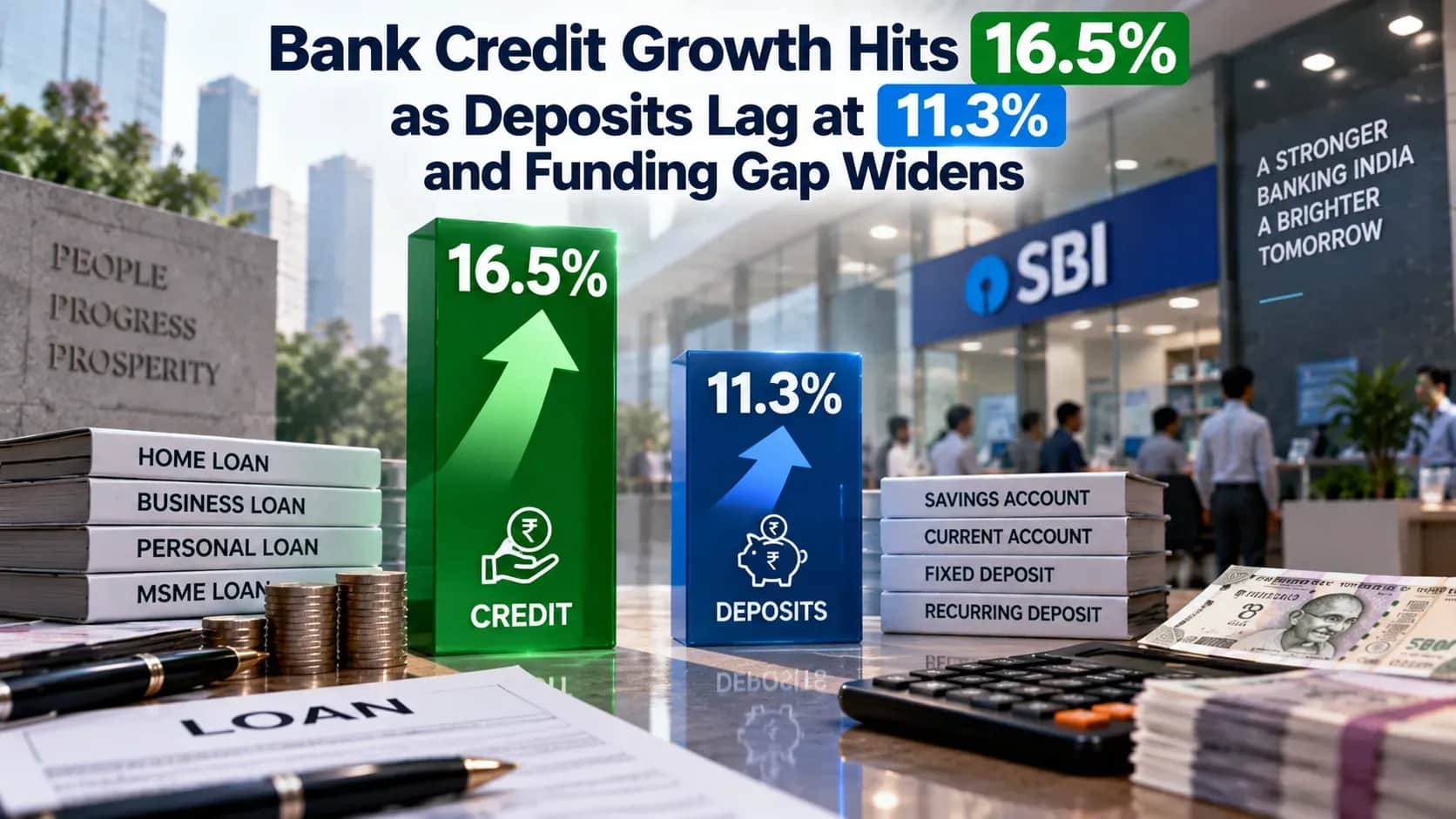
Bank credit grew 16.5% in Q1 FY27, while deposits rose 11.3%, leaving a wider funding gap as NBFC and industrial borrowing picked up across India.
India’s banking system entered FY27 with loan growth running well ahead of deposit growth. Bank credit expanded 16.5% year-on-year in Q1 FY27, while deposits rose 11.3%, according to CareEdge Ratings’ banking sector assessment reported on September 19, 2026. The report covered banks across India and linked the acceleration largely to stronger lending to NBFCs, companies, industry and trade. For borrowers, that can mean better availability of credit. For banks, the immediate concern is funding those loans without allowing the gap with deposits to widen further.
The short-term effect could help businesses that need working capital, vehicle finance or expansion funding. The longer-term picture is less comfortable if deposits keep growing more slowly. Banks may then compete harder for savings, lifting funding costs and slowing the pass-through of cheaper borrowing.
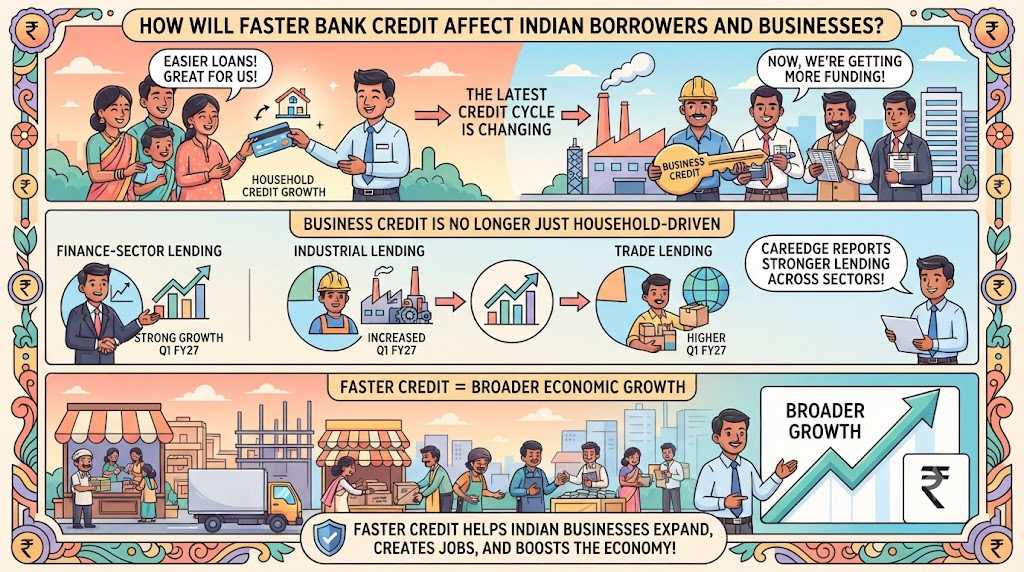
For Indian businesses, the change is useful because the latest credit cycle is no longer being driven mainly by household borrowing. CareEdge reported stronger finance-sector, industrial and trade lending during Q1 FY27. That means more bank money is moving towards companies that need cash for raw materials, supplier payments, inventories, machinery and daily operating expenses. NBFCs are also receiving more bank funding, which can later flow to vehicle buyers, small firms and borrowers outside the largest cities.
Households may not feel the effect immediately. A higher system-wide credit growth number does not mean every home loan, personal loan or business loan becomes cheaper. Pricing still depends on a borrower’s income, repayment record, collateral, lender policy, and the bank’s own funding cost. The positive side is availability. When banks and NBFCs have more room to lend, eligible borrowers may see more offers and quicker access to formal credit, especially in segments where demand has been strong.
The table below keeps the main figures together. The important point is the gap between credit and deposits, not the headline number alone.
The gap also affects savers. Banks seeking stable deposits may compete through rates, tenure options, or targeted products. That can help depositors, while borrowers may not receive the same benefit immediately.
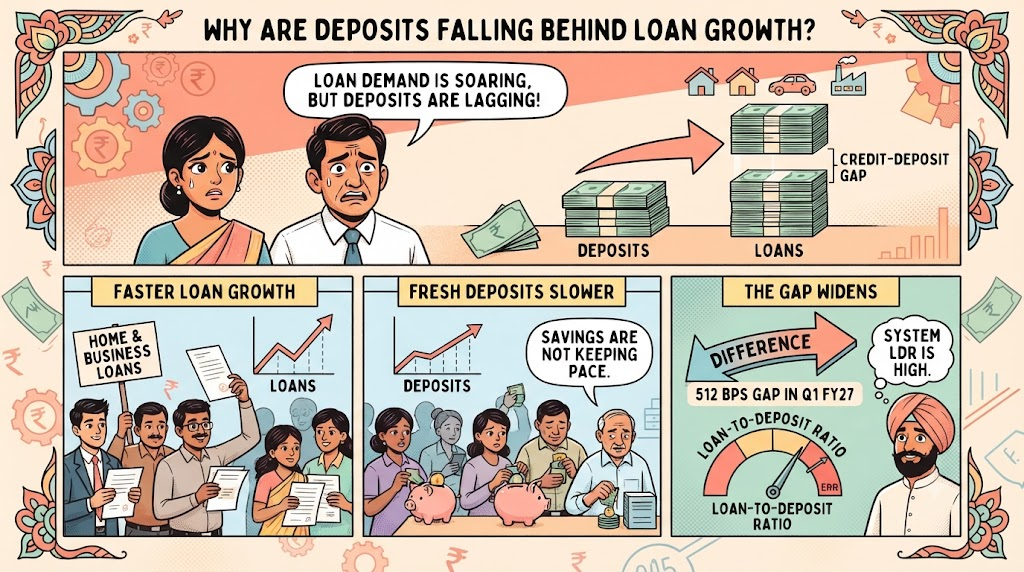
Loan growth ran ahead of deposit growth in Q1 FY27, pushing the gap wider. CareEdge put the difference at 512 basis points, while the banking system’s loan-to-deposit ratio rose to 83.3% during the quarter. A high ratio does not mean banks have stopped lending. It does show that a larger part of the deposit base is already tied to loans, leaving less room if credit demand stays elevated.
There is also a change in household saving behaviour. Bank deposits compete with mutual funds, market-linked products and other investments for household money. CareEdge Director Saurabh Bhalerao described deposit mobilisation as the key factor to watch. His point is fairly direct: credit expansion needs stable funding behind it. Otherwise, banks may need to raise deposit rates, use costlier funding sources or slow lending in selected categories.
The rise in lending had started before June. The pick-up in lending was visible even before June. PIB’s May 5, 2026 update put FY26 non-food credit growth at 15.9%, against 10.9% a year earlier. Industrial loans rose 15%, while credit to the services sector grew 19% over the year. The government said growth was spread across agriculture, industry, services and personal lending, with MSMEs, NBFCs and trade among the stronger areas.
That government update is useful because it shows the Q1 FY27 rise followed an already improving trend. A second official signal came from Akashvani News on May 30, 2026. Citing the Finance Ministry’s Monthly Economic Review for May, it reported that bank credit was growing at more than 17% year-on-year. The update also said system liquidity remained in surplus at the time.
Together, those releases show lending demand was already gathering pace before the CareEdge Q1 assessment. The later 16.5% reading therefore belongs to a wider credit recovery rather than a sudden change confined to 1 quarter.
LoansJagat had also tracked the borrower side of this change in an August 3, 2026 report covering June credit trends. It reported that bank credit to industry rose 19.2% year-on-year in June, compared with 6.3% a year earlier, while personal loan growth stood at 15.8%. Those figures use a different reporting cut from CareEdge’s Q1 numbers, so they should not be compared line by line. They still show the same broad shift. Industrial borrowing was gathering speed.
For borrowers, that shift carries an important takeaway. A faster flow of money towards companies and NBFCs can widen access to credit further down the chain, but it does not guarantee lower rates. A small company receiving 3 competing loan offers should still compare the total interest outgo, processing charge, prepayment conditions, and reset clauses rather than choosing the lender advertising the lowest opening rate.
CareEdge’s concern is not a shortage of borrowers. The pressure comes from keeping funding aligned with loan demand. Saurabh Bhalerao said, “Deposit mobilisation is now the key thing to watch.” CareEdge also linked part of the stronger lending to NBFCs and large corporates choosing bank funding while bond yields remained elevated.
The response will probably differ from bank to bank. Lenders can attract more term deposits, alter rates on selected maturities and use wholesale borrowing with tighter cost controls. They also have to resist chasing loan growth simply to preserve market share. A fast-growing loan book looks strong at first glance, but lending becomes harder to sustain if the money funding those loans becomes progressively more expensive.
For borrowers, the present numbers point to 2 different developments. Access to credit has improved in several business-linked segments, while cheaper credit remains uncertain. If competition for deposits raises funding costs, banks can be slower to pass lower costs to borrowers or may protect margins through loan spreads and fees.
For a small business or an individual borrower, the choice often comes down to a bank or an NBFC. NBFCs can sometimes move faster on approval. The catch is the extra cost. Processing fees, foreclosure charges, and later rate changes can add up, so the repayment amount needs a proper check before taking the loan.
Public-sector banks also have a large part in this credit cycle. CareEdge reported its credit growing 17.3%, faster than the 14.8% recorded by private banks. Their loan-to-deposit ratio also moved higher. That leaves deposit mobilisation important for lenders expected to keep financing agriculture, MSMEs, infrastructure, companies and households at the same time.
Bank credit growth of 16.5% in Q1 FY27 shows that lending has moved into a stronger phase, with NBFCs, industry and trade taking a bigger role. That can help companies seeking working capital and may improve access for borrowers who depend on NBFCs and other formal lenders.
Deposit growth remains the weaker part of the story. At 11.3%, it trailed credit by a wide margin during the quarter. If that gap narrows, banks will have more room to finance fresh lending without pushing funding costs higher. If it stays wide for longer, attracting deposits could become the main constraint on the next phase of bank credit growth in India.
It means the value of bank credit outstanding was 16.5% higher year-on-year during Q1 FY27. The rise reflects stronger borrowing across businesses, NBFCs, industry, trade, and other loan categories.
Not automatically. Higher credit growth can improve loan availability, but interest rates still depend on bank funding costs, deposit pricing, borrower risk, loan type, and each lender’s internal pricing policy.
Deposits are a major source of funds used by banks for lending. When credit expands much faster than deposits, banks may have to compete harder for deposits or raise money through other funding routes. Either route can increase costs.
More bank lending can open up borrowing for households and businesses. But if banks have to pay more to bring in funds, loan rates may rise, and approvals can become stricter.
Banks may offer better rates on selected fixed-deposit tenures when they need more stable funding. There is no automatic increase across every bank or every tenure. Deposit pricing depends on each lender’s funding position, loan demand, and existing deposit base.









.png&w=3840&q=75)


