.webp&w=3840&q=65)
By continuing, you agree to LoansJagat's Credit Report Terms of Use, Terms and Conditions, Privacy Policy, and authorize contact via Call, SMS, Email, or WhatsApp
Disclaimer: The information published on LoansJagat is intended for general informational and educational purposes only and should not be considered financial, legal, or investment advice. Interest rates, loan terms, statistics, and other data may change over time and may vary by lender or source. Please verify the latest information and consult a qualified financial advisor or the respective Bank/NBFC before making any financial decisions.
Subscribe Now
About the author

Arshathul Afia is a journalism graduate and fintech content writer with 4+ years of experience in digital publishing and research-led writing. She has written 200+ articles covering personal finance, lending, banking, digital payments, credit, insurance, and major financial developments in India. At LoansJagat, she focuses on simplifying complex fintech news, RBI updates, loan-related changes, policy developments, and industry trends for everyday readers. Her journalism background helps her approach stories with research, context, and clarity, while her SEO experience ensures content remains discoverable and relevant. She aims to make financial news easier to understand, practical, and useful for readers across India.
Related News
Simplify All Your Loans Into One Affordable EMI

Customers Served

Debt Consolidated

1200+ Reviews

Locations in India
Club all Loans & Credit Card Bills into Single EMI

Quick Apply Loan
Consolidate your debts into one easy EMI.

Takes less than 2 minutes. No paperwork.

10 Lakhs+
Trusted Customers

2000 Cr+
Loans Disbursed

4.7/5
Google Reviews

50+
Banks & NBFCs Offers
Other services mentioned in this article
Bank credit to industry grew faster in June 2026, and bank credit to households remained robust, providing headroom for investment but again causing problems with repayments and funding across the country.
In the financial year ending June 2026, Indian banks, on a year-on-year basis, saw a higher rise in industry lending, jumping from 6.3% in June 2025 to 19.2% in the current year. Personal loans rose a year later by 15.8% compared with 11.7% in the previous year. The data, which was published on 31 July 2026, comprised information on large companies, medium companies, small companies and individual borrowers.
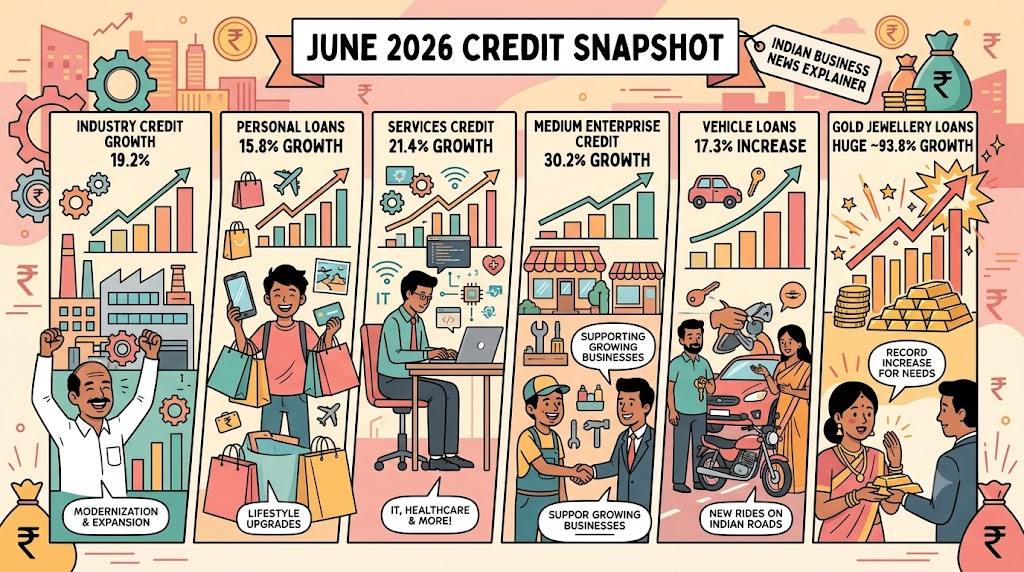
By the end of June, the amount of outstanding credit to industry stood at approximately ₹47.7 lakh crore. Loans to big industries increased 16.6%. The 30.2% growth was much faster for medium enterprises. Demand was from power, engineering, construction, petroleum-based industries, food processing, textiles, metals and chemicals. The increase in June did not come from any single big industry group.
Part of the rise is due to daily requirements. The bills for raw materials must be settled before the finished goods are sold; salaries cannot be deferred for the customer's delayed payment. A moderately well-ordered business can be cash poor for as long as 60-90 days.
Production data provided some support for the lending data. On 28 July 2026, the Ministry of Statistics and Programme Implementation announced a 7.3% increase in industrial production in June. Manufacturing increased 7.8% and 19 of 23 manufacturing groups grew. The growth of credit should not be viewed as an indicator of growth of every factory, but rather the 2 indicators were in line with each other last month.
The main figures have been consolidated into the table below. It also reflects the reason that the headline is broader than just an increase in company loans.
The table points to 2 borrowing trends. Companies, particularly medium firms, are returning to banks in larger numbers. Households have not stepped away from credit either. Vehicle and gold-backed loans are expanding much faster than card balances.
A factory loan rarely appears in a worker’s bank statement. Its effect is indirect. A packaging company may add a second shift, while a fabricator may finally pay a transporter waiting for 6 weeks. Such payments travel through local markets.
Medium enterprises employ technicians, drivers, accountants, machine operators and contract workers. Many do not have easy access to bonds or overseas funding. A bank remains their main organised source of finance. Credit can prevent a temporary cash gap from stopping production, but lending alone will not create jobs. The company still needs sales, timely customer payments and enough profit after interest.
Households continued to borrow for housing, vehicles, education and urgent expenses. Vehicle loans grew 17.3% to about ₹7.5 lakh crore. Education loans rose around 13%. Credit-card outstanding increased by only about 2%, well below the growth recorded in several secured categories.
Gold loans drew the most attention. Loans against gold jewellery within personal credit rose about 93.8%. The wider gold-backed loan portfolio reached roughly ₹5.4 lakh crore by the end of June. A LoansJagat report published on 1 July 2026 had placed the portfolio at ₹5.1 lakh crore as of 31 May, after 105.5% annual growth.
The appeal is easy to see. Jewellery is available, paperwork is lighter and disbursal can be quick. Families may need surgery or admission fees. Shop owners may need stock.
Risk appears when the borrower has no fixed repayment source. A loan taken for a 3-month gap can become a year-long burden after repeated renewal. Interest continues, and the jewellery remains at risk. A higher gold valuation helps the lender recover money after default. It does not improve the borrower’s income.
Also Read: Gold Loan Ticket Size Doubles to ₹2 Lakh Amid Unsecured Credit Shift
Crisil Ratings said in April 2026 that MSMEs, retail borrowers and companies choosing bank loans over corporate bonds could support credit growth during FY2026-27. Director Subha Sri Narayanan linked the return of corporate borrowing partly to bank finance becoming cheaper than bond funding for some companies.
ICRA gave a more cautious forecast later in April. Vice President and Sector Head Sachin Sachdeva expected credit growth to slow because of global uncertainty, crude-oil prices and possible disruption to supply chains. A company may borrow because it has new orders, or because imported material and transport have become costlier.
Banks therefore need to look beyond turnover. Order quality, customer payment history, inventory levels and existing debt deserve attention. A 90-day working-capital limit cannot be judged like a 5-year machinery loan. Gold loans also need income checks, particularly after repeated renewals.
The Press Information Bureau reported on 5 May 2026 that non-food credit grew 15.9% at the end of FY2025-26. Industry credit rose 15%, compared with 8.2% a year earlier. Micro and small industry loans grew 33.1%, while medium-industry credit increased 21.7%.
Personal loans grew 16.2% at the end of March. By June, that figure had eased slightly to 15.8%. Industry moved in the other direction, rising from 15% to 19.2%. Medium-enterprise credit climbed from 21.7% to 30.2%. The first quarter of FY2026-27 therefore brought a stronger corporate lending cycle without a sharp drop in household borrowing.
A home loan may stay on a bank’s books for 20 years, while a working-capital limit can change within a quarter. Banks need deposits for both and different credit checks.
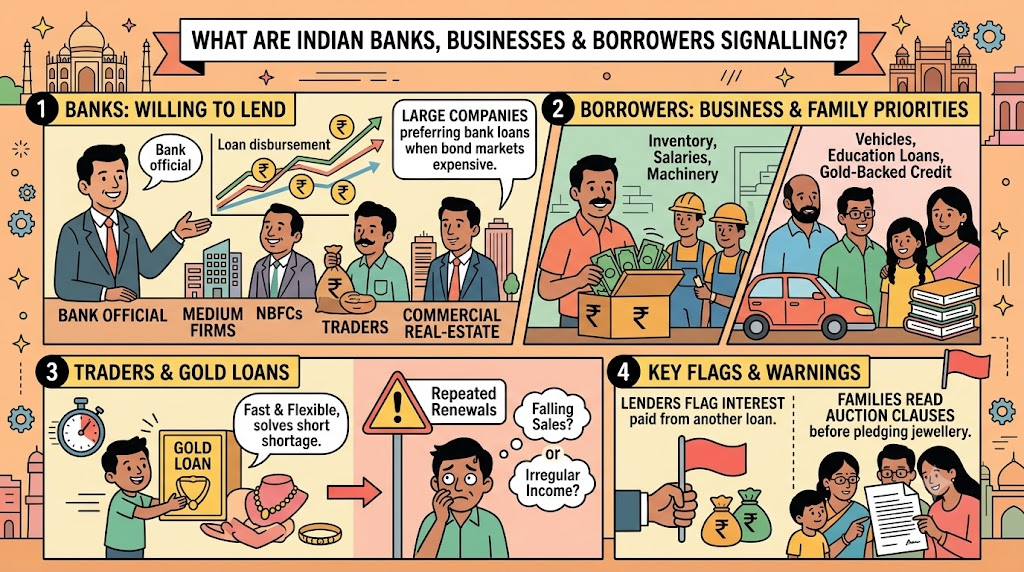
Banks appear willing to lend across several groups. Medium firms, NBFCs, traders and commercial real-estate companies all recorded strong borrowing. Large companies may also prefer bank loans when bond-market funding becomes expensive. That creates business for lenders, though it can increase exposure to sectors affected by fuel prices, exports or delayed projects.
Borrowers are revealing their priorities too. Companies need cash for inventory, salaries and machinery. Families are choosing vehicles, education loans and gold-backed credit. Small traders often use gold because the process is quicker than applying for a larger business limit. It can solve a short shortage. Repeated renewals may hide falling sales or irregular income.
Lenders should flag interest paid from another loan. Families also need to read auction clauses before pledging jewellery.
Banks need deposits that remain for longer periods. Higher fixed-deposit rates may attract savers, but they also raise the lender’s cost. Chasing growth without checking cash flow can create bad loans later, particularly among borrowers already carrying several obligations.
For companies, loan tenure should match the use. Machinery may justify a multi-year facility, while seasonal inventory may need only a short limit.
Households need an equally direct test. Every EMI should be compared with regular monthly income after rent, food, school fees and existing debt. An expected bonus is not guaranteed. Gold loans work best when the repayment source is already known.
Bank credit to industry growing 19.2% in June 2026 marks a sharp rise from the 6.3% pace recorded a year earlier. Large companies borrowed more, but medium enterprises recorded the stronger increase. Personal loans remained high at 15.8%, with vehicles and gold-backed borrowing doing more of the work than credit cards.
The coming quarters will show whether companies turn this money into output, hiring and supplier payments. Banks must fund the loan growth with deposits and keep their checks intact. Families should avoid taking a fresh loan only to pay an older one.
Credit can keep a machine running, stop a supplier payment from being delayed and help a household meet an urgent bill. It can also reveal weak cash flow within a few months. Repayment will tell the real story.
Companies borrowed more for working capital, inventory, engineering, power, construction and expansion during the first quarter of FY2026-27.
Vehicle, housing, education and gold-backed borrowing stayed active, while growth in credit-card outstanding remained much lower.
Yes. The wider gold-backed portfolio reached about ₹5.4 lakh crore by June 2026 after a sharp rise during May.
It can support hiring when companies receive orders and expand production. Loans used only to repay old debt may not add workers.
They should review the EMI, regular income, existing debt, renewal charges, and the result of missing a payment.
Check the interest rate, repayment schedule, valuation method, processing fee, and auction terms before handing over any jewellery.










.png&w=3840&q=75)


