
By continuing, you agree to LoansJagat's Credit Report Terms of Use, Terms and Conditions, Privacy Policy, and authorize contact via Call, SMS, Email, or WhatsApp
Disclaimer: The information published on LoansJagat is intended for general informational and educational purposes only and should not be considered financial, legal, or investment advice. Interest rates, loan terms, statistics, and other data may change over time and may vary by lender or source. Please verify the latest information and consult a qualified financial advisor or the respective Bank/NBFC before making any financial decisions.
Subscribe Now
About the author

Arshathul Afia
Arshathul Afia is a journalism graduate and fintech content writer with 4+ years of experience in digital publishing and research-led writing. She has written 200+ articles covering personal finance, lending, banking, digital payments, credit, insurance, and major financial developments in India. At LoansJagat, she focuses on simplifying complex fintech news, RBI updates, loan-related changes, policy developments, and industry trends for everyday readers. Her journalism background helps her approach stories with research, context, and clarity, while her SEO experience ensures content remains discoverable and relevant. She aims to make financial news easier to understand, practical, and useful for readers across India.
Related Blog Post
Simplify All Your Loans Into One Affordable EMI

Customers Served

Debt Consolidated

1200+ Reviews

Locations in India
Club all Loans & Credit Card Bills into Single EMI

Quick Apply Loan
Consolidate your debts into one easy EMI.

Takes less than 2 minutes. No paperwork.

10 Lakhs+
Trusted Customers

2000 Cr+
Loans Disbursed

4.7/5
Google Reviews

50+
Banks & NBFCs Offers
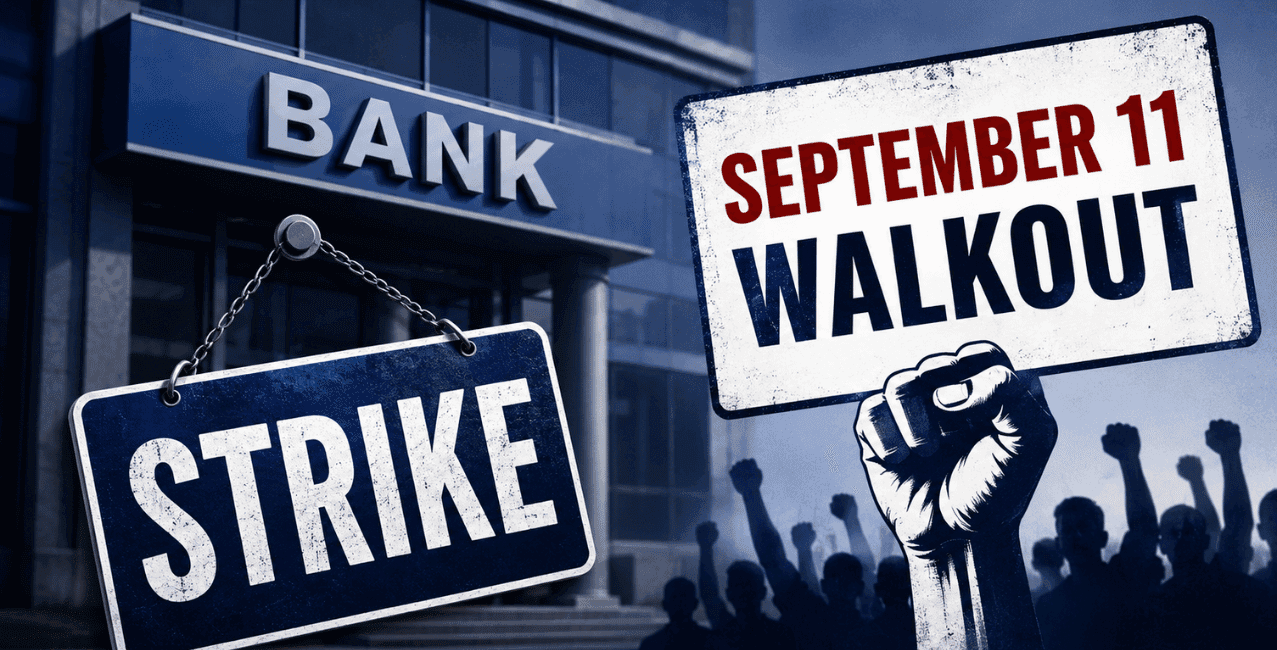
UFBU has called a nationwide bank strike on September 11, raising the risk of branch disruption over 5-day banking, incentives and pension demands across India.
Customers who need a branch on Friday, September 11, face immediate pressure. Cash deposits, cheque processing, demand drafts, KYC changes and loan documents may slow down, particularly at public sector banks. Later strikes could also delay property payments, loan disbursals and trade documents.
Read Also: Senior Citizen FD Rates Touch 8.5%: These Banks Are Offering the Highest Returns in August 2026
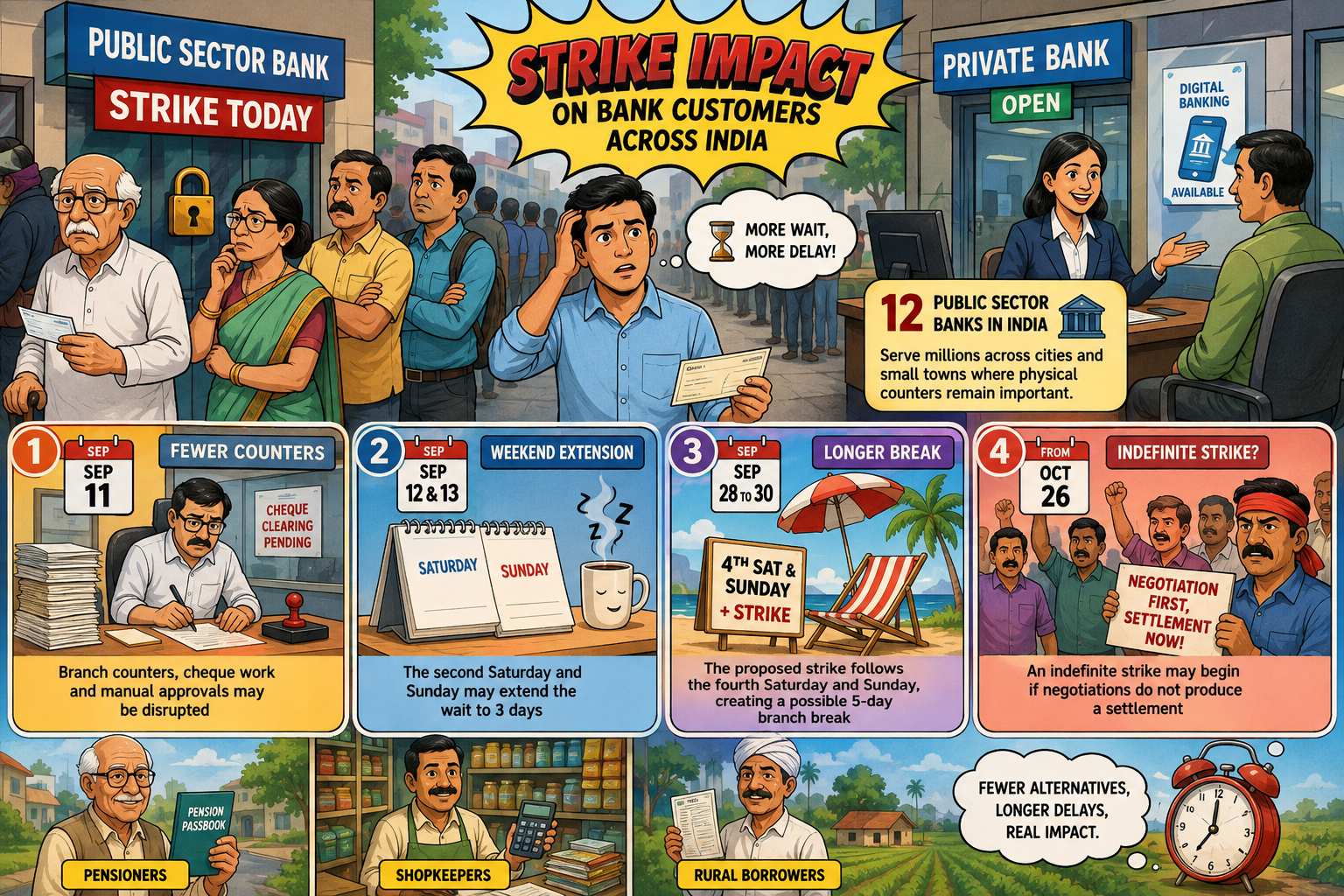
A Friday strike can leave a longer queue of unfinished work. Public sector branches may run fewer counters or close where participation is high. Private banks could operate normally, but their customers may still face delays when a cheque or document depends on an affected bank.
The effect will differ by city and bank. India has 12 public sector banks, according to the Department of Financial Services, whose banking page was updated on January 23, 2026. These lenders also serve smaller towns where physical counters remain important. Pensioners, shopkeepers and rural borrowers may have fewer alternatives when staff are unavailable.
Banking specialists divide the risk into automated transactions and employee-assisted work. UPI, IMPS, cards and internet banking should continue unless a bank reports a technical fault. ATMs may work, though cash replenishment can become uneven. Cheque verification or a loan file awaiting a signature cannot always move without staff.
The safer response is to move time-sensitive branch work forward. A LoansJagat service explainer on the February 12, 2026 bandh made the same useful distinction between a bank holiday and disruption caused by employee participation. Its borrower-focused reading applies here too: a scheduled EMI may debit automatically, but a fresh disbursal, document release or foreclosure request can wait if an authorised officer is absent. That timing gap is the main borrower risk.
Bank employees currently receive holidays on the second and fourth Saturdays. Other Saturdays remain working days. UFBU wants every Saturday declared a holiday, bringing commercial banks closer to the working pattern followed by several government offices and financial institutions.
The Indian Banks’ Association agreed to recommend 5-day banking under the 12th Bipartite Settlement and 9th Joint Note signed on March 8, 2024. Under the proposed arrangement, employees would work an extra 40 minutes from Monday to Friday. UFBU says the plan was sent for government approval but remained pending for more than 2 years.
Union leaders argue that longer weekdays would preserve weekly working time. The proposal still needs detailed branch timings and customer-service plans. A rural customer travelling on Saturday faces a different problem from a salaried customer using an application in Mumbai or Bengaluru.
Approving all Saturdays as holidays may address employee workload and reduce repeated strikes. Further delay keeps the existing branch schedule but leaves the dispute open.
The earlier performance-linked incentive arrangement came through the 11th Bipartite Settlement in November 2020. It allowed employees and officers up to Scale VII to receive an incentive of up to 15 days of basic pay plus dearness allowance, depending on the overall performance of their bank.
UFBU says the Department of Financial Services introduced a separate framework for Scale IV and higher officers in November 2024. Under that formula, senior officers may receive up to 365 days of basic pay based on individual performance. Employees and officers up to Scale III remain under the lower ceiling.
The unions call the difference discriminatory. They argue that growth, recoveries, deposits and customer service come from several grades. UFBU wants a negotiated formula instead of separate rules for senior officers.
Pension claims have widened the dispute. The unions want pension updation, improved benefits, a common dearness allowance formula for pensioners and an option for employees covered by the National Pension System to move to the Old Pension Scheme. These demands affect retired and serving employees, which gives the agitation a wider base.
The argument over Saturdays goes back to 2015. Banks began closing on the second and fourth Saturdays that year, while the remaining Saturdays stayed on the working calendar. Employee unions kept asking for a full Monday-to-Friday schedule.
There seemed to be some movement on March 8, 2024. IBA and UFBU recorded a proposal for 5-day banking as part of their settlement, with employees agreeing to work 40 extra minutes from Monday to Friday. The required government notification, however, never arrived.
By March 2025, the delay had led UFBU to announce a 2-day strike for March 24 and 25. Recruitment concerns and the disputed PLI directions were also on the list. The action was later put off after the Finance Ministry and IBA agreed to continue discussions.
Bank employees eventually stopped work across India on January 27, 2026. Their demand remained the same: all Saturdays should be holidays. Demonstrations followed in state capitals and other towns on August 12.
Another round of talks took place in Mumbai on August 20. IBA and UFBU discussed PLI, the pending 5-day week, pension dearness allowance and security at branches. AIBEA Circular No. 30/19/2026/52 recorded that IBA would take the PLI objections to government and labour authorities. Three days later, UFBU released its September and October strike programme.
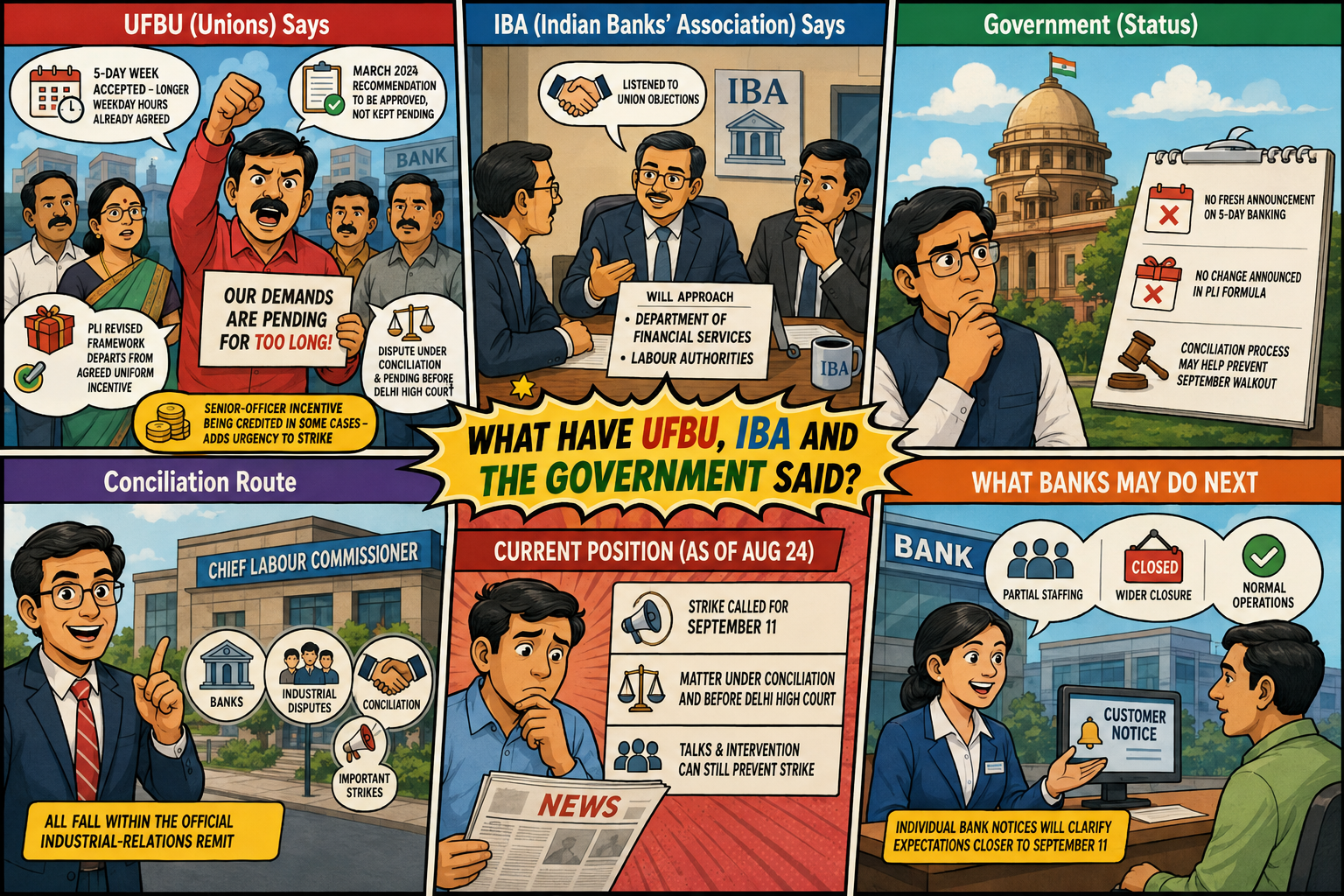
UFBU accused the government of taking a “negative attitude” towards long-pending demands. It said employees had already accepted longer weekday hours for a 5-day week. The unions want the March 2024 recommendation approved rather than left pending again.
On PLI, UFBU said the revised framework departs from the uniform incentive agreed through collective bargaining. It also claimed that the dispute is under conciliation and pending before the Delhi High Court. Banks have started crediting the senior-officer incentive in some cases, according to the union, which added urgency to the strike decision.
IBA did not announce a settlement after the August 20 meeting. AIBEA’s account said the association listened to union objections and agreed to approach the Department of Financial Services and labour authorities. The Chief Labour Commissioner lists banks, industrial disputes, conciliation and important strikes within its official industrial-relations remit. That gives the conciliation process a possible route to prevent the September walkout.
No fresh government announcement approving 5-day banking or changing the PLI formula was available when the strike call was reported on August 24. Individual banks may issue customer notices closer to September 11. Those notices will show whether branches expect partial staffing, wider closure or normal operations.
Read Also: Axis Bank Credit Card Rules Change August 28: DCC Fee Jumps to 3.5%
September 11 is still a strike call, so customers should watch for notices from their own banks before assuming every branch will shut. Still, the Friday timing leaves little room. The second Saturday and Sunday come next, which means unfinished counter work may have to wait until Monday. Another difficult stretch could arrive from September 26 to 30 if the later strike goes ahead.
Anyone with a cheque to deposit, property payment due or loan file awaiting approval should try to finish the work early. Routine transfers will probably continue online. Tasks requiring original documents or an officer’s signature are different. Borrowers facing a payment deadline should contact the branch and request written confirmation of the expected disbursal date.
Employees want all Saturdays off and have agreed to work 40 additional minutes from Monday to Friday.
Yes. Document checks, branch approval or an authorised officer’s signature may push disbursal to the next working day.
Yes. A disbursal needing document checks, branch approval or an authorised signature may move to the next working day.
Cheque clearing may slow where branch or back-office staff participation is high. Customers should deposit urgent cheques before September 11.
Yes. UFBU may defer or withdraw the strike if conciliation or direct talks produce an acceptable written settlement.








.png&w=3840&q=75)


