
.png&w=3840&q=65)
By continuing, you agree to LoansJagat's Credit Report Terms of Use, Terms and Conditions, Privacy Policy, and authorize contact via Call, SMS, Email, or WhatsApp
Disclaimer: The information published on LoansJagat is intended for general informational and educational purposes only and should not be considered financial, legal, or investment advice. Interest rates, loan terms, statistics, and other data may change over time and may vary by lender or source. Please verify the latest information and consult a qualified financial advisor or the respective Bank/NBFC before making any financial decisions.
Subscribe Now
About the author

Arshathul Afia
Arshathul Afia is a journalism graduate and fintech content writer with 4+ years of experience in digital publishing and research-led writing. She has written 200+ articles covering personal finance, lending, banking, digital payments, credit, insurance, and major financial developments in India. At LoansJagat, she focuses on simplifying complex fintech news, RBI updates, loan-related changes, policy developments, and industry trends for everyday readers. Her journalism background helps her approach stories with research, context, and clarity, while her SEO experience ensures content remains discoverable and relevant. She aims to make financial news easier to understand, practical, and useful for readers across India.
Related Blog Post
Simplify All Your Loans Into One Affordable EMI

Customers Served

Debt Consolidated

1200+ Reviews

Locations in India
Club all Loans & Credit Card Bills into Single EMI

Quick Apply Loan
Consolidate your debts into one easy EMI.

Takes less than 2 minutes. No paperwork.

10 Lakhs+
Trusted Customers

2000 Cr+
Loans Disbursed

4.7/5
Google Reviews

50+
Banks & NBFCs Offers
A Himachal consumer commission ordered HDFC Bank to pay ₹47,500 after a ₹1.99 crore loan rejection followed mortgage formalities, raising transparency concerns across Indian lending.
In the short term, the order may encourage applicants to seek written updates before paying for legal checks, valuation or mortgage registration. The negative effect of a late rejection can be heavy. A shop opening may get delayed, suppliers may walk away, and money spent on paperwork may bring no return. Over time, banks may need tighter branch procedures on when applicants should begin costly formalities.
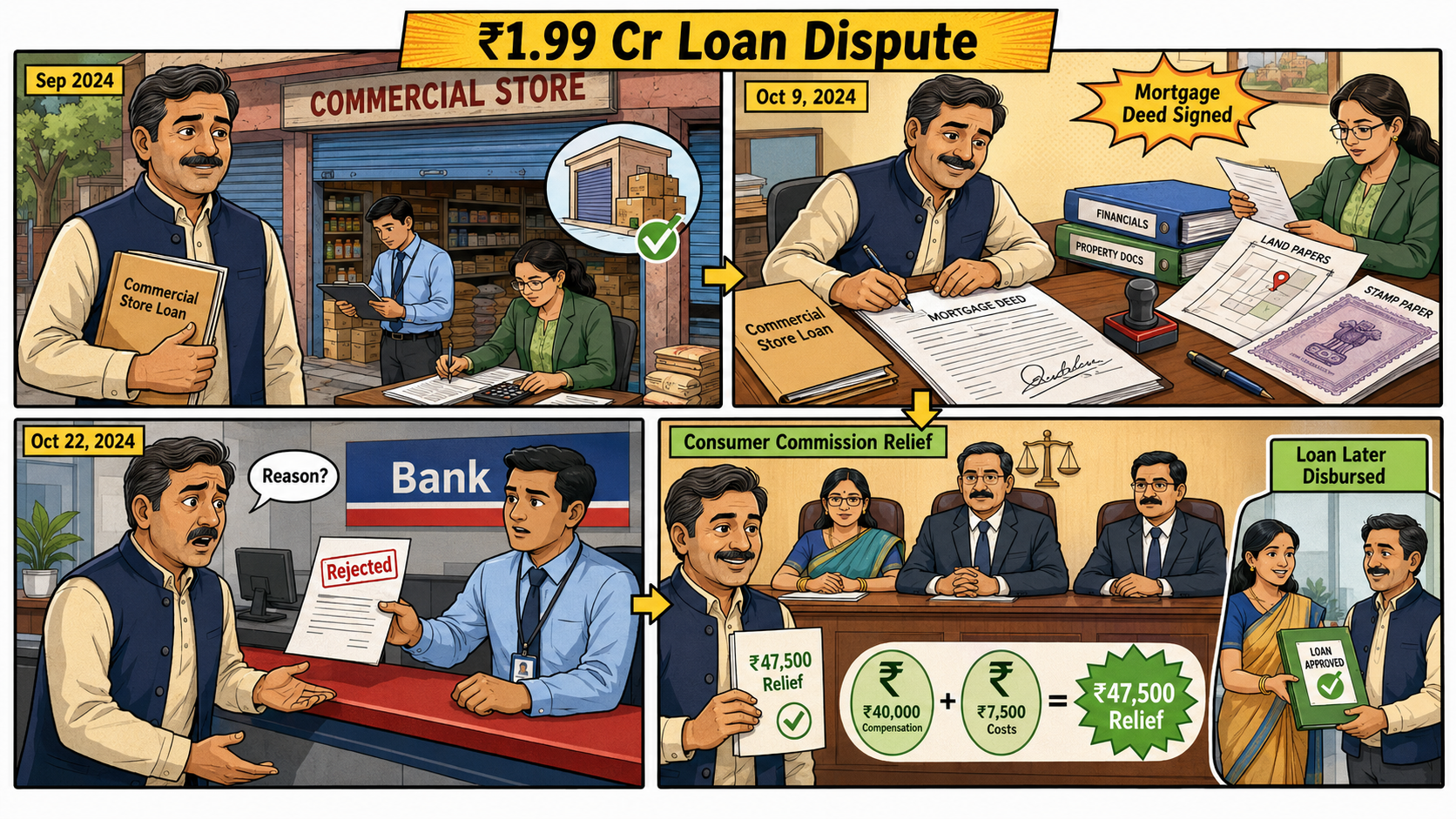
Soni approached HDFC Bank in September 2024. According to his complaint, bank officials inspected his building, examined stock, collected financial records and asked him to arrange land documents. He alleged that officials indicated the loan would be released soon.
The case moved from application checks to mortgage work within weeks. Its main developments are listed below.
The 13-day period between mortgage execution and rejection shaped the commission’s finding. It observed that directing an applicant to create a mortgage moved the process beyond an initial review and created a legitimate expectation that sanction was near.
A bank can refuse a loan when income, cash flow, collateral, repayment history or internal policy does not support the application. This order does not remove that authority. It tells borrowers to separate a sales assurance from a formal sanction. A relationship manager’s promise carries little value if the sanction letter has not arrived.
The positive outcome may be better record-keeping. Applicants can ask the branch to confirm whether the credit appraisal is complete before spending money on mortgage work. LoansJagat’s guide on personal loan rejection reasons, published on July 14, 2026, advises borrowers to identify the actual weakness before applying again. In this case, that advice goes a step further. Applicants should also ask why expensive documentation is required before final approval.
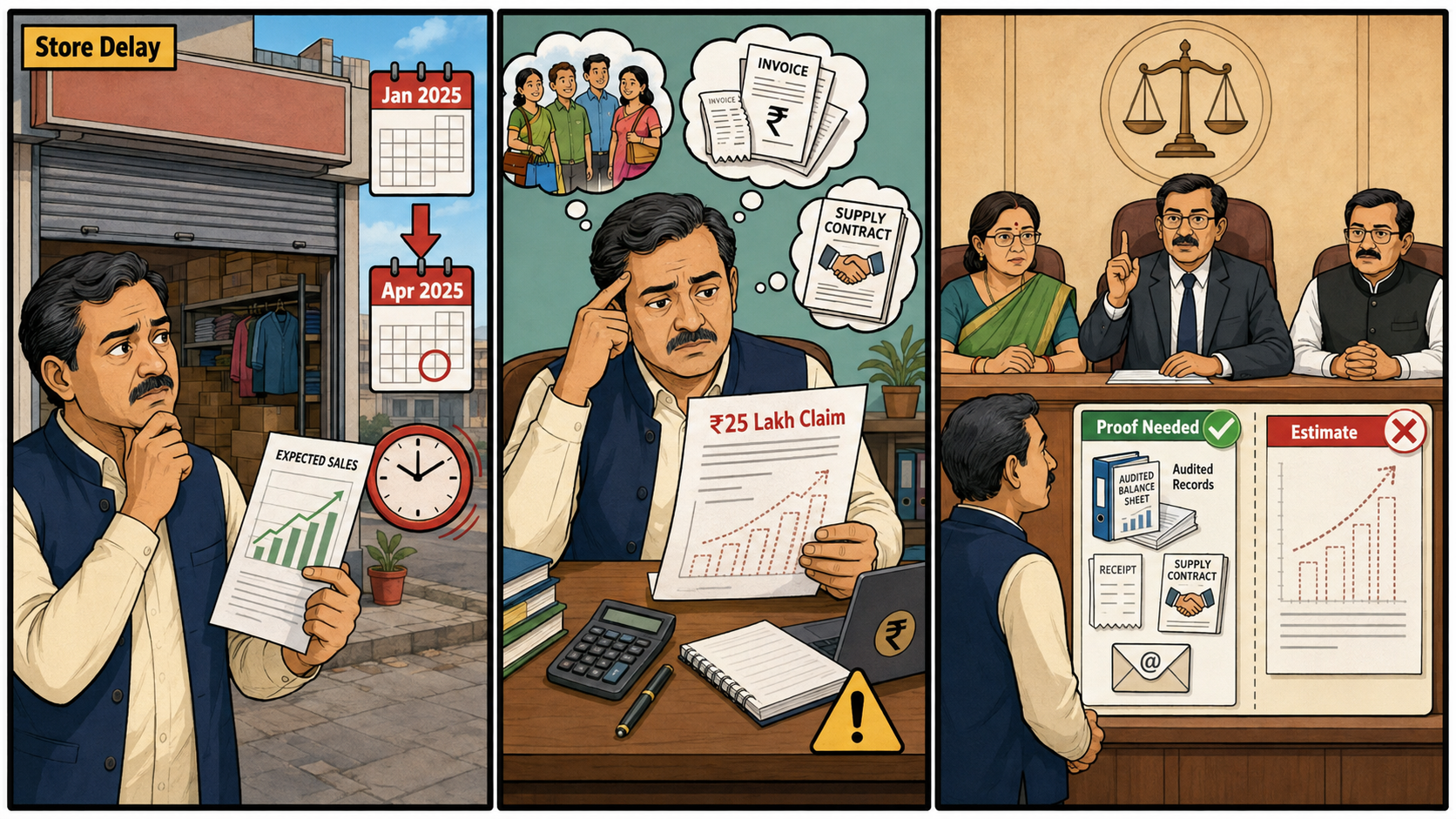
Soni said the rejection pushed the proposed store opening from January 2025 to April 2025. He estimated that the delay caused a ₹25 lakh business loss and sought compensation for the missed income.
The commission refused that part of the claim. It found no audited balance sheets or similar records showing that the delayed opening caused an exact ₹25 lakh loss. Forecasts, expected sales and proposed opening dates can explain a complaint, but they do not prove lost profit on their own.
This distinction is useful for other business owners. Legal expenses can be shown through receipts. A cancelled supply order can be supported by a contract or email. Lost profit requires stronger accounting records, particularly when the business had not started operating at the planned location.
The National Consumer Helpline’s Consumer Protection Act guidance, hosted by the Department of Consumer Affairs, says services hired for commercial purposes are generally outside the consumer definition. An exception may apply when a person uses the service exclusively to earn a livelihood through self-employment.
A Supreme Court decision from February 28, 2025, adds a warning. In The Chief Manager, Central Bank of India v. M/s Ad Bureau Advertising Pvt. Ltd., reported as 2025 INSC 288, the court held that a private company using a project loan to generate profit did not qualify as a consumer.
The Supreme Court of India judgment dealt with a private company, while the Hamirpur dispute involved a sole proprietorship. That difference can affect jurisdiction. A company, a small trader and a self-employed borrower may not receive the same legal treatment.
For rejected applicants, the safer solution is to begin with the bank’s grievance channel. National Consumer Helpline and the government’s e-Jagriti portal may provide further routes, but a commercial borrower should first check whether the complaint qualifies under consumer law.
The commission said that requiring official documents, mortgage charges and extensive administrative work could create a legitimate expectation of sanction. It described the later blanket rejection as an indication of arbitrary handling and a lack of bona fide appraisal.
Soni alleged that bank officials encouraged him to incur legal expenses and assured him that the loan would be released. He relied on the mortgage deed, inspection visits and later disbursal by another bank to support his case.
HDFC Bank’s response was absent from the proceedings described in the report. The bank did not file its written reply within 45 days after receiving notice. No representative later appeared at the hearing, and the commission proceeded without the bank’s defence.
That procedural detail deserves attention. The commission examined Soni’s affidavit and documents without a competing version from HDFC Bank. The Indian Express report did not carry a separate public statement from the lender on the July 17 order.
The first request should be made in writing. The applicant can ask the bank to identify whether the rejection arose from repayment capacity, collateral, documentation, credit history or internal policy. Emails and complaint acknowledgements provide a usable record.
Next comes document review. The borrower should check the application form, tax records, bank statements, business accounts, property papers and credit report. Sending fresh applications to several lenders immediately may create additional credit enquiries without fixing the original problem.
Any money spent during processing should also be recorded. Receipts for legal scrutiny, valuation, stamp duty, registration and mortgage preparation can support a later grievance. A verbal estimate will not carry the same weight.
If the bank does not resolve a service complaint, the applicant may contact the National Consumer Helpline on 1915. A complaint can also be filed through e-Jagriti, where consumer law eligibility is established. Business borrowers may need legal advice because commercial purposes can affect whether a consumer commission has jurisdiction.
The Hamirpur order deals with how HDFC Bank handled the application, rather than the bank’s authority to refuse ₹1.99 crore. Mortgage work, inspection visits and reported assurances were followed by a rejection after 13 days. The commission found that sequence unfair and awarded ₹47,500.
Borrowers should wait for written approval before treating a loan as confirmed. If a bank demands costly formalities earlier, the applicant should ask for the processing stage in writing. That small step can prevent wasted expense and provide evidence if the proposal later ends abruptly.
Yes, it can. Even after collecting all the papers and completing the appraisal, the bank is free to turn down the proposal. That said, if an applicant has proper records on hand, arbitrary handling, misleading assurances or avoidable costs charged along the way can still be challenged.
No. The order gave ₹47,500 as compensation for harassment, deficient service and the cost of litigation. Nowhere did it ask HDFC Bank to approve or release the loan amount.
Yes, and they should. A written request through the branch or the grievance cell will usually get the main reason on record.
Not straight away. The applicant should first review the rejection reason, credit report and financial papers. Several quick applications may add fresh enquiries without improving eligibility.
No. Commercial-purpose services may fall outside consumer law. Sole proprietors claiming the self-employment exception must support it, while companies may need another legal route.








.png&w=3840&q=75)


