
By continuing, you agree to LoansJagat's Credit Report Terms of Use, Terms and Conditions, Privacy Policy, and authorize contact via Call, SMS, Email, or WhatsApp
Disclaimer: The information published on LoansJagat is intended for general informational and educational purposes only and should not be considered financial, legal, or investment advice. Interest rates, loan terms, statistics, and other data may change over time and may vary by lender or source. Please verify the latest information and consult a qualified financial advisor or the respective Bank/NBFC before making any financial decisions.
Subscribe Now
About the author

Arshathul Afia
Arshathul Afia is a journalism graduate and fintech content writer with 4+ years of experience in digital publishing and research-led writing. She has written 200+ articles covering personal finance, lending, banking, digital payments, credit, insurance, and major financial developments in India. At LoansJagat, she focuses on simplifying complex fintech news, RBI updates, loan-related changes, policy developments, and industry trends for everyday readers. Her journalism background helps her approach stories with research, context, and clarity, while her SEO experience ensures content remains discoverable and relevant. She aims to make financial news easier to understand, practical, and useful for readers across India.
Related News
Simplify All Your Loans Into One Affordable EMI

Customers Served

Debt Consolidated

1200+ Reviews

Locations in India
Club all Loans & Credit Card Bills into Single EMI

Quick Apply Loan
Consolidate your debts into one easy EMI.

Takes less than 2 minutes. No paperwork.

10 Lakhs+
Trusted Customers

2000 Cr+
Loans Disbursed

4.7/5
Google Reviews

50+
Banks & NBFCs Offers
A 15 September 2026 report separates personal credit-card discounts from taxable referral payouts and online-game winnings, while India’s 2025 tax law sets rules for taxpayers.
Key Highlights
Sunainaa Chadha’s 15 September 2026 personal-finance report examined a familiar set of receipts: card cashback, reward points, fintech referral payouts, online sales of used belongings and prize money. They can all reach a person through an app or bank account. The reason behind each payment changes the tax answer. The report did not announce a new tax or say that every online prize attracts the same rate.
For households, this affects what goes into the next tax return. A salaried shopper could wrongly count a purchase discount as earnings, while someone collecting referral bonuses could omit taxable income. Freelancers face a longer-term accounting problem too. If cashback reduces the price of a work computer, claiming its original price for tax purposes may overstate the cost. The original bill and the later card credit need to be read together. This is particularly relevant when 1 person pays both home and work bills from the same card. The statement may show only a cashback total, while the invoices show which part came from each kind of spending.
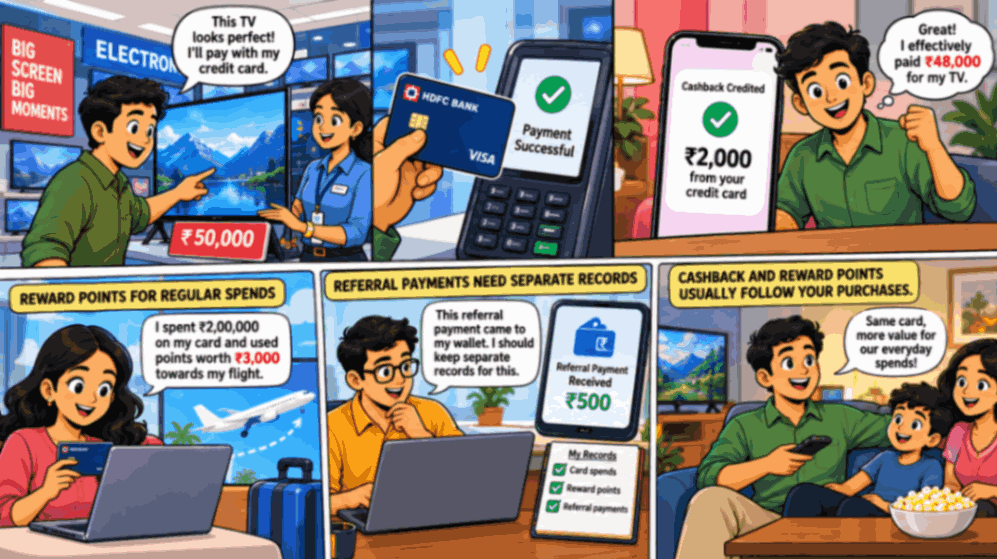
A ₹50,000 television bought with a credit card attracts ₹2,000 cashback in the report’s example. The buyer effectively pays ₹48,000. That ₹2,000 follows the purchase; it does not generally become another ₹2,000 of taxable income for a person who bought the television for home use. A cashback credit might arrive after the purchase, and the bank may list it separately. Its timing does not change the transaction that produced it.
Personal reward points generally follow similar reasoning. In the report’s example, a cardholder spends ₹2 lakh and uses points worth ₹3,000 towards a flight. The benefit follows those purchases. A referral payment appearing in the same wallet needs separate records; the card statement alone cannot explain why the app paid it.
Archit Gupta, the tax-platform executive quoted in the 15 September report, treats purchase-linked cashback as a price reduction. For business cardholders, he says the credit can reduce the expense they claim or the cost of an asset used for depreciation. He puts referral cash payouts in another category. An ordinary user generally reports them as Income from Other Sources; an incentive earned during business activity may count as business income. His examples turn on why the person received the money.
A credit-card news account updated on 2 September 2026 gave LoansJagat a related view: frequent small payments can be easy to overlook until they form 1 bill. The tax inference here follows from that observation. Scattered cashback credits are harder to match with purchases. Monthly statements, marked business invoices and separate referral screenshots can resolve that problem. The question is what triggered each reward. A payment earned for referring a user cannot be treated as shopping cashback merely because both credits arrived on the same day.
Earlier tax guidance addressed discounts. Circular No. 12/2022, dated and uploaded on 16 June 2022, said ordinary sales discounts, cash discounts and rebates allowed to customers did not require TDS under the provision for specified business benefits. Circular No. 18/2022 followed on 13 September 2022. Neither circular exempted every card reward or app payment.
A Ministry of Finance release issued on 1 April 2026 confirmed that the Income-tax Act, 2025 came into force that day. For September 2026 receipts, the current Act uses section 92 for other-source income and section 194 for specified winnings. Older articles cite sections 56 and 115BBJ of the previous Act. That Act still governs proceedings for years beginning before 1 April 2026.
An app that pays ₹500 when a friend signs up rewards an activity. That payment is generally taxable even after only 1 referral. An occasional payout can fall under other-source income; referral commissions earned through business activity can count as business income. The size of a transfer does not turn a referral reward into a purchase discount.
The Act generally excludes an old phone held for personal use from capital gains tax under its personal-effects rule. Used household furniture or a personal car can also qualify; jewellery and certain specified items cannot. Someone buying phones to resell for profit instead has business activity, even when both sellers use the same app.
The table puts the typical outcomes in 1 place. Each row assumes the payment came from the activity described; a different set of facts can change the result.
A freelancer’s personal card can still pay for a business computer. The work purchase needs business accounting, regardless of card ownership. The report also flags personal travel paid with points earned through business spending, without assigning 1 automatic answer to every redemption.
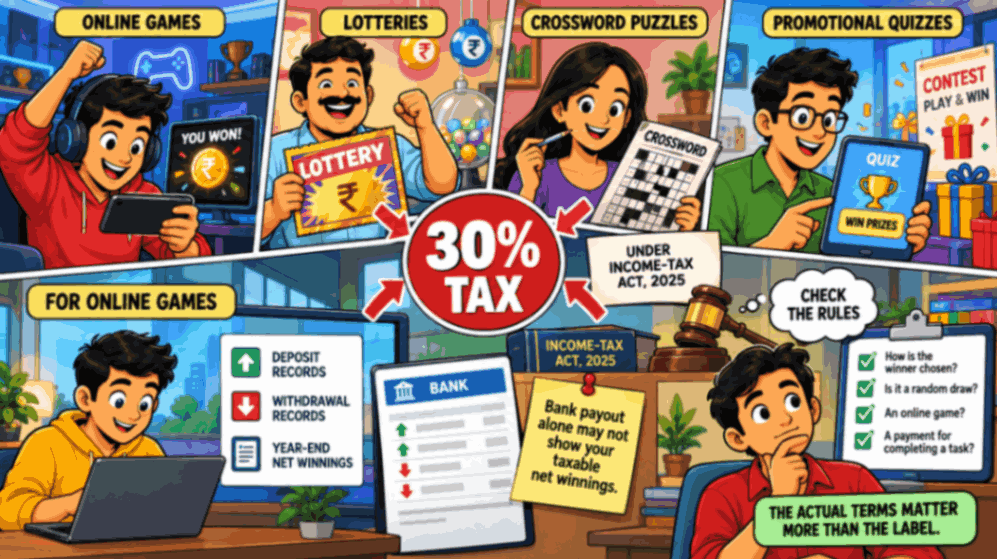
The Income-tax Act, 2025 taxes net online-game winnings at 30%. Its definition covers games offered on the internet and accessed through a computer or phone. Certain other winnings, including lotteries and crossword puzzles, also face 30%. A promotional quiz needs its rules checked; its online entry form alone cannot establish the prize category.
For online games, the law addresses net winnings when money leaves the player’s account and at tax-year end. Players should keep deposit and withdrawal records; a bank payout alone may not show the taxable net winnings. A quiz entrant should check how the organiser chose the winner before assigning the prize a tax category. A random draw, an internet game and a payment for completing a task do not describe the same activity. Organisers often call all 3 a “contest”, so the promotional label provides less help than the actual terms.
A bank credit shows how money arrived, not why. Purchase-linked cashback follows a bill; referral money pays for an activity. Selling an old personal item and winning an online game need separate checks. No September tax notification changed those categories.
The purchase invoice, card statement, referral terms, used-item listing and contest rules explain each receipt. Cardholders using 1 card for work and home spending should mark those bills as they arrive. A year later, that record is easier to use than a list of unexplained bank credits.
A bank transfer alone does not make cashback taxable. A credit tied to personal shopping generally reduces the purchase cost, even if paid later. Business cashback may reduce an expense claim or asset cost. The cardholder should match each credit to its bill. If 1 cashback payment combines several transactions, the reward statement can help split it across personal and business purchases.
Personal spending points generally stay linked to purchases when redeemed for a flight. Business-earned points spent on personal travel need a separate accounting review. The reward statement and bills can show which spending produced the points.
A ₹500 referral payout generally counts as income because the app paid for an activity. Occasional payments may fall under other sources; business referrals may fall under business income. The wider tax calculation decides the final liability. The app’s separate shopping cashback does not change this classification.
A phone held for personal use generally falls within the personal-effects exclusion. The purchase details and sale listing can help show how the owner used it. Buying phones for resale instead points to business income. The app used to sell them does not decide the classification. Regular sales and a resale plan can point to business income.
An online entry form does not settle a prize’s tax category. The Act taxes net online-game winnings at 30%, along with specified other winnings. The organiser’s rules and prize-award method help determine the category; participants should also check their TDS records.









.png&w=3840&q=75)


