
By continuing, you agree to LoansJagat's Credit Report Terms of Use, Terms and Conditions, Privacy Policy, and authorize contact via Call, SMS, Email, or WhatsApp
Disclaimer: The information published on LoansJagat is intended for general informational and educational purposes only and should not be considered financial, legal, or investment advice. Interest rates, loan terms, statistics, and other data may change over time and may vary by lender or source. Please verify the latest information and consult a qualified financial advisor or the respective Bank/NBFC before making any financial decisions.
Subscribe Now
About the author

Arshathul Afia is a journalism graduate and fintech content writer with 4+ years of experience in digital publishing and research-led writing. She has written 200+ articles covering personal finance, lending, banking, digital payments, credit, insurance, and major financial developments in India. At LoansJagat, she focuses on simplifying complex fintech news, RBI updates, loan-related changes, policy developments, and industry trends for everyday readers. Her journalism background helps her approach stories with research, context, and clarity, while her SEO experience ensures content remains discoverable and relevant. She aims to make financial news easier to understand, practical, and useful for readers across India.
Related News
Simplify All Your Loans Into One Affordable EMI

Customers Served

Debt Consolidated

1200+ Reviews

Locations in India
Club all Loans & Credit Card Bills into Single EMI

Quick Apply Loan
Consolidate your debts into one easy EMI.

Takes less than 2 minutes. No paperwork.

10 Lakhs+
Trusted Customers

2000 Cr+
Loans Disbursed

4.7/5
Google Reviews

50+
Banks & NBFCs Offers
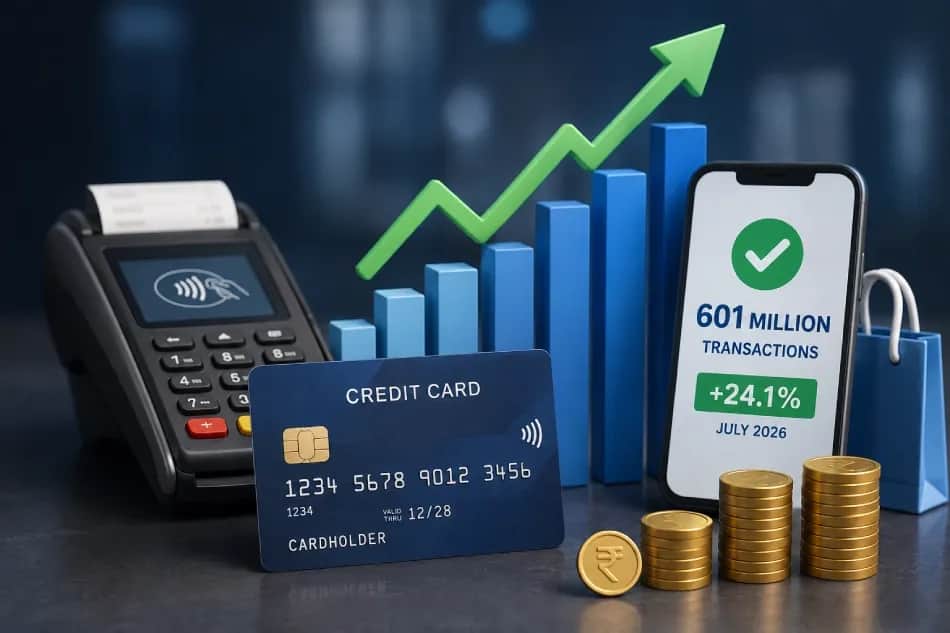
India’s credit card users made more payments in July 2026, but smaller purchases pulled average transaction value down despite higher overall card spending across India.
July brought a sharp rise in credit card use. Across India, customers made 601 million payments at card machines and online, according to Asit C. Mehta Investment Intermediates Limited’s Monthly Credit Card Insights for July 2026. That was 24.1% more than a year earlier. Spending rose at a slower pace, up 7.4% to ₹2.08 lakh crore. With more small payments entering the count, the average bill dropped 13.5% to ₹3,460. The report partly linked this change to everyday UPI payments made through RuPay credit cards.
For households, the immediate gain is easier credit at shops that accept UPI but may not have a card machine. The risk follows quietly. A string of small grocery, medicine and food payments can build a large statement balance. If this pattern continues, cards may become everyday payment tools rather than products saved for costly purchases, changing both household budgets and the way banks assess card usage.
The difference comes from simple arithmetic. Transaction volume rose much faster than the money spent, so each payment became smaller on average. A ₹300 pharmacy bill and a ₹600 grocery payment add 2 transactions, yet their combined value remains well below a flight booking or an electronics purchase. Repeated across millions of cardholders, such purchases pull the national average down.
More people also held cards. The number of outstanding credit cards reached about 122.9 million in July 2026, compared with 111.8 million a year earlier. Yet card growth alone cannot explain the 24.1% rise in payments. Existing users were also paying more frequently, helped by online checkouts and RuPay cards connected to UPI applications.
The table keeps the main figures together without loading the story with unnecessary data.
Nothing in the July figures points to a sudden stop in card spending. Smaller bills had appeared earlier too, with June’s average ticket already 12.9% below its year-ago level. July spending worked out to ₹16,812 per card, up 2.2% from June but 2.4% lower than in July 2025. People still put more money on their cards than they had a month earlier. They simply did it through smaller payments.
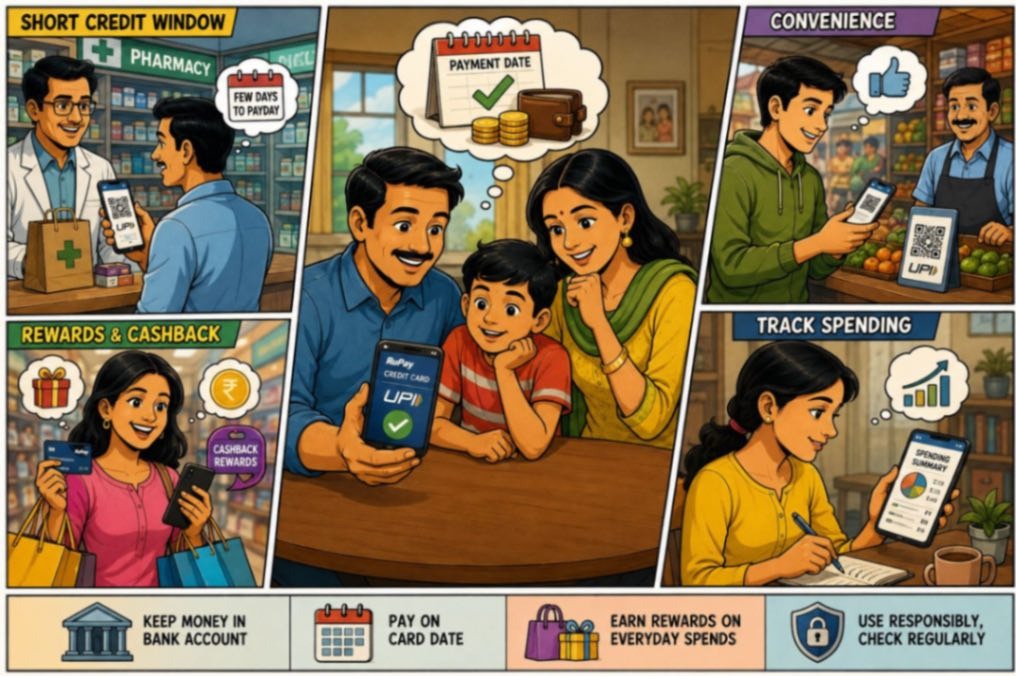
RuPay-UPI can help families keep money in their bank accounts until the card payment date. It may also provide cashback or reward points on purchases that previously earned nothing when paid directly from a savings account. For a salaried person facing a pharmacy bill a few days before payday, that short credit window can be useful.
Convenience can also hide the running total. UPI has trained users to scan quickly, enter a PIN and leave. When a credit card becomes the selected payment source, the purchase does not leave the bank account at once. A cardholder may see enough money in the account and still owe several thousand rupees on the card. That gap needs regular checking.
A card machine is no longer the only way for a small shop to accept payment on credit. The Press Information Bureau stated on December 13, 2023, under release ID 1987764, that shoppers could link a RuPay credit card to UPI and pay by scanning a merchant’s QR code. This gave neighbourhood stores a practical route to accept card-funded purchases without installing a separate terminal.
Read Also : RBI Re-KYC Deadline September 15: QR Merchants Face Payment Disruption Risk
India had allowed RuPay credit cards to be linked with UPI well before the July figures. The facility retained the familiar scan-and-pay process while moving the payment source from a bank account to a credit line. Card issuers then started building products around daily UPI use, often adding virtual issuance and rewards for merchant QR payments.
Punjab National Bank joined that push on April 22, 2026. Its partnership with Kiwi introduced a RuPay credit card with digital onboarding, 1.5% cashback on eligible scan-and-pay purchases and 0.5% on eligible online transactions. LoansJagat had covered the PNB-Kiwi launch, including its plan to offer credit-on-UPI access across PNB’s customer network.
By July, PNB recorded about 5.2 million credit card transactions, 8.9% more than in June after a much sharper rise during the previous month. Its credit card spending grew 173% from July 2025 and 8.6% from June. PNB still contributed only about 0.4% of industry spending, so its experience cannot explain the national increase by itself. It does show how a card designed for QR payments can produce many low-value transactions.
Read Also : Property Title With Family Member: Tax, Benami Rules & Ownership Risks
Asit C. Mehta Investment Intermediates linked the lower average ticket partly to small RuPay credit card transactions routed through UPI. The analysis did not state how many of the 601 million payments used this route. That limitation is important. A larger card base, higher online activity and repeated use of existing cards also helped lift transaction volume.
UPI is changing the way India pays, PNB Executive Director Bibhu Prasad Mahapatra said on April 22, 2026. He then turned to PNB’s reach. The bank runs more than 10,000 branches, and 60% are in rural and semi-urban areas. Through the Kiwi partnership, PNB hopes to bring formal credit closer to customers who have often found it harder to access.
Kiwi co-founder Siddharth Mehta described the tie-up as a route to safer and more flexible credit access. The product’s cashback design also reveals the commercial aim. Rewards encourage a customer to choose the linked card at the same QR code where a bank account would otherwise fund the payment.
LoansJagat’s reading of the July numbers is that the falling ticket size should not be treated as proof of a consumer spending collapse. Total card spending still rose 7.4%. The sharper issue for borrowers is visibility. Small payments feel light at the checkout, yet they combine into a single bill carrying high interest if the balance is not paid fully.
Read Also : Bank of India Cheque Update: ₹50,000 Cut-Off From January 1, 2027
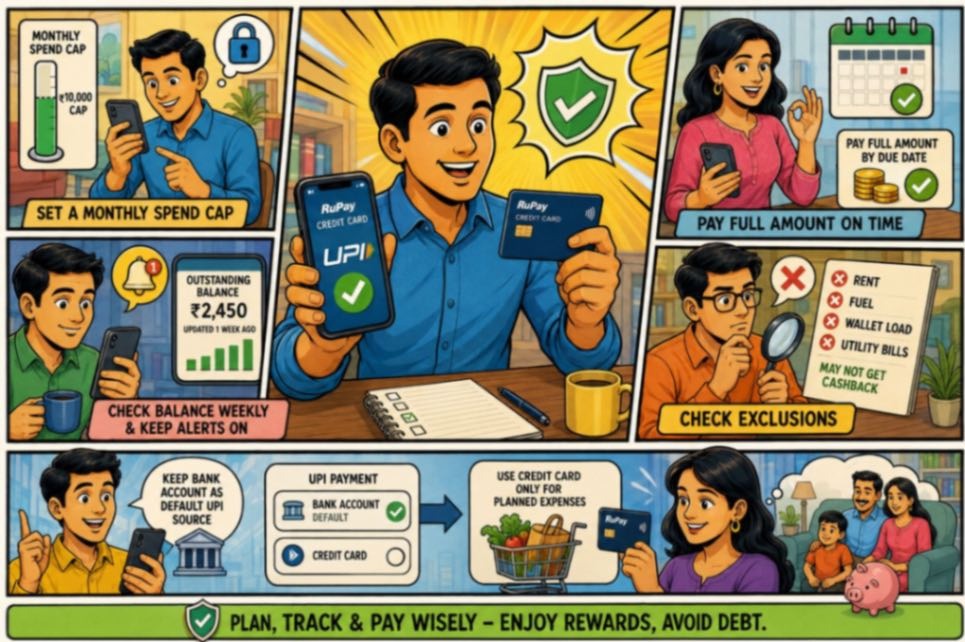
Cardholders can set a monthly ceiling for RuPay-UPI spending and check the outstanding balance every week. Transaction alerts should remain active. A person with a ₹10,000 monthly cap can stop using the card for QR payments after reaching that figure, even if the sanctioned credit limit is much higher.
The full statement balance should be paid by the due date whenever possible. Paying only the minimum due keeps the account from being immediately marked overdue, but interest can continue on the unpaid amount. Rewards rarely compensate for those charges. Customers should also read exclusions because rent, fuel, wallet loading and some utility payments may not earn the advertised cashback.
Users who find frequent credit payments difficult to track can keep their bank account as the default UPI source. The credit card may then be selected only for planned expenses. This small change places a pause before borrowing and reduces accidental card use at every merchant QR.
July 2026 showed how quickly credit cards are moving into daily payments. Indians completed 601 million PoS and online transactions, but the average payment fell to ₹3,460 as lower-value purchases became more common. RuPay-UPI contributed to the shift, though the available analysis does not establish its exact national share.
For consumers, wider acceptance can be useful. It provides short credit access at ordinary shops and may add rewards. The same convenience can make borrowing harder to notice. Regular balance checks and full repayment will decide whether small card-funded UPI payments remain useful or turn into expensive revolving debt.
Transaction count rose 24.1%, while total spending increased 7.4%. A growing number of smaller payments raised volume faster than value, reducing the average transaction size.
No. A linked RuPay credit card is mainly intended for eligible merchant payments. Person-to-person transfers and certain restricted merchant categories cannot generally be funded through the card.
Not necessarily. Total credit card spending increased to ₹2.08 lakh crore in July 2026. The lower average shows that each payment was smaller, while the combined amount still grew.
It can help users earn eligible rewards and delay payment until the billing date. It works best when the cardholder tracks every purchase and pays the full balance.
A monthly cap, weekly balance checks and full repayment by the due date offer practical control. Keeping a bank account as the default UPI source adds another safeguard.









.png&w=3840&q=75)


