
By continuing, you agree to LoansJagat's Credit Report Terms of Use, Terms and Conditions, Privacy Policy, and authorize contact via Call, SMS, Email, or WhatsApp
Disclaimer: The information published on LoansJagat is intended for general informational and educational purposes only and should not be considered financial, legal, or investment advice. Interest rates, loan terms, statistics, and other data may change over time and may vary by lender or source. Please verify the latest information and consult a qualified financial advisor or the respective Bank/NBFC before making any financial decisions.
Subscribe Now
About the author

Arshathul Afia is a journalism graduate and fintech content writer with 4+ years of experience in digital publishing and research-led writing. She has written 200+ articles covering personal finance, lending, banking, digital payments, credit, insurance, and major financial developments in India. At LoansJagat, she focuses on simplifying complex fintech news, RBI updates, loan-related changes, policy developments, and industry trends for everyday readers. Her journalism background helps her approach stories with research, context, and clarity, while her SEO experience ensures content remains discoverable and relevant. She aims to make financial news easier to understand, practical, and useful for readers across India.
Related News
Simplify All Your Loans Into One Affordable EMI

Customers Served

Debt Consolidated

1200+ Reviews

Locations in India
Club all Loans & Credit Card Bills into Single EMI

Quick Apply Loan
Consolidate your debts into one easy EMI.

Takes less than 2 minutes. No paperwork.

10 Lakhs+
Trusted Customers

2000 Cr+
Loans Disbursed

4.7/5
Google Reviews

50+
Banks & NBFCs Offers
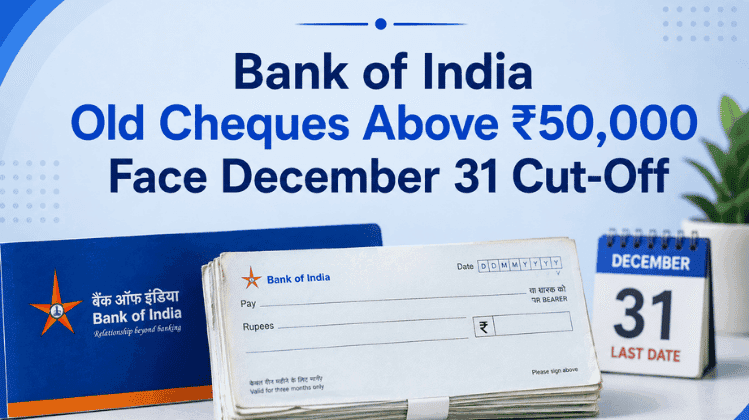
Still holding an old BOI cheque book? Look closely. Cheques worth ₹50,000 or more without an alphanumeric code may then fail after December 31, 2026.
An old BOI cheque book kept aside for property, rent or business payments now needs a closer look. In an advisory posted on August 17, 2026, Bank of India asked customers to check whether cheques of ₹50,000 and above carry an alphanumeric code. If that marking is missing, the bank will refuse the leaf after December 31, even when the account holds enough money. Customers using the affected series have been told to order a fresh cheque book.
The immediate risk is a failed payment after the cut-off. A shop owner could miss a supplier deadline, while a borrower may discover that an old post-dated cheque meant for an EMI cannot be processed. Over the longer term, the code gives BOI an extra way to identify each cheque leaf and screen suspicious instruments. Customers of other banks should check their lender’s own notice, because the published instruction names Bank of India customers.
The impact will be strongest among people who still use cheques for property instalments, rent, business purchases, school payments and loan accounts. Many households retain a cheque book for years because only a few leaves are used. That habit can hide an older series in a cupboard until the day a large payment is due. A leaf may appear usable, yet BOI can refuse it after the deadline if the amount reaches ₹50,000 and the required code is absent.
The table shows which payments need attention before the year ends.
The payee also carries some risk. A builder, landlord or vendor may accept a cheque months before presenting it. If the leaf fails later, the payment date has already passed and both parties must arrange another transfer. Customers can prevent that scramble by reviewing cheque numbers already handed to third parties, rather than checking only the unused leaves still at home.
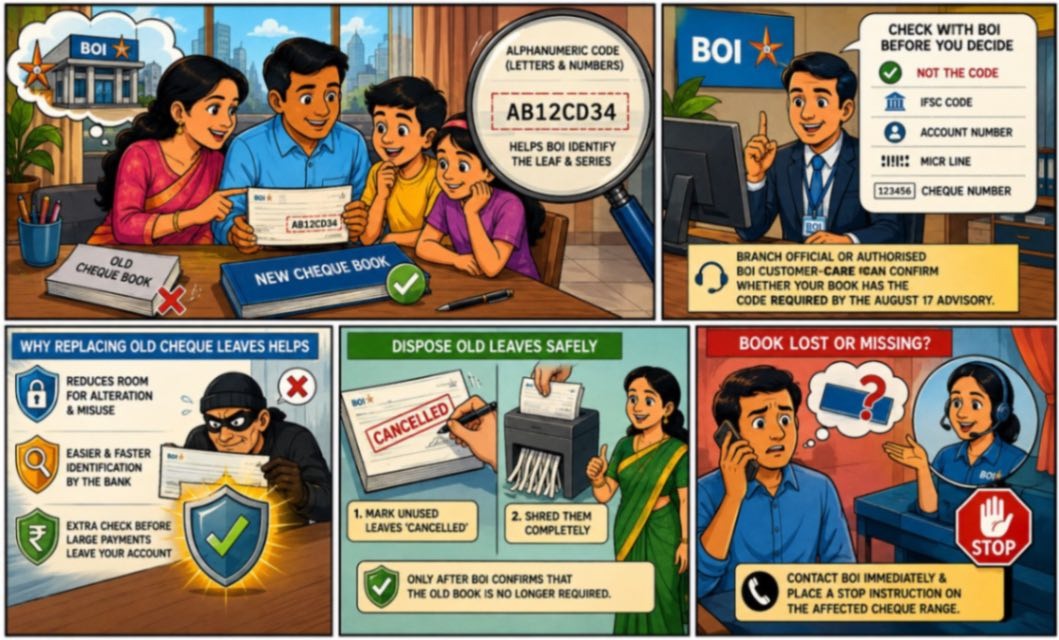
An alphanumeric code combines letters and numbers to help BOI identify the cheque leaf and its series. The customer should not guess which printed field qualifies. An IFSC, account number, MICR line or ordinary cheque number may also appear on the paper, but those details serve different functions. A branch official or authorised BOI customer-care channel can confirm whether the book carries the code required by the August 17 advisory.
The change can also reduce the room available for cheque alteration and use of an older series after the bank has moved to newer controls. Faster identification helps the bank compare the presented leaf with its internal record. For a genuine customer, that creates one extra check before a large amount leaves the account. The price is a small amount of work now: requesting the replacement, receiving it at the registered address and changing any post-dated instructions.
Blank signed leaves need special care during the switch. They should never be thrown away intact. Once BOI confirms that the old book is no longer required, unused leaves can be marked cancelled and shredded. If the book cannot be found, the customer should contact the bank at once and place a stop instruction on the affected cheque range.
Banking operations professionals separate 3 issues before advising a customer: the cheque series, the amount and the date on which the payee will present it. For this BOI update, the combination requiring action is specific. The leaf belongs to an older series, it lacks the alphanumeric code, and the payment is ₹50,000 or more after December 31, 2026. Checking only the age of the book can give the wrong answer.
Early replacement is the practical solution. A customer should take an unused leaf to the home branch or contact BOI through an authorised channel. After the bank confirms that a new book is needed, the customer should verify the registered delivery address before ordering it. The next job is less obvious. Every landlord, builder, lender or supplier holding an old post-dated leaf must receive a replacement before the agreed payment date.
LoansJagat’s borrower-focused reading is that post-dated loan cheques deserve first priority. A rejected EMI cheque can trigger a late fee under the loan contract and may also start follow-up calls from the lender. The LoansJagat guide to the Negotiable Instruments Act, 1881 explains why every returned cheque does not automatically become the same legal case. The recorded reason, the debt and the notice process still affect what happens next.
Read Also : RBI Re-KYC Deadline September 15: QR Merchants Face Payment Disruption Risk
Bank of India introduced its Centralised Positive Pay System for CTS cheques of ₹50,000 and above from January 1, 2021. Under that process, the drawer provides the account number, cheque number, cheque date, amount and beneficiary name after issuing the cheque. BOI then compares the submitted information with the instrument that reaches the bank for payment.
Positive Pay and the alphanumeric code address different stages. Positive Pay checks information supplied by the account holder. The newer code helps identify the physical leaf and its series. A customer may therefore have to use a current cheque book and complete the bank’s high-value cheque verification process. Doing one does not replace the other.
The earlier system also explains why the ₹50,000 figure appears again in the 2026 advisory. BOI has used that amount as an important point for added verification since 2021. The latest instruction goes further for old-series leaves by attaching a firm December 31 deadline. From January 1, 2027, customers issuing larger cheques without the code face refusal under the bank’s published notice.
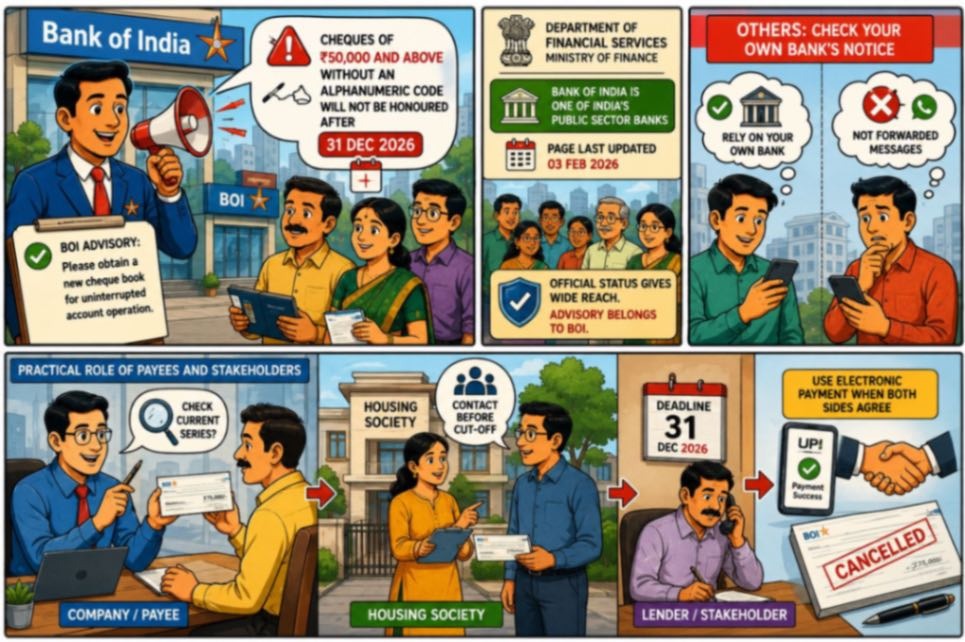
BOI’s public wording is direct: cheques of ₹50,000 and above without an alphanumeric code will not be honoured after December 31, 2026. The advisory asks affected customers to obtain a new cheque book for uninterrupted account operation. It does not announce that every old cheque book in India will expire on that date.
The Department of Financial Services, Ministry of Finance, lists Bank of India among India’s public sector banks. Its public-sector-bank page was last updated on February 3, 2026. That official status gives the advisory a wide customer reach, but the instruction still belongs to BOI. People banking elsewhere should rely on a notice from their own bank, not a forwarded message carrying another lender’s name.
Payees have a practical role too. A company accepting a high-value BOI cheque for deposit in 2027 should ask the drawer whether the leaf belongs to the current series. Housing societies and lenders holding post-dated cheques may also need to contact customers before the cut-off. An electronic payment can be used when both sides agree and the original cheque is returned or cancelled properly.
Read Also : Property Title With Family Member: Tax, Benami Rules & Ownership Risks
Bank of India customers should inspect old cheque books well before December 31, 2026. A cheque of ₹50,000 or more without the alphanumeric code can be refused after the cut-off. The review should include unused leaves, post-dated cheques and any payment already promised for 2027.
The safest response is simple but should not be delayed. BOI customers need to confirm the series, request a replacement when required and exchange old post-dated leaves before they reach the bank. Customers of other banks should follow their own lender’s instructions.
No. The published deadline concerns specified Bank of India cheques. Customers of other banks should verify instructions issued by their own lender.
The customer should show an unused leaf to a BOI branch or use authorised customer care. IFSC and MICR details should not be mistaken for it.
Yes, if a cheque is for ₹50,000 or more and lacks the required code, the drawer should replace it before the payee deposits it.
It may be treated as unpaid under the loan agreement until another payment succeeds. The borrower should contact the lender before the due date.
The advisory specifically names cheques of ₹50,000 and above. Even so, the account holder should confirm the old series with BOI before using it.









.png&w=3840&q=75)


