
By continuing, you agree to LoansJagat's Credit Report Terms of Use, Terms and Conditions, Privacy Policy, and authorize contact via Call, SMS, Email, or WhatsApp
Disclaimer: The information published on LoansJagat is intended for general informational and educational purposes only and should not be considered financial, legal, or investment advice. Interest rates, loan terms, statistics, and other data may change over time and may vary by lender or source. Please verify the latest information and consult a qualified financial advisor or the respective Bank/NBFC before making any financial decisions.
Subscribe Now
About the author

Arshathul Afia is a journalism graduate and fintech content writer with 4+ years of experience in digital publishing and research-led writing. She has written 200+ articles covering personal finance, lending, banking, digital payments, credit, insurance, and major financial developments in India. At LoansJagat, she focuses on simplifying complex fintech news, RBI updates, loan-related changes, policy developments, and industry trends for everyday readers. Her journalism background helps her approach stories with research, context, and clarity, while her SEO experience ensures content remains discoverable and relevant. She aims to make financial news easier to understand, practical, and useful for readers across India.
Related News
Simplify All Your Loans Into One Affordable EMI

Customers Served

Debt Consolidated

1200+ Reviews

Locations in India
Club all Loans & Credit Card Bills into Single EMI

Quick Apply Loan
Consolidate your debts into one easy EMI.

Takes less than 2 minutes. No paperwork.

10 Lakhs+
Trusted Customers

2000 Cr+
Loans Disbursed

4.7/5
Google Reviews

50+
Banks & NBFCs Offers
Small QR merchants face a September 15 re-KYC crunch, with industry estimates warning that up to 35% could face payment interruptions if verification remains incomplete.
India's payment companies are entering the final 2 weeks of a large merchant-verification exercise. Industry executives estimate that 30%-35% of smaller offline merchants using QR standees may not finish re-KYC by September 15, 2026. Around 1 million small online businesses could also remain unverified. The figures were reported on September 1 and are industry estimates, not official government data. The immediate risk is not a nationwide UPI shutdown. It is a merchant-level interruption where a payment provider cannot keep an account active without completing the required checks.
For a kirana shop, food stall, pharmacy, repair counter, or neighbourhood service business, even a short interruption can hurt daily collections. If payment acceptance is paused while verification is completed, the merchant may have to ask for cash or another payment route. Over time, stronger checks can improve merchant records and help payment companies spot suspicious or mismatched activity. In the short run, businesses with old documents or pending physical checks have little room left to fix errors.
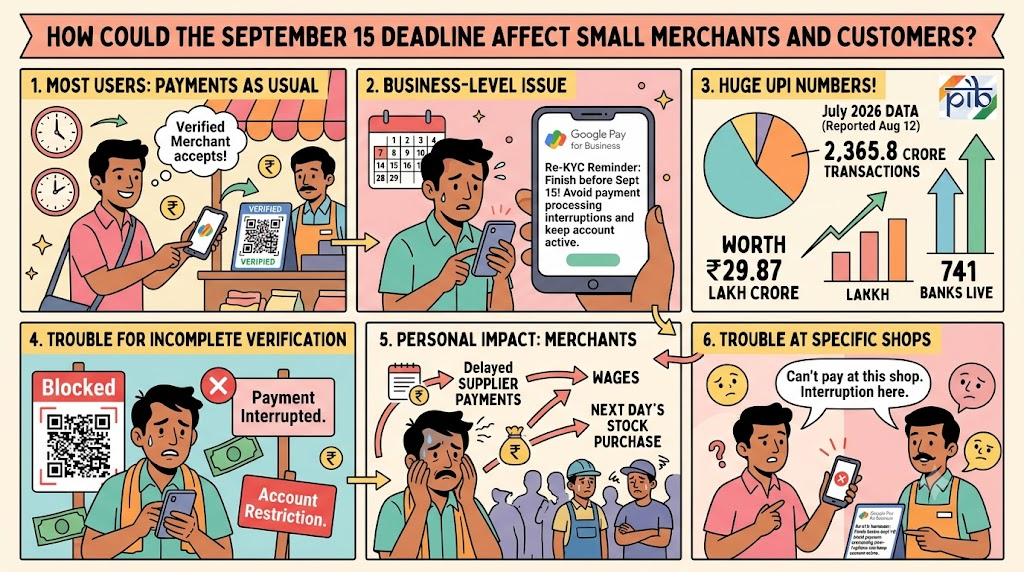
For most UPI users, the payment experience should continue normally. A customer can still send money through UPI, while a properly verified merchant can keep accepting it. Trouble can arise at a specific business whose verification remains incomplete. Google Pay for Business, for example, has told merchants seeing a re-KYC reminder to finish the process before September 15 to avoid interruptions to payment processing and keep the account active. That makes the deadline a business-level issue, not a warning about the entire UPI network.
The scale of UPI explains why the story carries weight. The Press Information Bureau reported on August 12, 2026, that UPI processed 2,365.8 crore transactions worth ₹29.87 lakh crore in July 2026, with 741 banks live on the platform. Those national numbers are huge, yet the effect of a merchant block is personal. One account restriction can delay supplier payments, wages, or the next day's stock purchase.
The current estimates also suggest that unfinished verification is concentrated among smaller merchants.
A large share of unfinished merchants reportedly contributes only a small portion of overall payment value and volume. That reduces the chance of a system-wide shock. It does not remove the local problem. A small retailer that depends on QR collections may still struggle with stock purchases or routine expenses if the payment account gets restricted.
There is also a consumer benefit. Better identification can make it harder for fake shops, misleading merchant names, or poorly documented accounts to stay unnoticed. The Department of Financial Services describes UPI as a system that combines bank-account access with merchant payments through a mobile interface. As digital payments spread further into local commerce, the accuracy of merchant records becomes more important.
A practical LoansJagat view is that the risk is mainly about cash flow and continuity for small sellers. Its LoansJagat payment aggregator explainer notes that aggregators allow businesses to accept UPI, cards, and wallets through a common payment setup. If verification blocks that merchant relationship, a business may lose access to more than 1 collection route. National payment volumes may barely move while the affected shop feels the full hit.
Read Also : 7.8 Crore ITRs Filed for AY 2026–27, Sets New Filing Record
Documentation appears to be the biggest obstacle. A small, owner-run shop may have started accepting QR payments years ago with basic bank and identity details. Re-KYC can require updated business information, accepted documents, and address or physical verification. A typo in the business name, an expired document, or a mismatch between the account and the actual shop can trigger another round of checks.
Industry executives told Moneycontrol that many kirana and mom-and-pop stores do not carry the same paperwork as larger businesses. One senior payments executive said the aim was to standardise KYC, but smaller stores often lack the documents needed to finish quickly. Another payments company founder said firms serving large offline networks had to expand teams into Tier 3 towns and rural areas because the work could not be handled only from major cities.
Merchants should now open the official business app used for collections, check for pending re-KYC alerts, and submit only the records requested there. If a document is rejected, it should be corrected quickly. Where the provider asks for a location check, physical verification, or video step, completing it early leaves room for another attempt if something goes wrong.
Shopkeepers should also avoid anyone asking for a UPI PIN, banking password, or OTP to "activate" KYC. Genuine verification can require identity and business documents, but a payment PIN should never be handed to a caller.
The warning signs appeared before the September 1 report. Indian Android app developers had already complained about long verification delays linked to cross-border merchant payments. Moneycontrol reported on August 20, 2026, that some developers had spent 6-8 months trying to finish checks, with repeated document submissions and rejections. For affected developers, overseas app and in-app sales could be paused until verification was completed.
That episode showed why the final days can become difficult. Verification is not always finished when a file is uploaded. A document may need correction, a physical visit may come later, or an account may contain older details that no longer match current records. The same problem gets harder when large numbers of small offline merchants are being processed across cities, towns and rural areas at once.
Government policy has pushed UPI deeper into everyday commerce at the same time. The Ministry of Finance said on August 8, 2026, that UPI handled 2,366 crore transactions worth about ₹29.9 lakh crore in July and remained free for the vast majority of merchant transactions. QR acceptance is now routine for many small businesses, which raises the cost of even a temporary account interruption.
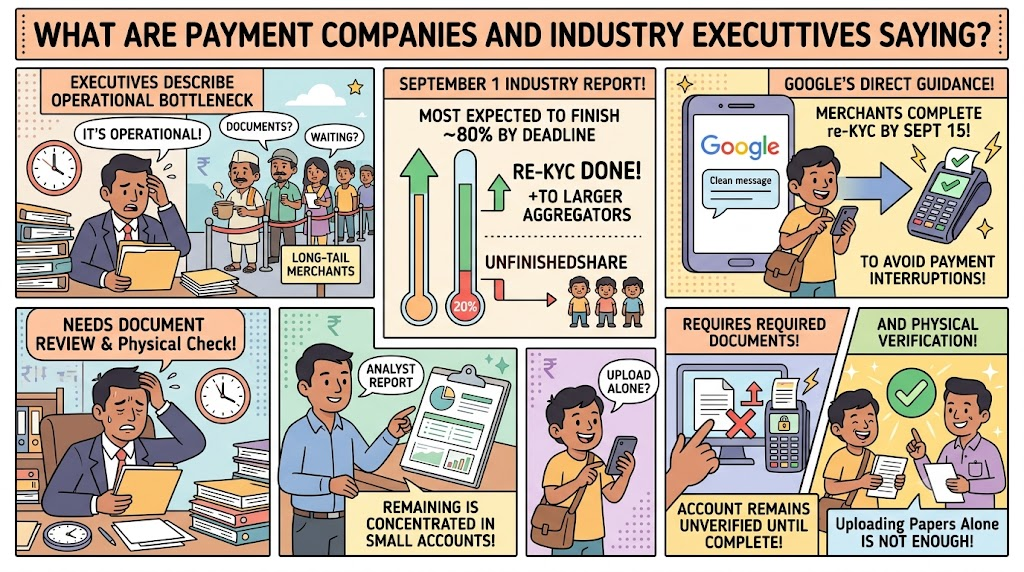
Payment executives describe the bottleneck as operational. Long-tail merchant accounts can need document review, follow-up, and sometimes a physical check. The September 1 industry report said most payment aggregators were expected to finish around 80% of merchant re-KYC by the deadline, leaving the unfinished share concentrated among smaller accounts.
Google's merchant-support guidance is more direct. It says merchants asked to complete re-KYC should do so before September 15 to avoid payment-processing interruptions. Its guidance also says an account can remain unverified until required documents and physical verification are completed. Uploading paperwork alone may therefore not finish the process.
For merchants, the practical route is straightforward. Payment companies need updated merchant records, while small businesses need collections to keep moving. The closer the process gets to September 15, the harder it becomes to fix a rejected document or arrange another verification step before payment access is affected.
This is also where the impact differs between a large payment company and a tiny retailer. An aggregator may carry thousands of unfinished accounts without seeing a large drop in payment value. A shopkeeper has only 1 business account to worry about. If that account is restricted, the disruption is immediate. That difference explains why the national numbers can remain stable while individual merchants still face a difficult few days.
The September 15 deadline is a merchant-compliance crunch, not a nationwide UPI shutdown. Up to 35% of smaller offline QR merchants may miss the timeline according to industry estimates, while around 1 million online businesses could also remain unverified. Those figures describe the backlog. They are not an official forecast of how many merchant accounts will actually be restricted.
For a small seller, the safest option is to finish every pending verification step now. India's payment network can absorb a limited merchant backlog without a major national disruption. A single shop may struggle to absorb a blocked collection account during a busy week. That is where the more immediate risk lies as September 15 gets closer.
The merchant may face payment or account restrictions until verification finishes. The exact action depends on the provider and account status.
No. UPI will continue working normally for customers and verified merchants. The risk applies mainly to merchant accounts with incomplete verification.
The merchant should check the official business app, submit requested documents, finish verification steps, and correct rejected records before September 15.
Yes. Payment providers may pause payouts or restrict transactions until pending KYC checks are completed and the merchant account is fully verified.
Yes. If merchant verification stays incomplete, the payment provider may restrict processing until the pending KYC checks are successfully completed.









.png&w=3840&q=75)


