

By continuing, you agree to LoansJagat's Credit Report Terms of Use, Terms and Conditions, Privacy Policy, and authorize contact via Call, SMS, Email, or WhatsApp
Disclaimer: The information published on LoansJagat is intended for general informational and educational purposes only and should not be considered financial, legal, or investment advice. Interest rates, loan terms, statistics, and other data may change over time and may vary by lender or source. Please verify the latest information and consult a qualified financial advisor or the respective Bank/NBFC before making any financial decisions.
Subscribe Now
About the author

Arshathul Afia is a journalism graduate and fintech content writer with 4+ years of experience in digital publishing and research-led writing. She has written 200+ articles covering personal finance, lending, banking, digital payments, credit, insurance, and major financial developments in India. At LoansJagat, she focuses on simplifying complex fintech news, RBI updates, loan-related changes, policy developments, and industry trends for everyday readers. Her journalism background helps her approach stories with research, context, and clarity, while her SEO experience ensures content remains discoverable and relevant. She aims to make financial news easier to understand, practical, and useful for readers across India.
Related News
Simplify All Your Loans Into One Affordable EMI

Customers Served

Debt Consolidated

1200+ Reviews

Locations in India
Club all Loans & Credit Card Bills into Single EMI

Quick Apply Loan
Consolidate your debts into one easy EMI.

Takes less than 2 minutes. No paperwork.

10 Lakhs+
Trusted Customers

2000 Cr+
Loans Disbursed

4.7/5
Google Reviews

50+
Banks & NBFCs Offers
India’s income tax filing count crossed 7.8 crore for AY 2026–27, setting a record as taxpayers completed returns under the staggered deadline calendar this year.
More than 7.8 crore Income Tax Returns were filed across India for Assessment Year 2026–27 by August 31, 2026. The Income Tax Department announced the record from New Delhi on September 1 and thanked taxpayers and professionals for completing their filings on time. The total covered returns submitted through the national e-filing portal across several taxpayer categories. It exceeded the 7.3 crore-plus returns reported during the previous filing season.
The immediate focus now moves to return verification, correction of filing errors and refund processing. Those who missed their applicable date can still use the belated-return route, but late fees, interest on unpaid tax and restrictions on carrying forward specified losses may follow. Over time, the increase could bring more income records into formal reporting. It does not prove that household incomes or direct tax collections rose by the same rate, since one filing count cannot establish either outcome.

The filing season ran on 2 major dates. Individuals and Hindu Undivided Families commonly using ITR-1 or ITR-2 had July 31, 2026, as their regular due date. By then, more than 5.9 crore returns under these 2 forms had been submitted. News on AIR, the government’s public broadcaster, reported that figure on August 1, 2026, citing the Income Tax Department.
August then brought returns from eligible taxpayers with business or professional income whose accounts did not require an audit. Proprietors, consultants, freelancers, professionals and eligible presumptive-tax users formed a large part of this group. Some firms, partners and trusts also came under the later date, depending on their legal status and audit position. By August 31, the cumulative count had passed 7.8 crore.
That distinction is important. The headline does not mean 7.8 crore people filed on the final day, nor does it represent only business returns. It combines returns received up to August 31, including the 5.9 crore-plus ITR-1 and ITR-2 filings already recorded by July 31.
The department has not yet published a full AY 2026–27 division covering first-time filers, old and new tax regime selections, verified returns, processed returns or refunds. Those details would reveal more about the record. Until then, the total confirms higher filing participation, but little beyond that should be assumed.
Finance Minister Nirmala Sitharaman announced the staggered return calendar while presenting the Union Budget 2026–27. A Press Information Bureau release published on February 1, 2026, said individuals filing ITR-1 and ITR-2 would continue with July 31. Non-audit business cases and eligible trusts were proposed to receive time until August 31. The Finance Act, 2026 later gave legal effect to the change.
The additional month addressed a practical filing problem. Salary taxpayers may rely mainly on Form 16, bank-interest details, the Annual Information Statement and Form 26AS. Business filers often have more scattered records. A consultant may receive payments from several clients. A small shop has sales, purchases and expenses to reconcile, while an F&O trader may need broker ledgers and turnover calculations before selecting the correct return.
The filing date therefore depends on the taxpayer’s income and audit status, not only the name of the form being used. The main AY 2026–27 dates are set out below.
For ordinary taxpayers, this division reduced the July filing pile-up and gave covered businesses more time to prepare accurate accounts. Still, the August date did not reopen the July deadline for someone who belonged to an ITR-1 or ITR-2 category. Declaring invented business income simply to claim a later date could produce a defective return or invite examination by the tax department.
Read Also : September 2026 Financial Changes: SGB Redemptions & Tax Deadlines
The filing record does not alter anyone’s tax bill. Tax payable still depends on income, deductions, exemptions, tax regime and credits already available. Nor does the record guarantee an early refund. Processing begins only after the return completes the required verification and passes the department’s checks.
There is a practical benefit for taxpayers who filed correctly. An ITR creates an official income trail that may support visa applications, rental documentation and borrowing. Banks and non-banking finance companies commonly ask self-employed applicants for recent returns because salary slips may not show their earnings.
LoansJagat’s view is that a larger pool of current ITR records can help more self-employed borrowers document income during loan assessment. Yet filing volume should not be presented as evidence that every filer has stronger repayment capacity. Lenders will still examine declared income, existing debt, bank activity, credit history and business cash flow.
A LoansJagat analysis of the August 31 ITR deadline also points to a less visible cost of late filing. For a taxpayer reporting an eligible business or capital loss, losing the ability to carry that loss forward may cost more in future tax than the immediate late fee.
Shalini Jain, Tax Partner at EY India, told ET Wealth Online in an article published on August 29, 2026, that partners of eligible non-audit firms could also fall under the August 31 date. Her explanation addressed a common mistake: the filing calendar is wider than a simple ITR-3 versus ITR-4 comparison.
Shaily Gupta, Partner at Khaitan & Co, said the additional month was intended to give business taxpayers enough time to finalise their books and complete filing. AY 2026–27 still relates to income earned during FY 2025–26 and remains governed by the Income-tax Act, 1961, even though the Income Tax Act, 2025 took effect from April 1, 2026.
Chartered Accountant Abhishek Soni, co-founder of Tax2Win, highlighted the tax-regime consequences. A person with business or professional income generally needs to submit Form 10-IEA by the original due date to opt out of the default new tax regime. Someone who missed that step cannot ordinarily choose the old regime for the first time through a belated AY 2026–27 return.
For taxpayers who missed August 31, the safer route is to file the correct belated return without inventing income or deductions. The general cut-off is December 31, 2026, or completion of assessment, whichever occurs first. Section 234F can impose a ₹1,000 fee where total income does not exceed ₹5 lakh and ₹5,000 in other applicable cases. Interest may arise separately when tax remains unpaid.
Read Also : India GDP Growth May Near 8% as Bank Credit Surges 18.3% in Q1 FY27
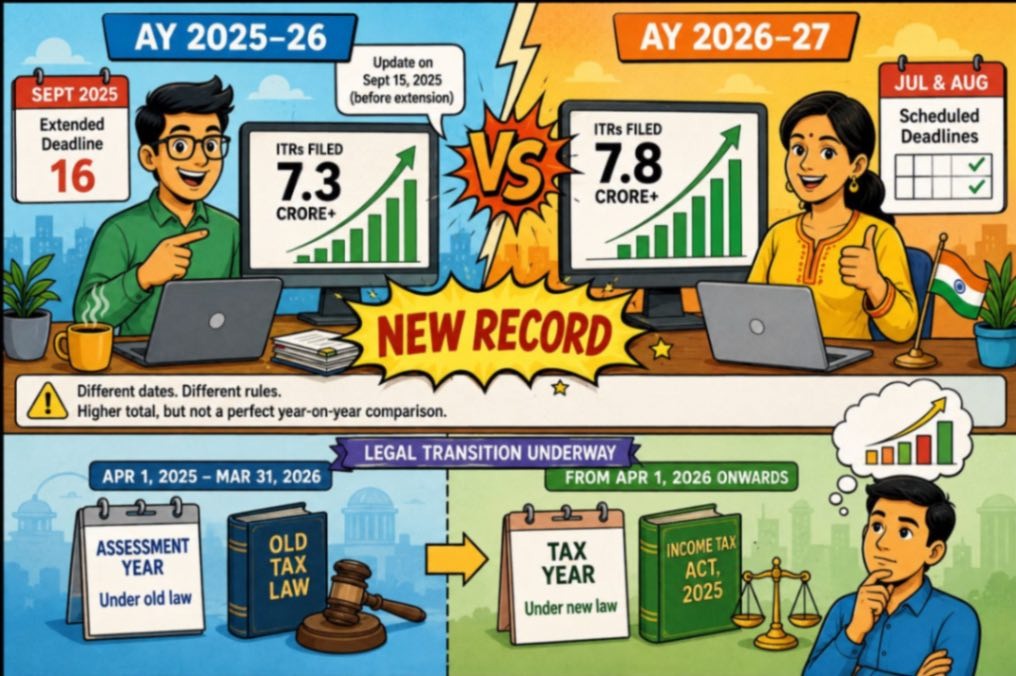
The previous assessment year recorded more than 7.3 crore returns by the extended September 2025 deadline. That update was released by the Income Tax Department on September 15, 2025, before the deadline received a further 1-day extension to September 16.
Comparing 7.8 crore with 7.3 crore shows a higher reported total, but the dates were different. AY 2025–26 had an extended September timetable for non-audit returns. AY 2026–27 used a scheduled July and August split. The latest figure therefore establishes a record, though it should not be treated as a perfect year-on-year comparison.
Another difference lies in the legal transition. AY 2026–27 covers income earned between April 1, 2025, and March 31, 2026. It remains an assessment-year filing under the older law. Income earned from April 1, 2026, moves into the tax-year framework introduced by the Income Tax Act, 2025.
Crossing 7.8 crore ITRs by August 31 gives AY 2026–27 a new filing record and places it above last year’s 7.3 crore-plus count. The staggered calendar helped by separating ordinary individual returns from eligible non-audit business and professional filings.
The headline, however, is only the first layer. Verification, accurate reporting and timely correction will decide whether those returns move through processing without avoidable delays. Late filers still have a route available, but waiting until December can increase the financial cost.
Taxpayers submitted over 7.8 crore returns by 31 August 2026. Tax officials shared the final count the following day.
The date mainly covered eligible taxpayers with business or professional income whose accounts did not require an audit. It also applied to certain firms, partners and trusts.
Yes. A belated AY 2026–27 return can generally be filed by December 31, 2026, subject to fees, interest and other legal conditions.
No. Filing and paying tax are different. A return may show nil tax or a refund after eligible relief, TDS and advance-tax credits are included.
No. Income should never be invented to change the return form or filing date. A false entry can produce incorrect reporting and expose the taxpayer to further checks.









.png&w=3840&q=75)


