
By continuing, you agree to LoansJagat's Credit Report Terms of Use, Terms and Conditions, Privacy Policy, and authorize contact via Call, SMS, Email, or WhatsApp
Disclaimer: The information published on LoansJagat is intended for general informational and educational purposes only and should not be considered financial, legal, or investment advice. Interest rates, loan terms, statistics, and other data may change over time and may vary by lender or source. Please verify the latest information and consult a qualified financial advisor or the respective Bank/NBFC before making any financial decisions.
Subscribe Now
About the author

Arshathul Afia is a journalism graduate and fintech content writer with 4+ years of experience in digital publishing and research-led writing. She has written 200+ articles covering personal finance, lending, banking, digital payments, credit, insurance, and major financial developments in India. At LoansJagat, she focuses on simplifying complex fintech news, RBI updates, loan-related changes, policy developments, and industry trends for everyday readers. Her journalism background helps her approach stories with research, context, and clarity, while her SEO experience ensures content remains discoverable and relevant. She aims to make financial news easier to understand, practical, and useful for readers across India.
Related News
Simplify All Your Loans Into One Affordable EMI

Customers Served

Debt Consolidated

1200+ Reviews

Locations in India
Club all Loans & Credit Card Bills into Single EMI

Quick Apply Loan
Consolidate your debts into one easy EMI.

Takes less than 2 minutes. No paperwork.

10 Lakhs+
Trusted Customers

2000 Cr+
Loans Disbursed

4.7/5
Google Reviews

50+
Banks & NBFCs Offers
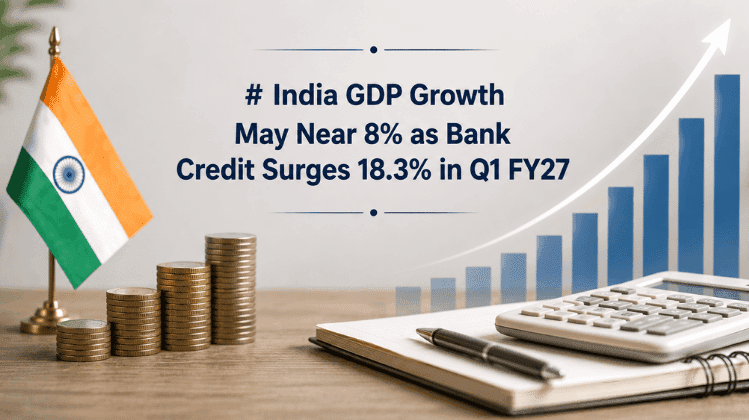
India’s economy may post a Q1 growth surprise after business loans, public spending and household demand stayed firm through an expensive, unsettled quarter across India.
India may report GDP growth close to 8% for Q1 FY27, the 3 months from April to June 2026. SBI Research has estimated growth at around 8%, while economists at Union Bank of India have placed it at 7.9%. The Ministry of Statistics and Programme Implementation scheduled the official release for August 31, 2026. That number will show how India performed while the West Asia conflict pushed up oil and shipping costs.
For workers and small firms, the 1st effect may come through factory orders, construction contracts and local hiring. If the pace holds for several quarters, companies could bring back projects they had kept waiting. There is a rougher side too. India buys more than 85% of its crude oil from abroad. Costlier fuel can quickly reach bus fares, delivery bills, food prices and factory expenses. A weak monsoon would add pressure in rural districts.
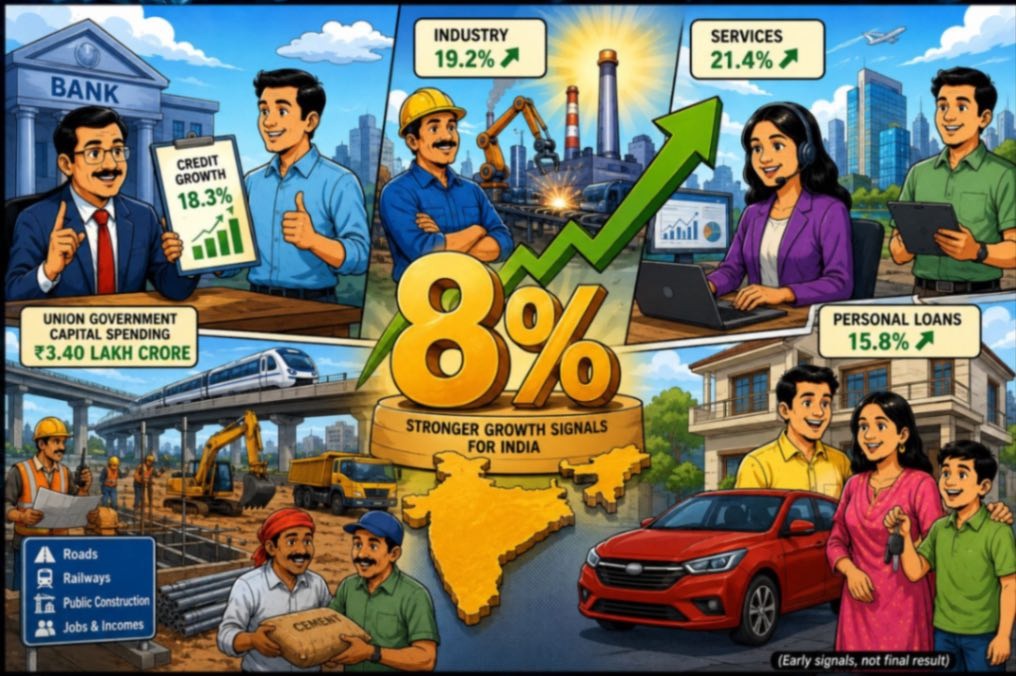
The June loan book looked very different from the previous summer. Outstanding non-food credit had risen 18.3% from June 2025. At that point last year, the increase was only 9.3%. Banks had not recorded a stronger June-end figure since 2012, when growth reached 18.7%.
Businesses drove much of the change. Loans to industry rose 19.2% after growing only 6.3% a year earlier. Services followed with a 21.4% increase, well above the previous 8.8%. Personal loans grew 15.8%. Homebuyers and vehicle owners continued to borrow, though factories, traders and other service businesses now accounted for a larger part of the credit increase.
The table shows the limited group of indicators behind the stronger GDP estimates. These remain early signals, not the final growth result.
Credit growth compares the loan book at the end of June with the figure from 1 year earlier. It does not show that banks sanctioned 18.3% more loans during Q1. Some firms may also have borrowed extra money simply because oil, metals and imported parts became dearer. Even so, stronger industry and services lending points to wider business demand.
Public spending helped. The Press Information Bureau said in its August 5, 2026 account review that Union government capital expenditure reached ₹3.40 lakh crore during April to June. Road work, rail contracts and public construction send money beyond large contractors. Cement dealers, truck operators, equipment renters and workers in nearby towns receive orders as well.
A factory loan can travel through the economy in ordinary ways. A textile unit in Surat may purchase yarn, book trucks and add a shift. An engineering company in Pune might release a supplier payment that had been pending for weeks. Each decision creates paid work elsewhere, though the benefit is rarely immediate or evenly spread.
Vehicle demand offered another sign. The Society of Indian Automobile Manufacturers said on July 15, 2026, that passenger vehicles posted their highest Q1 sales, reaching 1.27 million units. Two-wheeler sales touched 5.63 million. Those purchases support showrooms, mechanics, insurers and registration agents. Lower GST rates and softer financing costs helped. Commodity prices and rainfall could hurt the next quarter.
Borrowers should not read the growth forecast as a promise of cheaper loans. Banks need deposits before they can keep lending at this speed. When deposits lag, lenders may offer higher returns to savers and protect their loan pricing. Home, vehicle and business borrowers could therefore see stronger economic news without an immediate reduction in monthly instalments.
A LoansJagat published on August 1, 2026, compared the 19.2% rise in industry credit with 15.8% growth in personal loans. For borrowers, the useful detail lies in that gap. Business lending can support jobs and supplier income. Yet rapid credit becomes uncomfortable when repayments grow faster than wages or company cash flow.
SBI Research reached its near-8% estimate through a nowcasting model using 54 high-frequency indicators from agriculture, industry and services. It's August 11, 2026 assessment found acceleration in 86% of those indicators, against 69% in Q1 FY26. Vehicle sales, goods movement, public spending and credit fed into the estimate.
Union Bank economists led by Kanika Pasricha expected 7.9%. Their call drew attention because average oil prices were close to $97 a barrel during a quarter affected by the West Asia conflict. Kotak Mahindra Bank economists Upasna Bhardwaj and Harsh Doshi focused on the destination of credit. In their reading, faster loans to industry and services showed that borrowing had moved towards sectors producing goods, trade and commercial services.
Others remained cautious. A Reuters poll conducted from August 17 to 24, 2026, placed median growth at 7.1% among 58 economists. Forecasts ranged from 6.2% to 8%. HDFC Bank economist Sakshi Gupta said the recovery in private investment was still new and had not spread widely enough. Companies facing uncertain oil, freight and raw-material costs may borrow for daily operations without committing to a new plant.
The next step is practical. Banks need a stronger deposit base. Government departments need to pay contractors on time and keep projects moving. Fuel and food supplies require close attention because a sudden price jump can eat into household spending before higher business activity produces better wages.
India entered the quarter after GDP growth readings of 8.3%, 8% and 7.8% across the previous 3 quarters. Domestic activity was already moving faster. Q1 then brought a fresh test through higher oil prices, shipping delays and a late monsoon.
June 2025 had shown a different credit pattern. Non-food loans grew 9.3%, industry credit 6.3% and services credit 8.8%. Personal loans, at 11.7%, were growing faster than lending to many businesses. By June 2026, industry and services were ahead. That reversal is the strongest part of the current story.
Exports also gave the quarter some support. Goods and services exports rose by more than 11% during April to June, according to trade figures reported in August 2026. Overseas demand cannot remove the oil risk, but it gives Indian producers another source of revenue when local costs rise.
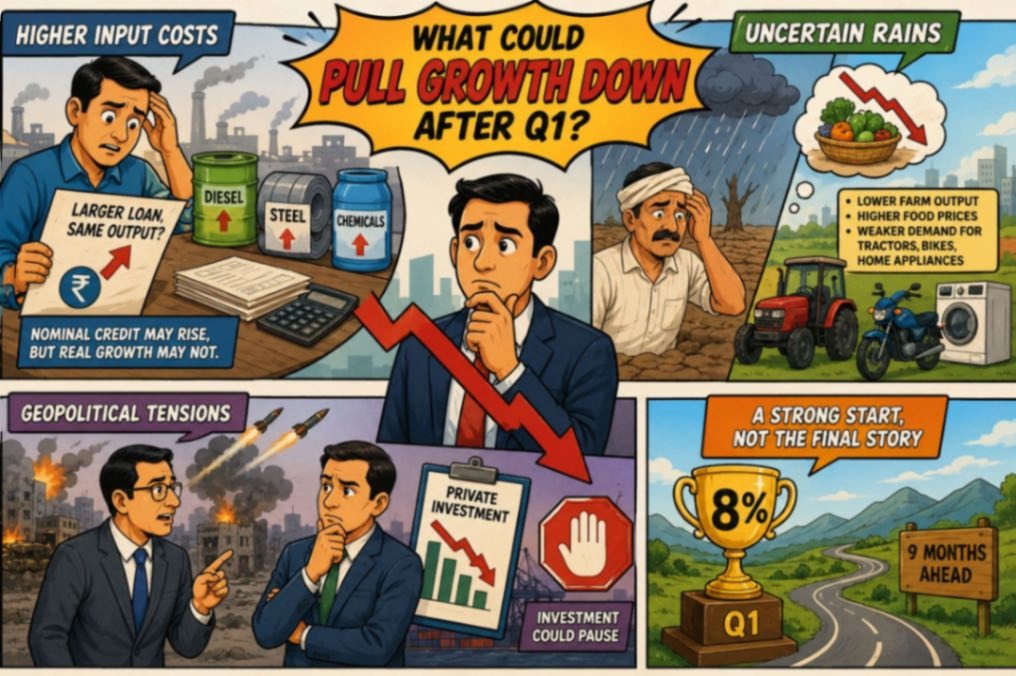
The bank-credit number is nominal, while the GDP figure discussed here is real growth after price changes. A company paying more for diesel, steel or chemicals may need a larger loan without producing more goods. The official GDP estimate could therefore come below the strongest forecasts.
Rainfall remains another weak spot. Poor rains can cut farm output, push up food prices and reduce purchases of tractors, two-wheelers and household goods. Private investment could also pause if the West Asia conflict worsens. An 8% Q1 result would be strong. It would not settle the outlook for the remaining 9 months.
India’s possible GDP surprise has support from business credit, public investment, vehicle demand and exports. The shift towards industry and services loans makes the 18.3% headline more useful than an increase driven mainly by personal borrowing.
The official result will show how much of that financial activity became actual output. If growth lands near 8%, India will have crossed a difficult quarter better than expected. Keeping that pace will depend on oil, rain, deposits and fresh private projects.
No. The 18.3% is the increase in non-food credits that the banks provided during the last fiscal quarter as compared to the end of the last fiscal year. This percentage does not reflect the number of newly provided loans during this reporting quarter.
Yes. However, there would be a lag between the time of the increased growth of the economy and the time of increased employment. Food processors, builders, manufacturers, logistics and services providers etc., would begin to hire more personnel once they receive more business. Employment increases would happen after a long period for bigger projects.
It can, especially when lending reaches manufacturing, construction, trade and transport. The timing varies. A factory order may create work quickly, while a large infrastructure project can take months before hiring reaches the site and its suppliers.
Not by itself. Banks also look at deposit costs, available funds, inflation and borrower risk. If lenders must pay more to attract deposits, home loan rates may stay firm even after a strong GDP result.
The answer depends on where the loans go and whether borrowers can repay them. Credit used for productive business activity can support income and jobs. Risk builds when debt rises faster than company earnings, household wages or bank deposits for several quarters.









.png&w=3840&q=75)


