

By continuing, you agree to LoansJagat's Credit Report Terms of Use, Terms and Conditions, Privacy Policy, and authorize contact via Call, SMS, Email, or WhatsApp
Disclaimer: The information published on LoansJagat is intended for general informational and educational purposes only and should not be considered financial, legal, or investment advice. Interest rates, loan terms, statistics, and other data may change over time and may vary by lender or source. Please verify the latest information and consult a qualified financial advisor or the respective Bank/NBFC before making any financial decisions.
Subscribe Now
About the author

Arshathul Afia is a journalism graduate and fintech content writer with 4+ years of experience in digital publishing and research-led writing. She has written 200+ articles covering personal finance, lending, banking, digital payments, credit, insurance, and major financial developments in India. At LoansJagat, she focuses on simplifying complex fintech news, RBI updates, loan-related changes, policy developments, and industry trends for everyday readers. Her journalism background helps her approach stories with research, context, and clarity, while her SEO experience ensures content remains discoverable and relevant. She aims to make financial news easier to understand, practical, and useful for readers across India.
Related News
Simplify All Your Loans Into One Affordable EMI

Customers Served

Debt Consolidated

1200+ Reviews

Locations in India
Club all Loans & Credit Card Bills into Single EMI

Quick Apply Loan
Consolidate your debts into one easy EMI.

Takes less than 2 minutes. No paperwork.

10 Lakhs+
Trusted Customers

2000 Cr+
Loans Disbursed

4.7/5
Google Reviews

50+
Banks & NBFCs Offers
Adding a relative to property papers without explaining the payment may expose families to tax notices, income clubbing, ownership disputes and Benami scrutiny later on.
The immediate effect may be a query about how the non-paying owner acquired the share. Over a longer period, weak paperwork can affect rent, capital gains, inheritance and sale rights. A family arrangement remains lawful when the deed and money trail show a genuine gift, loan or shared purchase. Trouble begins when the second person merely lends a name while the payer keeps the benefit and control.
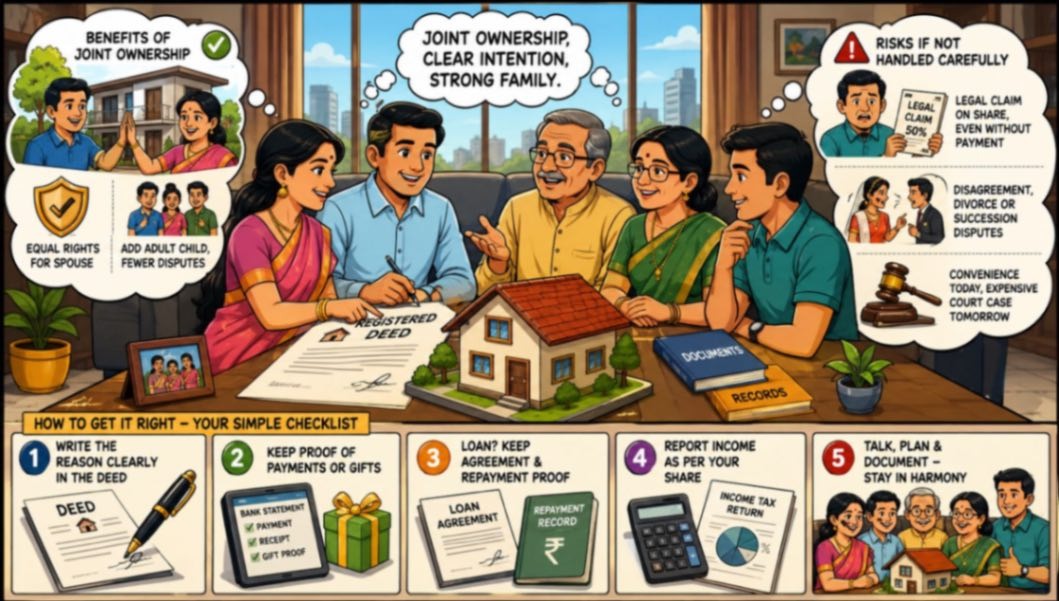
Joint ownership can help spouses build equal rights in a home. Parents may also add an adult child to reduce succession disputes later. If the intention is genuine, the recipient does not need to contribute money merely to become an owner. The registered deed must state what share has been transferred and why the recipient paid nothing.
Problems arise when families treat registration as a casual formality. A person named a 50% owner can gain a legal claim over that portion, even if another family member paid the full price. Any future sale may require that owner’s participation. A disagreement, divorce or succession dispute can turn an old convenience into an expensive court case.
The tax effect depends on the arrangement behind the second name.
The wording in the table cannot replace supporting documents. Bank statements, payment receipts, loan papers and income-tax returns should support the same version. If the deed indicates a gift but later records call the payment a recoverable loan, tax officials may ask for an explanation.
Practising chartered accountant and author Ashish Karundia told Mint in a report published on September 1, 2026 that the tax department receives property details through registrars and tax-deduction filings. When a deed names 2 owners but 1 return shows no capacity to acquire the property, officials may examine the source of that person’s share.
Karundia advised families to decide the arrangement before completing the purchase. A gift should be recorded as a gift from the beginning. A loan should include written terms, repayment obligations and a traceable transfer. His advice points to a simple fix. The deed, bank record and tax return should not tell different versions of the same purchase.
Section 92 of the Income-tax Act, 2025 covers money or property received without adequate payment. If a person receives immovable property without paying for it and the stamp duty value exceeds ₹50,000, the stamp duty value may become taxable as income from other sources. The exemption for gifts from specified relatives can remove that recipient-level tax.
The recognised list includes a spouse, parents, children, grandparents, grandchildren, siblings and certain relatives connected through marriage. It does not include a cousin. A person who transfers a property share to a cousin may therefore create a tax liability for the recipient, even when the transferor describes it as a family gift.
Registration remains necessary when an existing owner gives away a property share. India Code publishes the Transfer of Property Act, 1882, which requires an immovable-property gift to be completed through a registered instrument signed by the donor and attested by witnesses. A municipal mutation, a housing-society entry or a utility bill does not transfer title by itself.
Stamp duty also survives the income-tax exemption. Each state decides the applicable charge, and some states offer lower rates for specified family transfers. Families should check the local registration rate before choosing a gift deed over succession through a will.
A spouse may become a registered owner while the person who transferred the share continues to pay tax on its rental income. Section 25 treats a person as the deemed owner when house property is transferred to a spouse without adequate payment, except under an agreement to live apart. A related provision covers transfers to a minor child, other than a married daughter.
Section 99 contains the income-clubbing rules. Income arising from an asset transferred to a spouse without adequate payment can be added to the transferor’s taxable income. Similar treatment can apply to a son’s wife and a minor child. An adult child who receives a genuine gift generally reports income from that share independently.
The later sale has another consequence. A person receiving gifted property usually carries forward the previous owner’s acquisition cost while calculating capital gains. Writing a higher market value in the gift deed does not automatically create a new purchase cost.
A family loan creates ownership for the borrower when the borrower uses the money to purchase the stated share. The lender’s normal claim is repayment of the amount. Paying for the property does not automatically make the lender the owner of the borrower’s registered portion.
The agreement should record the loan amount, date, interest terms, repayment period and action after default. The payment should move through a bank. Under Section 185, a loan of ₹20,000 or more generally cannot be accepted in cash when the statutory conditions apply. Section 188 places similar restrictions on repayment. A breach can attract a penalty equal to the amount accepted or repaid.
A LoansJagat report published on 17 April 2026 explains that adding a wife as a co-borrower does not automatically qualify her for home-loan tax deductions. She must also hold an ownership share and contribute towards repayment. Families should therefore align the sale deed, loan agreement and EMI trail before adding a relative to the property papers.
Read Also : RBI Re-KYC Deadline September 15: QR Merchants Face Payment Disruption Risk
Benami risk appears when the named owner has not paid, has not received a genuine gift or loan, and does not enjoy the property’s actual benefit. In that situation, the person on paper may be only a name lender for the person who provided the money.
The law excludes some family arrangements from its definition. Property held in the name of a spouse or child may qualify when the individual pays from known sources. Property held jointly with a brother, sister, parent, grandparent, child or grandchild may also qualify when the funds come from the individual’s known sources.
Those exclusions do not protect every family transaction. Cousins, uncles, aunts, nephews and nieces do not appear in that specific family provision. Still, a genuine gift to one of them may avoid Benami treatment if the recipient receives the ownership benefit, although separate gift-tax rules may apply.
Where a Benami transaction is used to defeat a law, avoid statutory dues or avoid creditors, punishment can range from 1 year to 7 years of rigorous imprisonment. The fine can reach 25% of the property’s fair market value. Authorities may also confiscate the property.
India removed the separate Gift Tax Act in 1998, but later taxed certain gifts in the recipient’s hands. Under the Income-tax Act, 1961, Section 56(2)(x) addressed property received without adequate payment. Sections 27 and 64 covered deemed ownership and income clubbing.
The Income-tax Act, 2025 came into force on April 1, 2026. It moved these provisions to Sections 92, 25 and 99 without removing their basic purpose. Rule 237 added structured reporting for property purchases, sales, gifts and joint development agreements at the ₹45 lakh threshold.
Benami enforcement had already changed earlier. The 2016 amendment received presidential assent on August 10, 2016, while its main provisions took effect on November 1, 2016. It introduced attachment, adjudication, confiscation and stronger prosecution provisions.
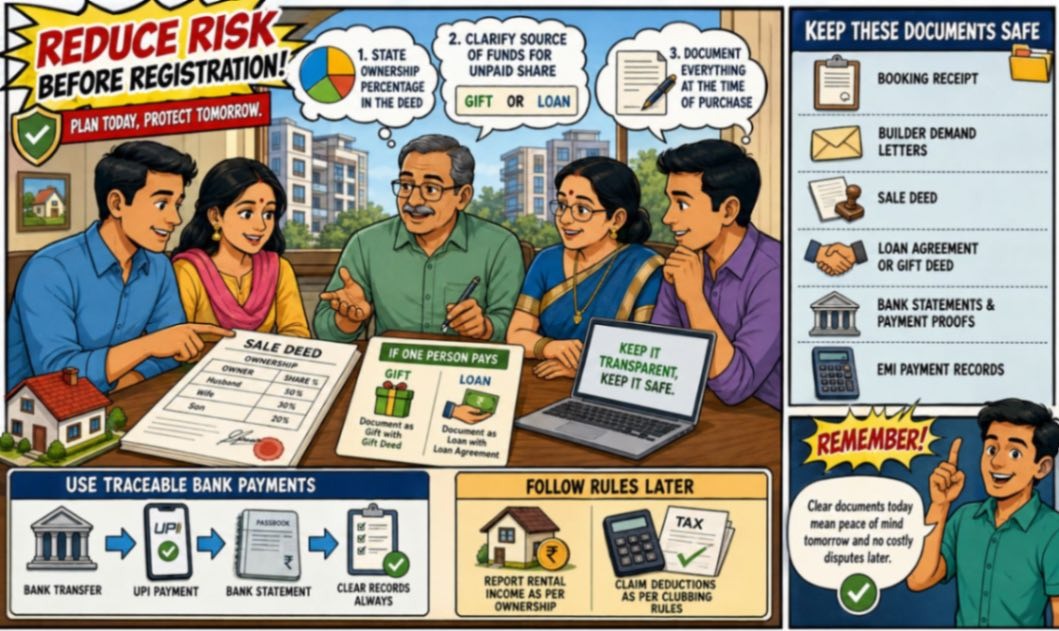
Buyers should state each person’s ownership percentage in the deed. If only 1 person pays, the papers should identify whether the unpaid share is a gift or funded through a loan. Informal explanations given years later carry less weight than documents signed when the property was purchased.
Each payment should pass through a traceable account. Families should retain the booking receipt, builder demand letters, sale deed, loan agreement, gift deed and proof of EMI payments. Rental income and deductions in later returns should follow the recorded ownership and clubbing rules.
Adding a family member to a property title is legal when that name represents genuine ownership. The payment can come through contribution, gift or loan. Each route needs its own paperwork.
The safest time to record the arrangement is before registration. Once the deed, bank trail and tax returns begin showing different accounts, the family may face questions that could have been avoided.
A genuine gift to a spouse is exempt in the recipient’s hands. Stamp duty may apply, while rent from the transferred share can remain taxable to the transferor.
A deed stating a definite 50% share can give that person equal ownership rights. The payment record still needs to explain whether the share came through contribution, gift or loan.
Not automatically. A genuine gift to an adult child can create valid ownership. The deed, source of funds and later control of the property should support that gift.
The husband may remain the deemed owner for tax purposes when he transferred the share without adequate payment. The exact reporting depends on Sections 25 and 99.
Large cash loans can breach the banking-channel rules. A family property loan should move through an account and carry a signed agreement with repayment terms.









.png&w=3840&q=75)


